- Category
- Herbs and spices
- State
- Liquid
- Usual unit
- teaspoon
What it is
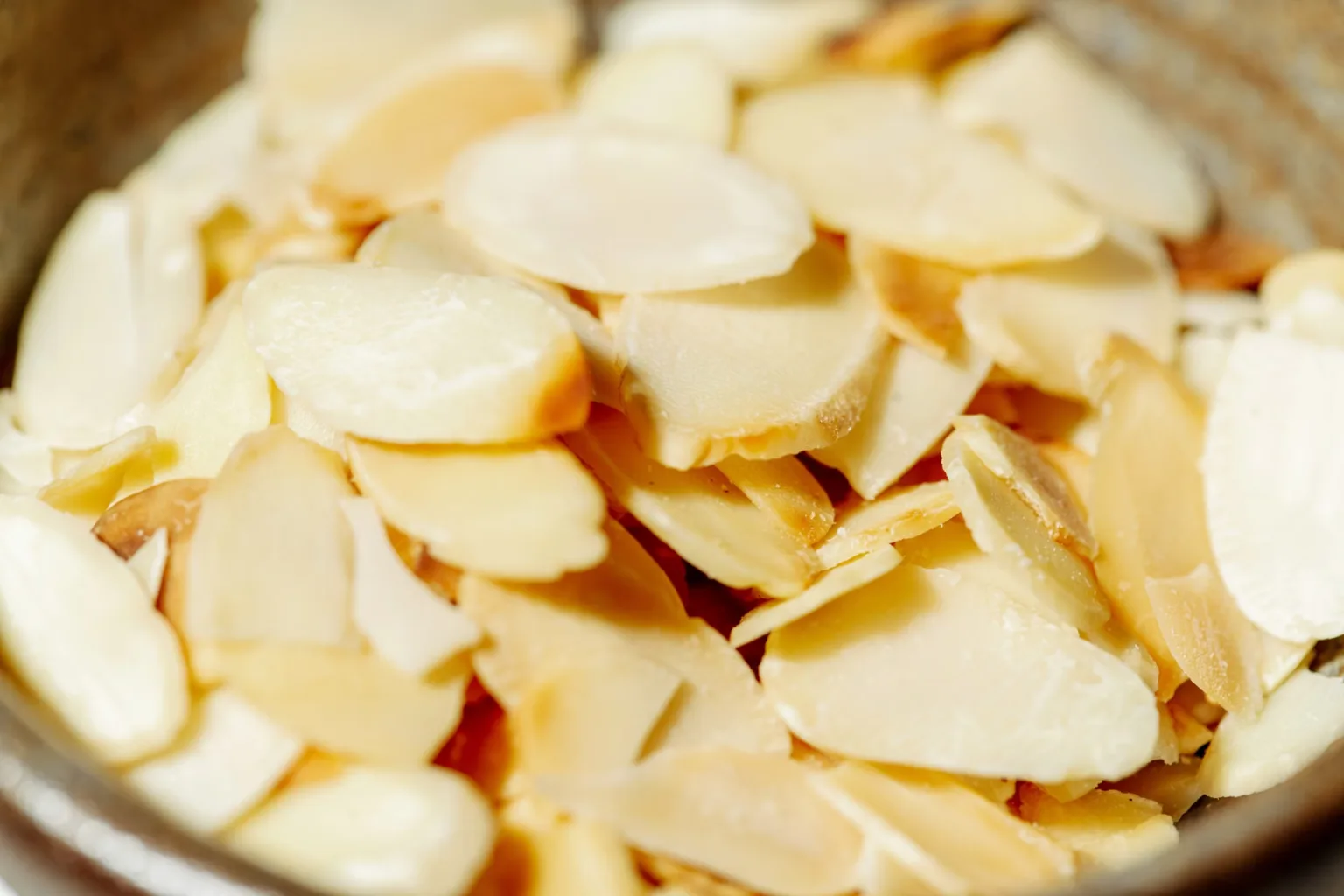
Almond essence is a liquid product used to add an almond-associated aroma to food, especially sweet preparations. Its name indicates the intended aromatic profile, but does not establish the ingredients, production method or concentration of a particular brand. Nor does the name alone prove that it contains almonds as a nut. It is useful to distinguish essence from whole, chopped or ground almonds: these forms provide flavour and, depending on the format, bulk and texture; essence is used as an aromatic accent and does not automatically replace those functions. Almonds are used in pastry and sweets such as biscuits, marzipan and praline, while extracts have been used to add aroma to sweet preparations. To find out the composition and use of a particular essence, check its label.
When to use it
Use it when a sweet preparation calls for an almond aroma and does not rely on almonds for bulk or texture. It may be added to batter, cream or filling if the product is suitable for food use and the recipe allows that kind of flavouring. In pastry, almonds pair with chocolate, citrus and stone fruit; the result from a particular essence will nevertheless depend on its formulation. Do not add it simply because a recipe contains almonds: essence does not replace the bulk, moisture or texture of whole or ground almonds. Follow the amount specified in the recipe and on the package, rather than assuming that every brand has the same strength.
How to use it
Read the label before use to confirm that the product is intended for food use and to check its recommended amount and storage directions. Measure carefully using the unit specified by the recipe or manufacturer; strength can vary between products and cannot be inferred from the name alone. If the recipe allows, mix the essence into the batter, cream or filling so the aroma is distributed evenly. For a new recipe, start with the stated amount and, if appropriate, adjust in a later preparation. Do not taste a product that is not identified as suitable for consumption. Do not directly replace ground almonds with essence: almonds also contribute bulk and texture. Do not substitute one essence for another without checking their labels, since composition and concentration can differ.
Flavour and texture
It is chosen for the almond-associated aroma indicated by its name, but its exact strength and profile depend on the product and cannot be inferred from the name alone. Unlike chopped or ground almonds, essence does not provide pieces, crunch or the bulk of a solid ingredient. Almonds pair in sweets with chocolate, citrus and stone fruit. Use essence as an aromatic accent, not as an equivalent to those forms of almond.
How to choose it
Choose a product whose label clearly identifies it as suitable for food use and provides directions. Check the ingredient list and allergen information: the word “almond” in the name is not enough to establish the composition. Look for the recommended amount, format and any storage instructions. If you have an allergy or need to avoid an ingredient, do not assume an essence is free of it; check the package information and ask the manufacturer if anything is unclear.
Storage
There is not enough information to establish a temperature, shelf life or storage method that applies to every almond essence. Follow the directions printed on the package and close it as instructed by the manufacturer. Check dates and product-specific guidance. Do not apply storage advice for whole or ground almonds to an essence, as these are different products.
Substitutions
A food-grade almond extract or essence might serve a similar aromatic role if the recipe and product labels allow the swap. Do not assume they have the same concentration or can be measured in the same way. Ground almonds add flavour and texture, but are not a drop-for-drop substitute for essence and do not serve the same function. Change a recipe only with information about the specific product.
Common mistakes
Do not assume every essence has the same strength or measure by eye when the recipe or package gives an amount. Do not confuse essence with ground almonds: essence adds an aromatic accent, while ground almonds also change bulk and texture. Do not infer a product’s ingredients or allergens from its name alone.
Safety and allergens
Use only a product identified as suitable for food use and follow its label directions. If you have an allergy or dietary restriction, check the package ingredient list and allergen information; the product name alone does not establish its composition.
Culinary uses
- aromatic flavouring for sweet baking
- aromatic accent for desserts and fillings
Recommended techniques
- measure according to the specific product label and recipe
- mix into batter, cream or filling so the aroma is distributed evenly
Pairs well with
- chocolate and vanilla in sweet preparations
- citrus and stone fruit in pastries
Frequently asked questions
Is almond essence the same as ground almonds?
No. Ground almonds add substance and texture; essence is used as an aromatic accent. They are not direct substitutes.
Can I swap almond essence for almond extract?
Only if the recipe and both product labels allow the swap. Do not assume an equivalent concentration, and follow the directions for the specific product.
Does almond essence necessarily contain almonds?
That cannot be determined from the name alone. Check the ingredient list and allergen information, especially if you need to avoid almonds.
Sources and review
Automatically researched, cross-checked and validated content. Sources consulted:
- Client Challenge doi.org
- Almendra: usos, variedades y combinaciones en pastelería pastrypedia.net
- Almendras: propiedades, beneficios y cómo usarlas en la cocina abc.es
- Almendra procesada, lo que debes saber para conocer este fantástico producto | Almendras de la mancha almendrasdelamancha.com
- Almendras: qué son, propiedades y usos en cocina bonviveur.com
- Ensalada de Remolacha con Almendra 1960 (Beet and Almond Salad) - lacocina.utsa.edu
- Nutrition After Your Transplant - Health Online healthonline.washington.edu
- Glimpses of an 18th century Colonial Kitchen in Manila archium.ateneo.edu
- EL AMOR A TRAVÉS DE LA COCINA: EXPLORING THE scholarsbank.uoregon.edu
- Family Food Cent$ newsletter - febrero 2022 - SDSU Extension extension.sdstate.edu
- La cocinera de todo el mundo, o la cocina sin cocinera : coleccion de las mejores y mas escelentes recetas | Library Digital Collections | UC San Diego Library library.ucsd.edu
- Ingredientes dornsife.usc.edu
- ¿Las almendras son dulces? Análisis de su sabor, variedades y mejores usos en repostería aliciascake.es
- Explorando la Esencia de Jaén a Través de su Gastronomía: El Papel del Cereal y la Almendra oleomontes.com