- Category
- Herbs and spices
- State
- Fresh
- Usual unit
- tablespoon
What it is
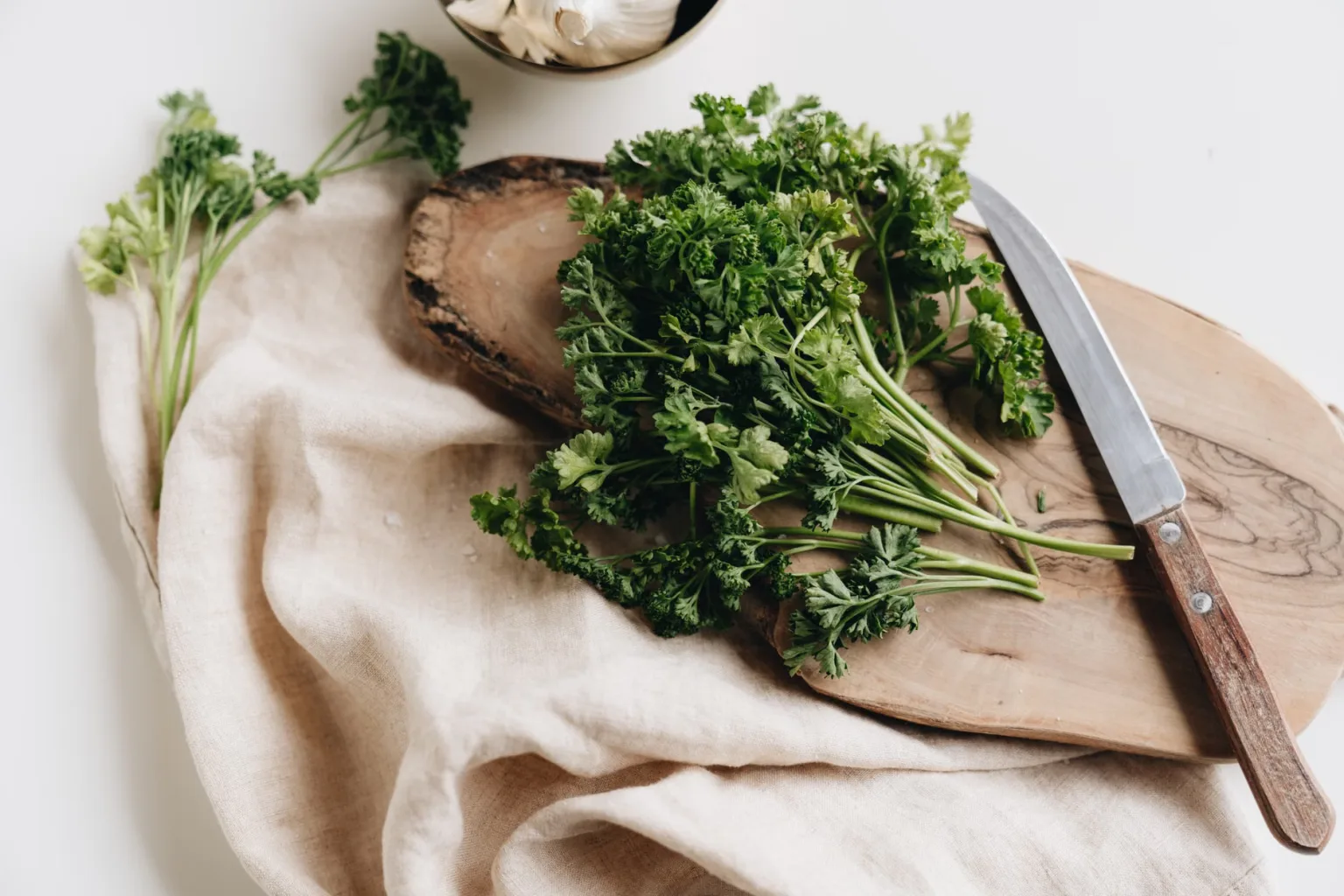
Chopped parsley is fresh parsley whose leaves have been cut into small pieces so they can be mixed into food easily. It belongs to the Apiaceae family and is used as an aromatic herb and seasoning. Flat-leaf and curly parsley have different appearances and culinary characteristics, so the result can vary depending on which type you use. Parsley is available fresh, dried, and frozen, but this profile covers the fresh, chopped form. It can season food, contribute aroma, and add a green finish to many preparations.
When to use it
Use it when you want a fresh herbal note or a green finish just before serving. It works in sauces, vinaigrettes, marinades, soups, stews, omelets, salads, and dishes with fish, meat, or vegetables. Because intense heat and prolonged cooking can reduce its presence, it is especially useful near the end of preparation. You can also mix it raw with garlic and oil or scatter it over the finished dish.
How to use it
Check that the parsley is clean, then chop it with a knife if the leaves are still large. Mix it raw into sauces, vinaigrettes, dressings, or herb mixtures, or scatter it over salads, omelets, vegetables, fish, and meat. For hot dishes, add it near the end of cooking or just before serving rather than exposing it to intense heat for a long time. This lets it contribute aroma and color without overwhelming the other ingredients. Start with a modest amount and adjust to taste; flat-leaf and curly parsley may behave somewhat differently.
Flavour and texture
Parsley leaf tastes fresh, slightly sharp, and peppery. Its aroma and intensity can vary between flat-leaf and curly types. Finely chopped, it mixes easily into sauces and dressings and adds small green flecks to a dish.
How to choose it
Choose fresh parsley with a bright, vivid green color. Avoid bunches with yellowing or wilted leaves, which can indicate that they were harvested some time ago. Flat-leaf and curly parsley differ in appearance and culinary characteristics, so choose the type that suits your intended use.
Storage
To keep parsley fresh, place the stems in a container of water, cover them with a bag, and store them in a cool place or in the refrigerator. Change the water frequently. You can also freeze it chopped in a bag, a useful option for keeping it ready to cook with. The cited source says frozen parsley remains usable for several months.
Substitutions
Fresh parsley can be replaced with dried or frozen parsley, both available forms of the herb. No fixed conversion is provided here, so add the alternative gradually and adjust to taste. Flat-leaf parsley can also stand in for curly parsley, or vice versa, though their culinary characteristics are not identical.
Common mistakes
Avoid intense heat and long cooking if you want parsley's aromatic character to remain noticeable. Adding it too early to a stew can make it less prominent at serving time. Do not choose yellowing or wilted leaves, and do not assume flat-leaf and curly parsley will give exactly the same result.
Safety and allergens
Wash fresh parsley thoroughly under cold running water before eating or preparing it. Use clean hands, surfaces, and utensils when handling it.
Culinary uses
- Fresh herb seasoning
- Finishing garnish
- Aromatic component in sauces and dressings
Recommended techniques
- Chop finely and add near the end of cooking
- Mix raw into sauces, dressings, or herb mixtures
- Stir into soups and stews shortly before serving
Pairs well with
- Garlic and onion
- Fish and seafood
- Meat and poultry
- Vegetables, soups, and sauces
Frequently asked questions
When should chopped parsley go into a hot dish?
Add it near the end of cooking or just before serving. Parsley does not withstand intense heat or long cooking well.
Can chopped parsley be frozen?
Yes. One described storage option is to chop it and keep it in a bag in the freezer.
What is the difference between flat-leaf and curly parsley?
They differ in appearance and culinary characteristics. Flat-leaf parsley is commonly used for seasoning, while curly parsley is often used as a garnish; their flavors can also differ.
Estimated nutrition
- Fat
- 0 g
- Saturates
- 0 g
- Carbohydrate
- 0 g
- Sugars
- 0 g
- Protein
- 0 g
- Salt
- 0 g
Sources and review
Automatically researched, cross-checked and validated content. Sources consulted:
- Client Challenge doi.org
- The Essential Glossary of Cooking Terms for the Culinary Arts - Escoffier escoffier.edu
- Todo sobre el perejil: beneficios, recetas y usos en la cocina hola.com
- Perejil- Gastronomía - Región de Murcia Digital regmurcia.com
- Sabores de nuestras tierras/recetas - 2024 | Agricultura y Recursos Naturales ucanr.edu
- educational content to support healthful lifestyle practices sjsu.edu
- Dictionary of Health Related Terms: English – Spanish hia.berkeley.edu
- Perejil: propiedades, beneficios y usos en la cocina bonviveur.com
- - YouTube youtube.com
- Vamos a Conservar Alimentos: Sopas extension.psu.edu
- Fresh Produce Recipe Book | Wsu s3.wp.wsu.edu
- Tortilla con Hongos 1952 (Mushroom Omelet) - lacocina.utsa.edu
- Nutrition Education Materials for Food Pantries | UNL Food | Nebraska food.unl.edu
- EL USO DEL PEREJIL EN LA COCINA MEDITERRÁNEA | Mi Europa SABE a Mediterráneo mieuropasabeamediterraneo.com
- El perejil joseanalija.com