- Category
- Grains, flour and pasta
- State
- Dry
- Usual unit
- cup
What it is
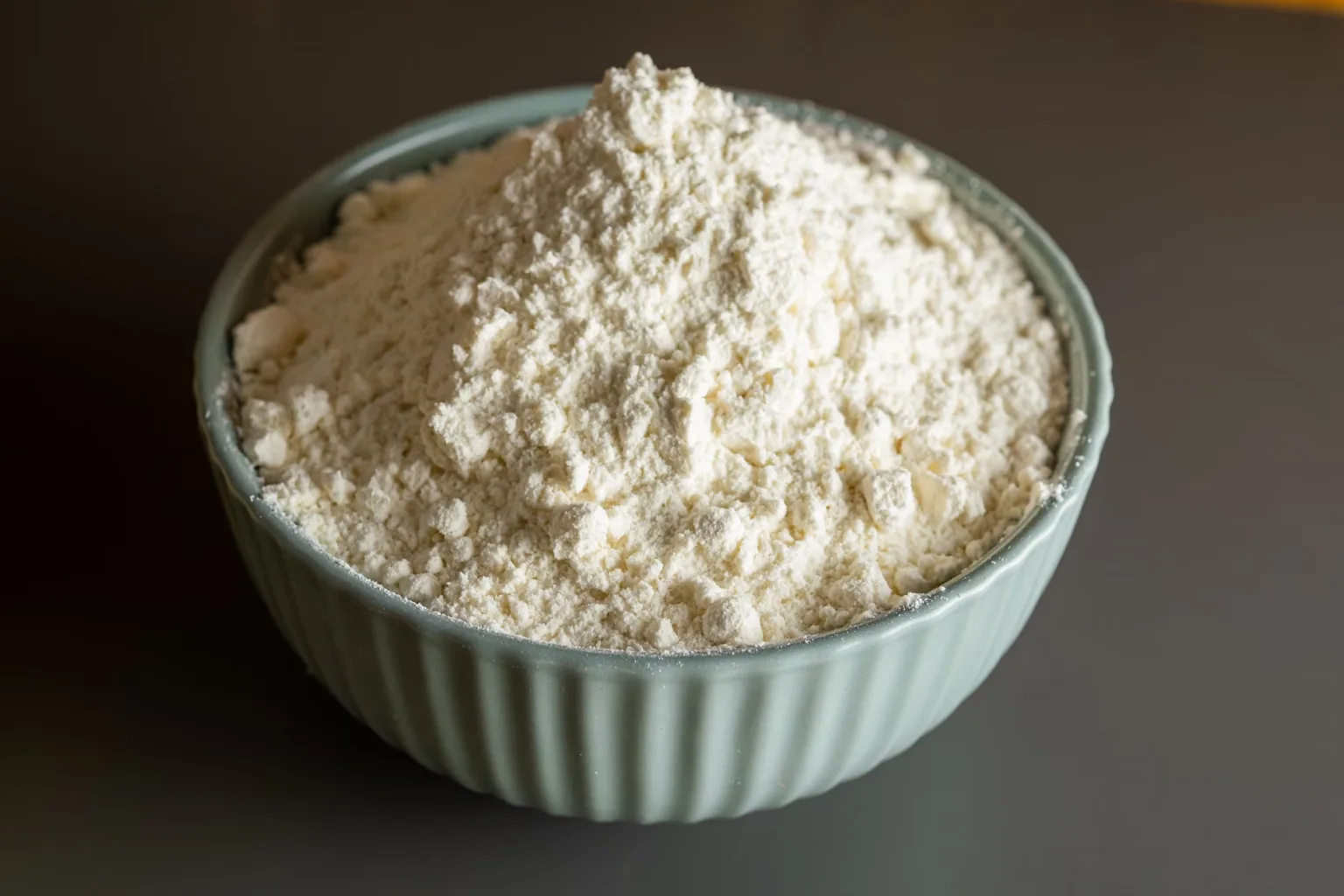
Plain white wheat flour is made by milling and selecting the inner part of the wheat grain rather than using the whole grain with its bran. It is a fine, dry ingredient used in many preparations. When hydrated and worked, wheat proteins can form a network that helps provide structure and elasticity to dough. Not all white flours behave alike: strength, protein, milling and refinement affect liquid absorption and the finished result. White flour therefore does not necessarily mean a flour suited to every recipe. Check the flour type or strength shown on the package, especially for bread and fermented doughs.
When to use it
Choose white wheat flour when a recipe needs a dough with structure, elasticity or the ability to retain fermentation gases. It can be used for bread, enriched baked goods, pizza dough and other kneaded preparations; weaker varieties are generally more suitable for cookies, cakes and some sauces. It is also useful for thickening preparations or coating food. If the package identifies a strength or recommended use, compare it with the recipe: flour suitable for bread is not always the best choice for a delicate cake, and vice versa.
How to use it
Measure the amount specified in the recipe and check whether it calls for plain, pastry, bread or strong flour. To make dough, add the liquid gradually and mix or knead as directed: hydration and working the dough contribute to its structure, but the result also depends on the particular flour. For fermented doughs, choose flour suited to the bread or pizza you are making. For thickening, add it as the recipe directs and mix thoroughly with the liquid to help avoid lumps. It can also be used in coatings and baked preparations. Do not automatically replace it with whole-wheat, rye or gluten-free flour: these may change absorption, elasticity, flavor and texture, and gluten-free blends may need adjustments to liquid, binders or technique.
Flavour and texture
Its flavor is generally mild, so it can be used in sweet and savory preparations without dominating them. The powder is fine, and its behavior changes when mixed with liquid depending on the particular flour: some doughs become more elastic, while others are more tender or less strong. Kneading and liquid absorption also influence the final texture. White flour is not the same as whole-wheat flour, which includes the whole grain and gives a denser texture and more pronounced flavor.
How to choose it
Read the label rather than relying only on the color or the word “white.” Check whether the package identifies plain, low-strength, bread or strong flour, and choose according to the preparation: fermented bread dough and cake may need different flours. Make sure the package is intact, dry and properly closed. If a recipe specifies a particular strength or type, do not assume that every white flour will give the same result.
Storage
Keep the flour in a tightly closed container in a cool, dry place, away from strong odors. Protect the package from moisture and close it again after each use. Avoid using product that has become damp, smells unusual or shows visible signs of deterioration; also follow the package directions. These are general practical measures for preserving its qualities, not a shelf-life guarantee: check the label for product-specific information.
Substitutions
Whole-wheat and rye flour may work in some recipes, but they are not identical swaps: they can change texture, flavor and dough behavior. Gluten-free flours are not automatic replacements for wheat flour either; they may require adjustments to liquid, binders or technique. If a recipe relies on elasticity or fermentation, changing flour may alter its structure. For a predictable result, use the flour specified or choose a recipe designed for the alternative.
Common mistakes
Treating every white flour as if it had the same strength can affect elasticity and texture. Another mistake is replacing it with whole-wheat, rye or gluten-free flour without adapting the recipe: absorption, flavor and structure may change. Do not add all the liquid at once if the recipe says to add it gradually, and do not ignore the flour type specified on the package or in the recipe.
Safety and allergens
Follow the package and recipe instructions, and consult official food-safety recommendations if you are unsure. Keep the flour dry and protected, and do not use it if the package is damaged or the product shows signs of deterioration. The available information does not provide a specific safety warning for this flour.
Culinary uses
- Aporta estructura y elasticidad a panes y masas fermentadas
- Espesa salsas y guisos; también sirve para rebozar
Recommended techniques
- Amasar e hidratar para desarrollar la estructura de la masa
- Mezclar con líquidos para espesar preparaciones
- Usar en rebozados y masas horneadas
Pairs well with
- Agua, para hidratar y formar masa
- Levadura, en masas fermentadas
- Azúcar, mantequilla y huevos, en algunas masas enriquecidas
Frequently asked questions
Does plain white wheat flour contain gluten?
Yes. Wheat flour contains proteins related to gluten and is not suitable for people who need to avoid gluten because of coeliac disease.
Can I use the same flour for bread and cake?
Not always. Strength and other characteristics vary; a flour suited to fermented dough may not give the texture wanted in a cake. Follow the recipe and package guidance.
How should I store white flour?
Keep it tightly closed in a cool, dry place away from strong odors. Follow the label for product-specific details.
Estimated nutrition
- Fat
- 0.98 g
- Saturates
- 0.16 g
- Carbohydrate
- 76.3 g
- Sugars
- 0.27 g
- Fibre
- 2.7 g
- Protein
- 10.3 g
- Salt
- 0 g
Sources and review
Automatically researched, cross-checked and validated content. Sources consulted:
- Tipos de harina y su uso en la cocina profesional - EN LA COCINA Magazine enlacocina.telemesa.es
- Harina: tipos, usos en cocina y elegir - CocinoPedia.com cocinopedia.com
- A PROGRAM FOR extension.usu.edu
- Dictionary of Health Related Terms: English – Spanish hia.berkeley.edu
- Food & Fun Afterschool hsph.harvard.edu
- Healthy Eating Plan for Weight Management med.uc.edu
- Harina: tipos y clases de harina para usar en la cocina bonviveur.com
- Development of the Spanish Healthy Food Reference Budget for ... dau.url.edu
- informe anual de indicadores - agricultura, pesca y alimentación servicio.mapa.gob.es
- Determinación proximal de los principales componentes nutricionales de harina de maíz, harina de trigo integral, avena, yuca, zanahoria amarilla, zanahoria blanca y chocho | infoANALÍTICA doi.org
- Para la ciudadanía aesan.gob.es
- ¡Asegurándonos de que no eres un robot! journals.library.columbia.edu
- Directory of the 200 largest US food and tobacco processing ... ageconsearch.umn.edu