- Category
- Vegetables
- State
- Fresh
- Usual unit
- unit
What it is
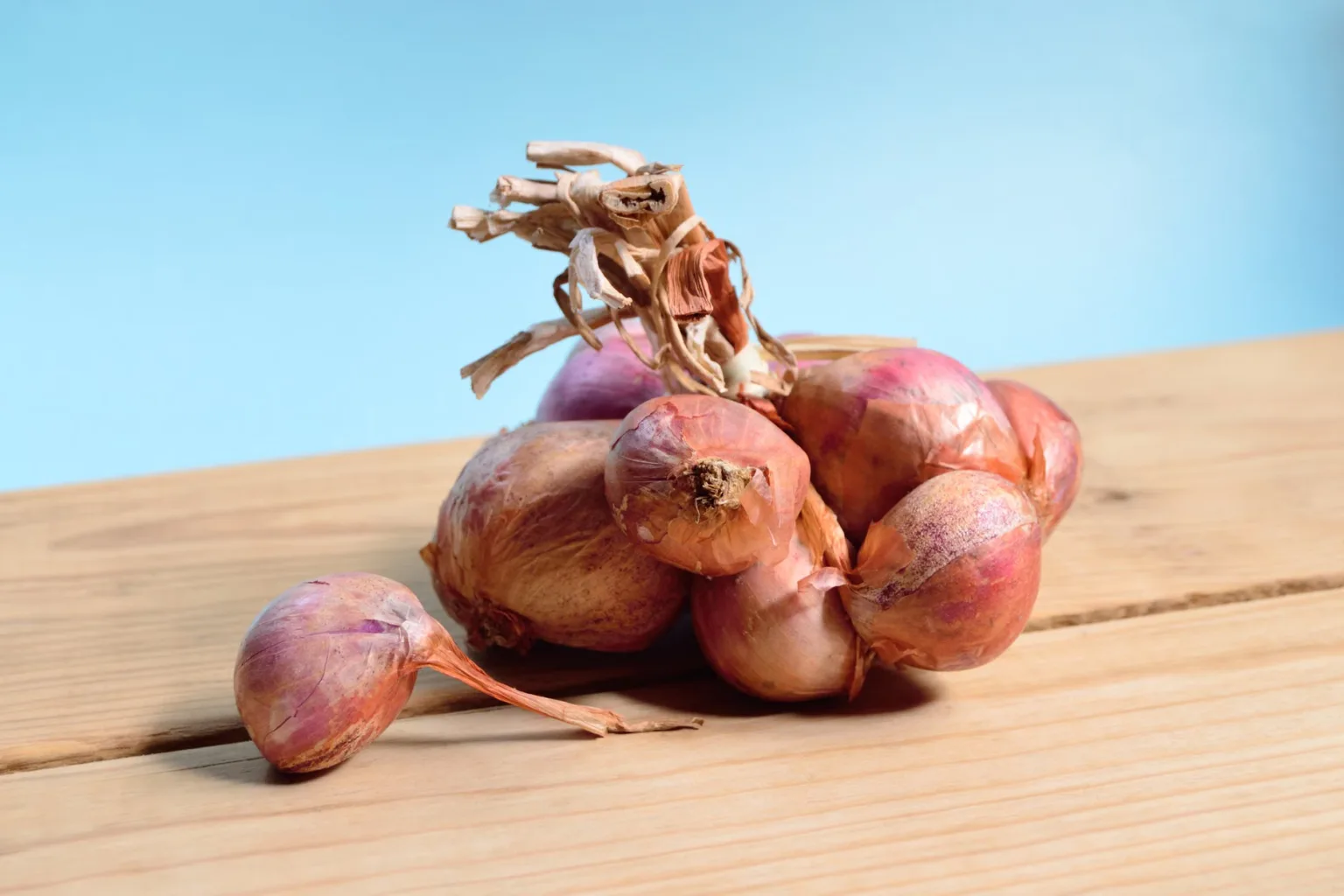
A shallot is an edible bulb in the Alliaceae family, related to onions, garlic, spring onions and leeks. Small shallots are often elongated, though varieties can differ in shape and color; their skins may range from coppery or pink to violet, gray or white. Inside, the layers are fine and the texture is tender. Their flavor is generally sweet and delicate, with a slight bite when raw and aromatic notes that can recall garlic. A shallot is not simply a miniature onion: it has its own aroma and is usually less forceful than a common onion. Size and color vary by variety, so they are not, by themselves, reliable signs of quality.
When to use it
Choose shallots when you want a gentle, aromatic onion flavor that does not overpower the rest of a dish. Raw, they work in salads, dressings and vinaigrettes; cooked, they can form a base for sauces, stews, braises and soups. They can also be roasted, caramelized or confited as an accompaniment to meat, fish and cheese appetizers. Their flavor changes with preparation: raw shallot is livelier and may be slightly sharp, while cooking softens it and can bring out its sweetness. If a recipe relies on a strong onion flavor, a shallot will give a more delicate, different result.
How to use it
Remove the dry skin and trim the ends. To mince a shallot, halve it lengthwise and cut the halves into small pieces; for a vinaigrette or salad, slice it thinly so its aroma is distributed evenly. Add it raw for a brighter, sharper note, or cook it gently in a pan as a starting point for sauces and stews. You can also add shallots whole or halved to a roast, or cook them until tender and sweet to serve as a side. Other suitable preparations include stewing, sautéing, caramelizing, braising and confiting. Match the cut and amount to the dish: small pieces spread their aroma more evenly, while halves retain more presence. The available evidence does not establish a universal cooking time, so follow the texture required by your recipe.
Flavour and texture
Shallots combine gentle sweetness with an onion-like aroma and notes reminiscent of garlic. Raw, they can have a slight bite; cooked, their flavor generally becomes rounder and more delicate. Their interior is fine and tender, and the texture can range from crisp slices in salads to soft pieces in stews or roasts. Intensity varies with variety and preparation.
How to choose it
Choose firm bulbs that feel heavy for their size, with dry, clean, intact skins. Avoid bulbs with soft spots, damp areas, bruises or mold. Shallots vary in shape and color by variety, so they do not all need to look alike. For easier preparation, choose bulbs of similar size; the available evidence does not support the claim that smaller shallots always taste better.
Storage
Keep whole shallots in a cool, dark, dry place with good air circulation. Avoid leaving them crowded in a damp space. Once peeled or cut, refrigerate them in a closed container. The precise storage life depends on conditions and cannot be established from the available evidence. Check the bulbs and discard any with visible mold or deterioration.
Substitutions
White onion can replace shallot, but its flavor is usually stronger; start with less and adjust to the dish. Spring onion or the white part of a leek can also work when you want a mild profile. For a more aromatic result, combine white onion with a little garlic. No substitute reproduces shallot's delicate flavor exactly, so expect the finished dish to taste different.
Common mistakes
Do not treat shallots as identical to onions: their flavor is generally more delicate and can change a dish's balance. Avoid using the same amount of onion without tasting, since it may dominate. Do not assume every shallot has the same color, shape or intensity; variety and preparation matter.
Safety and allergens
Wash and handle shallots with clean utensils. Check their condition before use and discard any with visible mold or deterioration.
Culinary uses
- Aromatic base for sauces, stews and braises
- Fresh or cooked seasoning for salads, dressings and vinaigrettes
- Side dish or garnish when roasted, caramelized or confited
Recommended techniques
- Peel and finely chop or slice
- Serve raw in salads or vinaigrettes
- Sauté gently or soften in a pan
- Roast, braise, caramelize or confit
Pairs well with
- Meat, poultry and fish
- Vegetables and mushrooms
- Cheese-based appetizers and sauces
Frequently asked questions
Is a shallot just a small onion?
Not exactly. Shallots are related to onions, but are generally more delicate and sweet, with their own aromatic notes.
Can shallots be eaten raw?
Yes. Mince or thinly slice them for salads, dressings and vinaigrettes; raw shallots can have a slight bite.
What can I use instead of a shallot?
Try a smaller amount of white onion, spring onion or the white part of a leek. The flavor will not be exactly the same.
Sources and review
Automatically researched, cross-checked and validated content. Sources consulted:
- Client Challenge doi.org
- The Essential Glossary of Cooking Terms for the Culinary Arts - Escoffier escoffier.edu
- Chalota: qué es y en qué recetas utilizarla hola.com
- ¿Qué es la chalota? | Quirónsalud quironsalud.com
- Chalotas | www.cocinista.es cocinista.es
- Chalota, la hermana más dulce y suave de la familia de las cebollas: propiedades, beneficios y recetas directoalpaladar.com
- Chalota: qué es, propiedades y usos en la cocina del sustituto de la cebolla bonviveur.com
- Gastronomy Blog | Page 23 sites.bu.edu
- Chalotas o escalonias | Gastronomía & Cía gastronomiaycia.com
- Food Composition and Heat Treatment with Special Emphasis ... digitalcommons.unl.edu
- 2026/2027 Catering Menu - Auxiliary Services - Fresno State auxiliary.fresnostate.edu
- Food and Drink | Getty Center getty.edu
- Peas and Justice Cookbook prescott.edu
- Commodity Codes for Website purchasing.louisiana.edu