- Category
- Fish and seafood
- State
- Paste
- Usual unit
- teaspoon
What it is
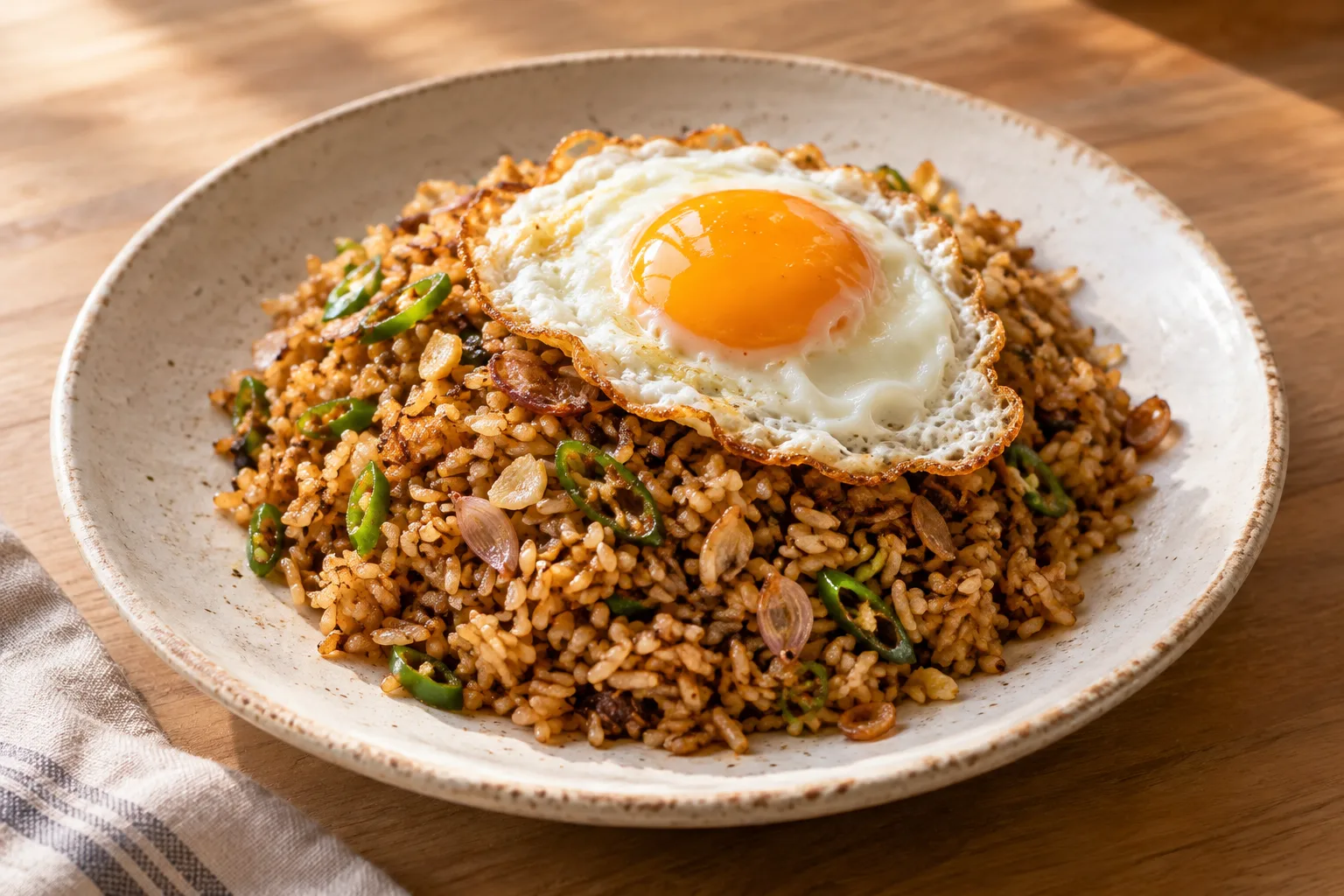
This profile describes terasi narrowly, using the evidence provided: sambal terasi is presented as a spicy sambal made with bird’s-eye chili and shrimp paste. In that context, terasi is identified as the shrimp paste used in the condiment. The evidence does not explain how the paste is made, whether or how it is fermented, its commercial texture, salt level, or differences between products. This profile therefore does not assume that every product is alike or assign the ingredient an origin, season, or shelf life. The documented meal presents sambal terasi alongside jasmine rice, tempe mendoan, and sautéed greens.
When to use it
Use terasi when you want to follow its documented role in sambal terasi: as an ingredient in a spicy preparation with bird’s-eye chili. The source also shows that sambal served in a meal with jasmine rice and tempe mendoan, offering a concrete serving context. No quantities, complete recipe, or other applications are established by the evidence. Adjust to the recipe you are following and to the particular product rather than assuming a standard amount.
How to use it
The evidence-supported use is to incorporate terasi into sambal terasi with bird’s-eye chili, then serve that condiment as part of a meal. One documented example serves it alongside jasmine rice and tempe mendoan; use this as a meal-planning reference, not as evidence that terasi is applied directly to every component. The source does not specify proportions, mixing order, cooking, or timing. Follow the instructions of the recipe you are actually making and the product label. Without a reliable recipe, there is no basis here for giving an exact formula.
Flavour and texture
The evidence describes sambal terasi as spicy and names bird’s-eye chili and shrimp paste as components. It does not separately describe the paste’s sensory profile or say whether products vary in saltiness, intensity, smoothness, or graininess. Taste the finished preparation cautiously and do not assume that different brands or formats will have the same profile.
How to choose it
The evidence does not compare brands, formats, or quality criteria. Check the product name and label to confirm that it is shrimp paste and to find the manufacturer’s instructions for that specific product. The available information cannot support a recommendation about a particular origin, variety, salt level, or consistency. Choose a package whose information you can read and that suits the recipe you plan to make.
Storage
No reliable information is supplied about storage, shelf life, or whether terasi should be refrigerated or frozen, so a universal time or storage condition cannot be given. Follow the directions on the specific package and use clean utensils when serving. If the package gives no clear guidance, ask the manufacturer or seller rather than assuming a particular storage method is appropriate.
Substitutions
The supplied evidence names no direct substitute for terasi and does not compare other condiments. If you do not have it, you can leave it out, understanding that the result will no longer be the documented sambal terasi. Another shrimp paste may be a category-level option if your recipe allows it, but check its label and do not assume it will have identical flavor or composition.
Common mistakes
Do not assume terasi is a ready-to-serve sauce: the evidence identifies it as shrimp paste used in sambal terasi. Do not assume every product has the same flavor, texture, or composition, and do not invent proportions when no recipe is available. To stay within the documented use, incorporate it into a sambal preparation and check the product instructions.
Safety and allergens
Check the label and follow the manufacturer’s directions for the specific product. The available information does not provide specific official safety warnings or storage instructions for terasi.
Culinary uses
- A shrimp-paste ingredient in sambal terasi
- A savory condiment served alongside a meal
Recommended techniques
- Mixing shrimp paste into sambal
- Serving sambal as a table condiment
Pairs well with
- Bird’s-eye chili in sambal terasi
- Nasi putih (jasmine rice)
- Tempe mendoan
Frequently asked questions
What is terasi according to the available evidence?
It is identified as shrimp paste used in sambal terasi, which is described as a spicy sambal with bird’s-eye chili.
How is it used in the documented meal?
It is part of sambal terasi. The source shows that condiment served in a meal with jasmine rice and tempe mendoan.
What can I use if I do not have terasi?
The evidence does not establish a direct substitute. You can omit it or consider another shrimp paste if your recipe allows, without assuming the result will be identical.
Sources and review
Automatically researched, cross-checked and validated content. Sources consulted:
- Client Challenge doi.org
- food preparation methods and regional collections.lib.utah.edu
- Changing Dietary Habits in Bali digitalcollections.sit.edu
- Taro | www.cocinista.es cocinista.es
- RICE: IS IT NICE? smea.uw.edu
- CHAPTER I INTRODUCTION repository.uph.edu
- Iterations of Ichthyology asset.library.wisc.edu
- Sasaknese Cultural Identity Embedded in Zainuddin Abdul ... jurnal.unai.edu
- g.tjahyadikarta – International Reporting blogs.baruch.cuny.edu
- La soja en el foco gastronómico: el cultivo versátil. | Kikkoman kikkoman.es
- Salsa Teriyaki: su origen e ingredientes | The Gourmet Journal thegourmetjournal.com
- Para Qué Sirve la Salsa Teriyaki: Análisis y Comparativa de las Mejores Opciones para tu Comida Asiática thaibistro.es
- Salsa teriyaki: el auténtico sabor a Japón | Recetas Nestlé recetasnestle.com.ar
- productos archivos | Germinarte germinarte.es