- Category
- Nuts and seeds
- State
- Paste
- Usual unit
- cup
What it is
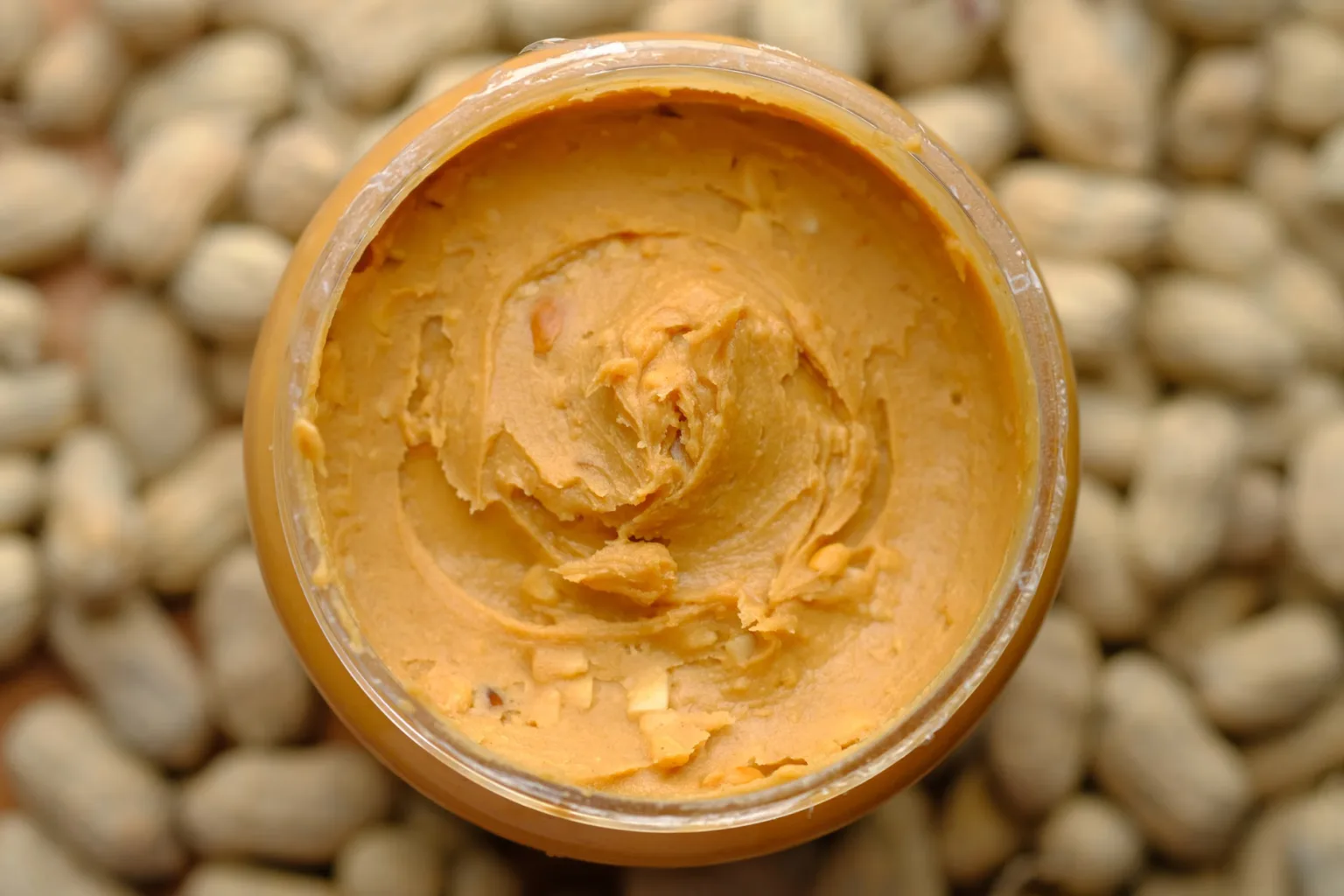
Natural peanut butter is a paste made by grinding peanuts, which are commonly roasted first. In simple versions, peanuts are the main ingredient and may be the only ingredient; other products or recipes may include salt, sugar, oils or additional ingredients, so check the label. Grinding turns the peanuts into a spreadable mixture that can be smooth or contain small pieces. If the product does not contain enough stabilizer to keep it uniform, its natural oil may separate and collect on top; stirring brings the paste together again. Peanuts are used like culinary nuts, although botanically they belong to the legume family.
When to use it
Use it when you want a pronounced toasted-peanut flavor and a creamy texture in a dish. It works on toast and crackers, with fruit, or mixed into smoothies and desserts. It can also be used in savory sauces or stirred into vegetable soup for body and a peanut note. Choose a smooth style when you want it to blend easily, or a crunchy style when you want pieces for texture. Salt, sugar and other ingredients vary by product, so check the label and account for its flavor when adding it to a recipe.
How to use it
If oil has collected on top, stir the peanut butter before serving, scraping the bottom of the jar as needed to distribute the paste evenly. Spread it directly on bread or toast, or serve it with fruit and crackers. For a smoothie, blend it with the other ingredients until evenly incorporated; for a sauce, add it gradually and stir to help prevent lumps. It can also be mixed into cookies, bars and other baked desserts. Adjust the salt or sugar in your recipe with the jar’s ingredient list in mind. Choose a crunchy style for pieces of peanut, or a smooth one for a more uniform mixture.
Flavour and texture
Its flavor is typically pronounced and toasted, with the characteristic taste of peanuts, though salt, sugar and other ingredients can change the profile. The texture is a thick, spreadable paste that may be smooth or contain crunchy pieces. In some varieties, oil separates and forms a layer on top; stirring can incorporate it again.
How to choose it
Read the ingredient list to see whether the product contains only peanuts or also includes salt, sugar, oils or other additions. Choose smooth or crunchy according to how you plan to use it, and check that the container is intact. If you want a less salty or less sweet product, compare labels rather than assuming every natural peanut butter has the same ingredients.
Storage
Follow the storage directions on the container, since formulations and instructions can differ between products. Close the jar securely after use and avoid putting wet or dirty utensils inside. If oil separates, stir the paste to make it more uniform again; separation can occur in peanut butter without stabilizers and, by itself, does not show that the product has spoiled.
Substitutions
If you only want a different texture, swap smooth peanut butter for crunchy, or the other way around; both retain the peanut flavor. Neither is a substitute for avoiding peanuts. If you need an alternative because of an allergy or other dietary restriction, check the alternative product’s ingredients and allergen statements instead of assuming another spread is safe.
Common mistakes
Do not assume every jar contains only peanuts: check the label before cooking. Also, do not automatically discard the product if oil has separated; stir it and follow the storage directions. Before adding extra salt or sugar to a recipe, consider what is already in the peanut butter.
Safety and allergens
Contains peanuts. If you have a peanut allergy, do not eat it and check the container’s ingredient list and allergen statements. Use a clean utensil and follow the manufacturer’s storage directions.
Culinary uses
- crema para untar
- base para batidos, salsas y preparaciones dulces
Recommended techniques
- untar
- mezclar o batir en preparaciones
Pairs well with
- pan y tostadas
- fruta
- batidos
- galletas y postres
Frequently asked questions
Why is there oil on top?
Natural oil can separate from the paste, especially in products without stabilizers. Stir the contents thoroughly to bring them together again.
Does natural peanut butter always contain only peanuts?
Not necessarily. Some products include salt, sugar, oils or other ingredients; the ingredient list on the container is the best guide.
How can I use it in a sauce?
Add it gradually to the other ingredients and stir until evenly distributed. Take account of any salt or sugar already in the product.
Estimated nutrition
- Fat
- 53.3 g
- Saturates
- 10 g
- Carbohydrate
- 20 g
- Sugars
- 6.67 g
- Fibre
- 6.7 g
- Protein
- 30 g
- Salt
- 0.33 g
Sources and review
Automatically researched, cross-checked and validated content. Sources consulted:
- ¿Por qué la muerte es origen de miedos y tabúes? doi.org
- Aceite vegetal - Wikipedia, la enciclopedia libre es.wikipedia.org
- Aplicaciones de la Biotecnología en Seguridad Alimentaria aesan.gob.es
- Qué es (y qué no es) la estadística, usos y abusos de una disciplina clave en la vida de los países y las personas | Estudios económicos doi.org
- Para la ciudadanía aesan.gob.es
- Tanzania Food Composition Tables | The Nutrition Source nutritionsource.hsph.harvard.edu
- Propiedades de la crema o mantequilla de cacahuete – Botanical-online botanical-online.com
- Arachis hypogaea - Wikipedia, la enciclopedia libre es.wikipedia.org
- ▷ Mantequilla de cacahuete 【 Kitchen Academy 】 google.com
- - YouTube youtube.com
- Crema de cacahuetes: análisis y comparativa de las mejores opciones para tus dulces y recetas aliciascake.es
- 5 pasos para hacer mantequilla de cacahuete casera perfecta frutossecosauro.es
- Mantequilla de cacahuete perfecta (con o sin Thermomix) - Tarthélémy google.com