Americas · Latin America

Guyana

Guyana’s food reflects its northern South American landscapes and a history shaped by Indigenous communities, colonial rule, enslavement, indentureship, and migration. Cassava, rice, coconut, fish, roots, herbs, and peppers appear in preparations as varied as cassava bread, pepperpot, cook-up rice, metemgee, and curry with roti. These dishes have family and community variations; together they illuminate a diverse food culture rather than a single, fixed national menu.

Food and eating habits

How people eat in Guyana

50 indicators exploring everyday meals, ingredients and food culture. Information is completed progressively from documented evidence.

0 of 50 indicators with documented information

Not all data are comparable: food supply, purchases and intake are different measures. Check the period, population and method for each finding. Qualitative descriptions do not establish percentages or amounts.

Timing and company

0/8
Timing and company — Guyana
IndicatorFindings and context
Meal times Awaiting research
Meals per day Awaiting research
Meal duration Awaiting research
Daily energy distribution Awaiting research
Weekdays and weekends Awaiting research
Eating at home and away Awaiting research
Cooking frequency Awaiting research
Eating together Awaiting research

Pantry and recipes

0/2
Pantry and recipes — Guyana
IndicatorFindings and context
Most consumed ingredients Awaiting research
Ingredient prevalence in recipes Awaiting research

Cereals and plant foods

0/6
Cereals and plant foods — Guyana
IndicatorFindings and context
Cereals and cereal products Awaiting research
Bread Awaiting research
Pulses Awaiting research
Vegetables Awaiting research
Fruit Awaiting research
Potatoes, roots and tubers Awaiting research

Protein foods

0/5
Protein foods — Guyana
IndicatorFindings and context
Meat Awaiting research
Fish and seafood Awaiting research
Eggs Awaiting research
Milk and dairy products Awaiting research
Protein sources Awaiting research

Fats, flavours and condiments

0/3
Fats, flavours and condiments — Guyana
IndicatorFindings and context
Cooking fats Awaiting research
Herbs and spices Awaiting research
Sauces and condiments Awaiting research

Meal composition

0/6
Meal composition — Guyana
IndicatorFindings and context
Breakfast composition Awaiting research
Main meal composition Awaiting research
Dinner composition Awaiting research
Appetisers and snacks Awaiting research
Desserts and sweets Awaiting research
Portion sizes Awaiting research

Techniques and equipment

0/5
Techniques and equipment — Guyana
IndicatorFindings and context
Cooking techniques Awaiting research
Vegetable preparation Awaiting research
Food preservation Awaiting research
Fermented foods Awaiting research
Kitchen equipment Awaiting research

Drinks

0/3
Drinks — Guyana
IndicatorFindings and context
Everyday drinks Awaiting research
Coffee and tea preparation Awaiting research
Drinks with meals Awaiting research

Nutrition and dietary patterns

0/3
Nutrition and dietary patterns — Guyana
IndicatorFindings and context
Energy and nutrients Awaiting research
Salt and sugars Awaiting research
Dietary patterns Awaiting research

Shopping, prices and waste

0/7
Shopping, prices and waste — Guyana
IndicatorFindings and context
Food expenditure Awaiting research
Cost of a common basket Awaiting research
Cost of specific meals Awaiting research
Grocery shopping locations Awaiting research
Shopping frequency Awaiting research
Prepared food and delivery Awaiting research
Household food waste Awaiting research

Seasons and celebrations

0/2
Seasons and celebrations — Guyana
IndicatorFindings and context
Seasonal produce Awaiting research
Celebration food Awaiting research
Explore its cuisines

Guyana’s Culinary Atlas: Cassava, River Fish, Rice, and Shared Traditions

Documentary synthesis prepared with AI assistance. It does not replace specialist review or certify kitchen testing. · Updated 31 October 2026

Land, waterways, and a many-sided food culture

Guyana lies on the northern mainland of South America, with an Atlantic coast, extensive rivers, rainforest, and interior communities. This varied setting helps explain why fish and seafood, cassava and other roots, rice, coconut, and tropical produce all have a place in the country’s foodways. Bangamary, a freshwater fish known in Guyana, is one example of the foods associated with its waters; it is not a stand-in for every local fish or regional diet.

Guyana’s culinary culture is also shaped by its diverse population and layered history. Indigenous food knowledge, African and Indian traditions, Chinese and Portuguese influences, European colonial legacies, and Caribbean connections are all part of the documented picture. Their presence is not uniform in every dish or household. A useful way to approach Guyanese food is through particular ingredients, preparations, and communities, rather than treating the cuisine as one unchanging blend. Georgetown’s markets and restaurants offer one urban setting for encountering this diversity, while Indigenous communities maintain distinct traditions in other parts of the country.

History, migration, and culinary exchange

Guyanese foodways developed within a history that includes Dutch and British colonial rule, plantation agriculture, slavery, resistance, and indentureship. These were unequal systems of power and movement, not simply a sequence of freely chosen cultural exchanges. The history of the Demerara rebellion of 1823 is one documented part of the wider story of resistance and social change in the country.

Indigenous knowledge, including the cultivation and processing of cassava, is among the foundations of Guyana’s food culture. Enslaved Africans brought foodways and cooking practices that are associated with hearty one-pot meals and ground provisions. Indian indentured labourers brought culinary traditions that helped establish curries and roti as familiar foods. Later Chinese migration is associated with Guyanese versions of fried rice and noodle dishes, while European influences appear in breads, pastries, and other preparations. These broad connections should not be read as exclusive ownership of a dish or as evidence that every household cooks alike. Recipes changed as ingredients and traditions met in Guyana, creating local versions that may resemble foods elsewhere while having their own histories and variations.

Cassava, rice, fish, coconut, and the working pantry

Cassava is a defining ingredient in several preparations. It can be processed into cassava bread or transformed into cassareep, a dark, concentrated liquid made by boiling down cassava juice. Cassareep gives pepperpot much of its characteristic color and flavor. Bitter cassava must be processed appropriately: traditional grating and pressing help remove harmful compounds from the pulp. A woven matapee is one documented tool for pressing it.

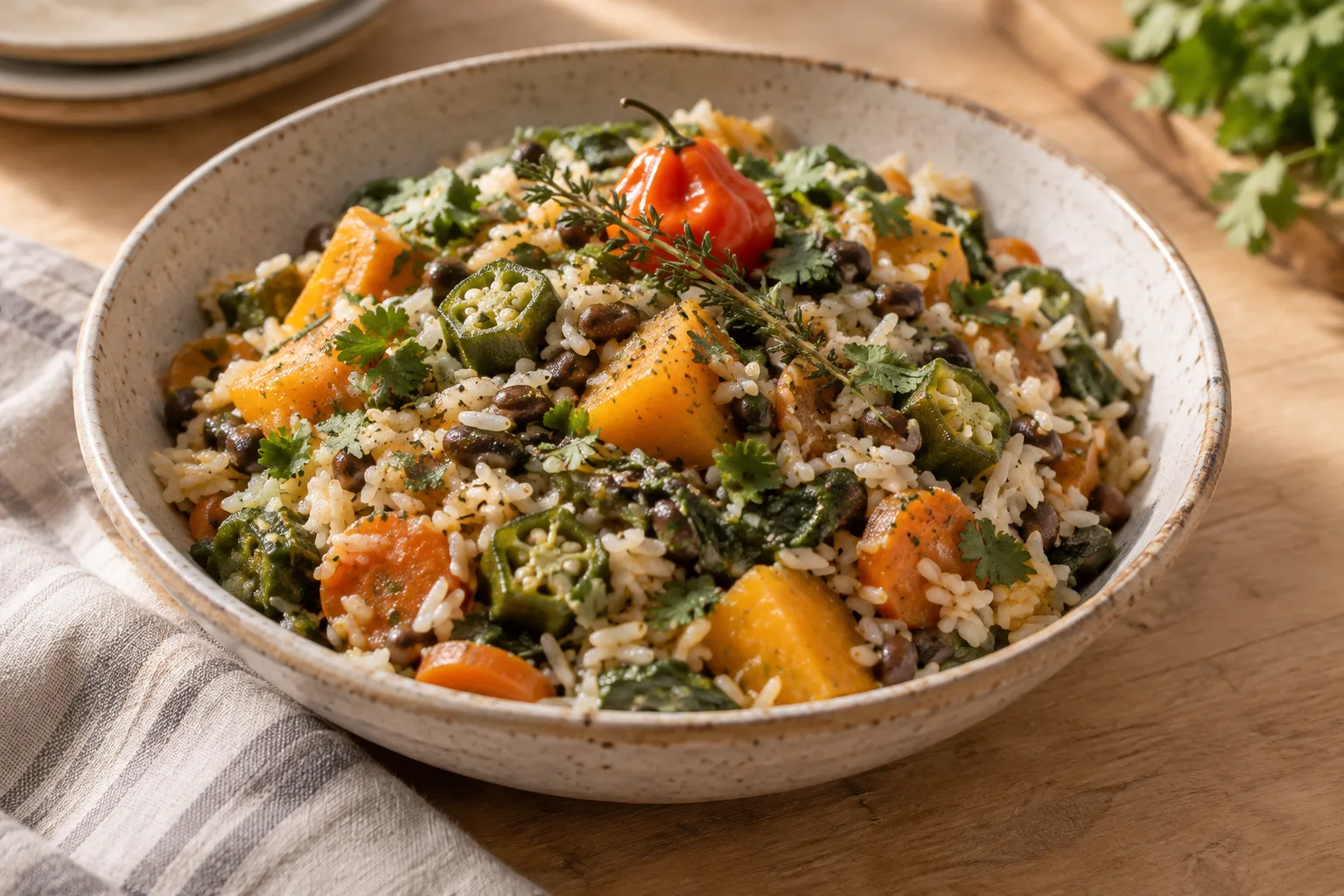
Rice provides the base for cook-up rice, a one-pot dish that may combine rice, peas or beans, coconut milk, herbs, vegetables, and meat or fish. The choice of legumes, protein, and greens varies between cooks and households. Coconut milk also gives richness to cook-up and to dishes such as metemgee. Sweet potato, yam, cassava, and plantain are among the roots and starchy foods used in substantial meals. Fish and seafood reflect the country’s waterways and coast; bangamary is a locally known freshwater fish. This pantry is not a fixed checklist: particular ingredients and combinations depend on the preparation, community, and household.

Deep stews, fragrant curries, and varied textures

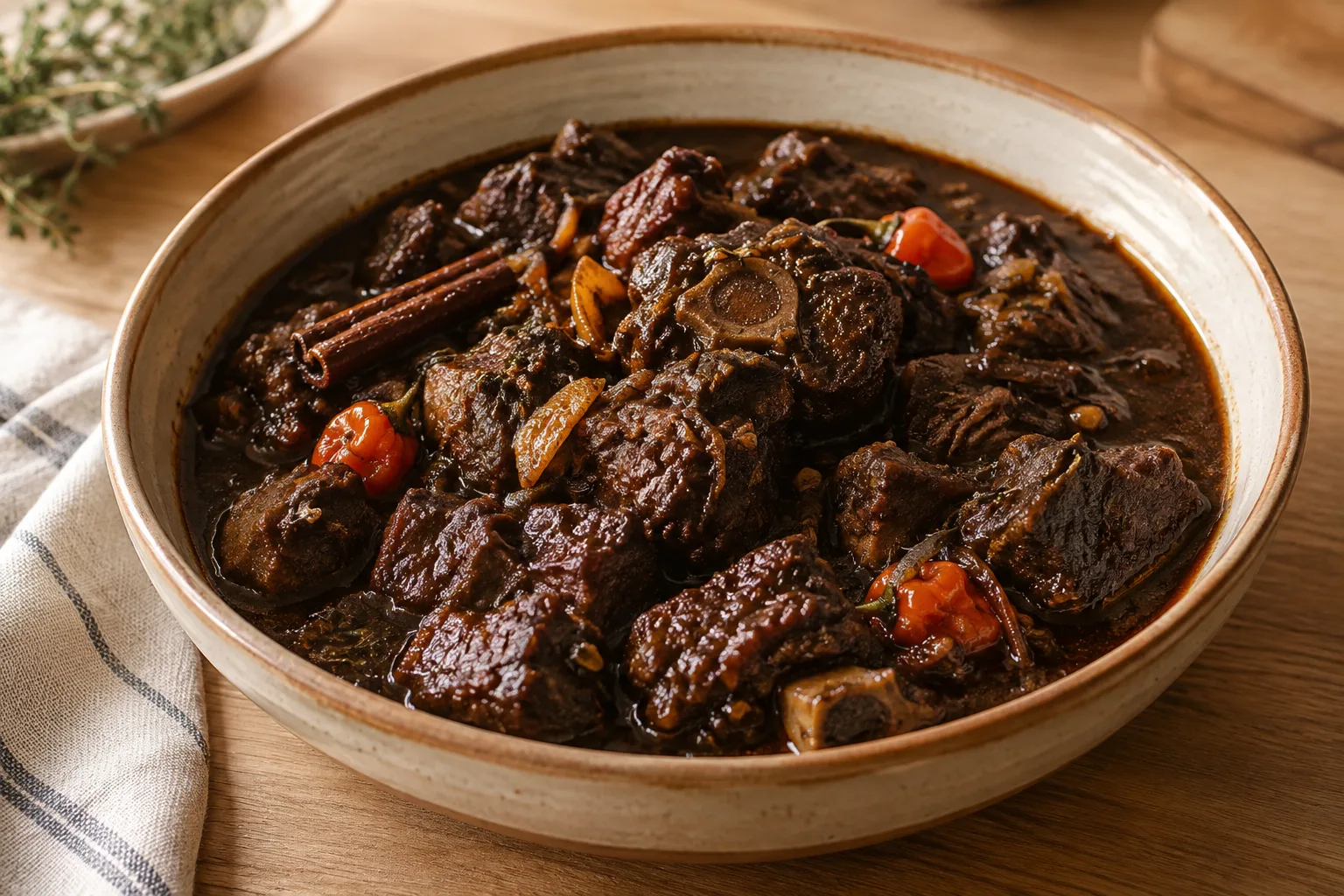
Pepperpot is known for its deep, dark character. Meat cooks slowly with cassareep, whose concentrated cassava flavor and color distinguish the stew, alongside seasonings such as thyme, cinnamon, cloves, and hot pepper. Recipes differ in their choice of meat and details of seasoning. The dish’s depth comes from the combination of the cassareep and long cooking, rather than from heat alone.

Curries with roti offer a different combination: aromatic spices and a sauce eaten with soft flatbread. Meat, fish, or vegetables may be used, and the level of chile heat can vary. Coconut milk brings a creamy quality to cook-up rice and metemgee, where it meets beans, roots, dumplings, or other substantial ingredients. Other preparations emphasize crispness or a more direct taste, as with cassava bread or fish cooked on its own. Across these dishes, texture matters as much as seasoning: a thick root-vegetable stew, tender meat, moist rice, pliable roti, and crisp cassava bread are distinct experiences. The variety reflects ingredients and cooking choices, not a single flavor profile that applies to every Guyanese meal.

Festive meals and the passing on of food knowledge

Pepperpot is especially associated with Christmas morning, when it may be served with bread. Its slow-cooked preparation and the practice of reheating it over successive days are part of the dish’s documented festive character. This is a well-known tradition, not a claim that every Guyanese household celebrates or eats in the same way.

Cook-up rice has its own occasion-specific associations. A Guyanese cook describes it as a New Year’s Eve food, prepared for the first meal of the new year; other accounts also describe it as a family meal whose ingredients and texture differ from one household to another. A large pot can be adapted with different peas, vegetables, and proteins, which makes the dish a vehicle for passing on family preferences as well as cooking knowledge. Seven curry, a collection of seven vegetarian curries, is another preparation documented in Guyana and may be served on a large water-lily leaf. These examples point to varied ways food accompanies celebration and gathering. Traditions are living practices, shaped by families and communities; no single dish or calendar should be presented as universal.

Pressing cassava, reducing cassareep, and cooking in one pot

Cassava processing makes clear that preparation can be essential to the safe use of an ingredient. In one traditional method, cassava is grated and the pulp is placed in a flexible woven matapee to press out liquid. Cassareep is made by boiling and reducing cassava juice until it becomes dark and concentrated. This process produces a distinctive ingredient for pepperpot; cassareep is not simply an interchangeable sweetener.

Pepperpot is slowly cooked so that meat and seasonings develop together with cassareep. Cook-up rice uses a different approach: rice, peas or beans, coconut milk, aromatics, and optional vegetables or protein cook together in one pot. Its finished texture can be wetter or more settled according to household preference and method. Metemgee brings roots and other ingredients together in a coconut-based stew. Other techniques in the wider pantry include baking or toasting grated cassava into cassava bread, and preparing salted fish by soaking or boiling it before further cooking. Each technique serves a particular ingredient and dish; these examples do not amount to a single method used throughout the country’s cuisine.

Breakfasts, substantial pots, and occasions for sharing

Bake and saltfish is a documented breakfast or brunch: fried dough is served with salted fish that has been prepared with seasonings such as onion, tomato, and chile. It contrasts with the rich stews and rice dishes eaten at other times. Salted fish is often soaked or boiled to reduce excess salt before it is cooked, so its preparation differs from that of fresh fish.

A meal may also be organized around curry and roti, a bowl of metemgee, or a shared pot of cook-up rice. The latter can bring rice, legumes, coconut milk, herbs, and other ingredients together in a single preparation, with versions suited to different households. Pepperpot has a particularly strong connection to Christmas morning; cook-up rice has documented New Year’s Eve associations. Seven curry gathers multiple vegetarian curries into one serving. These are specific patterns of serving and occasion, not a complete timetable for Guyanese meals. The table changes with the dish and the people sharing it: a breakfast of fried dough and fish is unlike a festive stew or a generous one-pot meal, and household practices vary.

A glossary of Guyanese ingredients and preparations

Local dish names point to preparations with recognizable ingredients, while leaving room for household and community variation. The definitions below identify the foods and tool described in this atlas; they are not fixed recipes.

  • Cassareep: A dark, concentrated liquid made by boiling and reducing cassava juice; a defining ingredient in pepperpot.
  • Pepperpot: A slowly cooked meat stew flavored with cassareep and seasonings, especially associated with Christmas morning.
  • Cook-up rice: A one-pot preparation of rice with peas or beans, often coconut milk and herbs, and optionally vegetables, meat, or fish.
  • Metemgee: A substantial stew of roots and other ingredients cooked in a coconut-based broth; ingredients vary.
  • Bake and saltfish: Fried dough served with seasoned salted fish, commonly described as a breakfast or brunch dish.
  • Seven curry: A serving of seven vegetarian curries, sometimes presented on a large water-lily leaf.
  • Matapee: A flexible woven basket used to press cassava pulp during processing.
  • Bangamary: A freshwater fish known in Guyana and included among the country’s documented food ingredients.

One country, many cuisines

Demerara-Mahaica and Georgetown

Demerara-Mahaica includes Georgetown, Guyana’s capital, and is associated with the historic Demerara sugar-producing area. The city offers an urban setting for encountering Guyanese food traditions and the country’s diverse cultural influences. Demerara sugar is linked to the region’s cane production and has a slightly sticky crystal and a mild caramel or toffee character. This coastal area provides a documented point of reference, but it does not represent every food tradition in Guyana, particularly those of Indigenous communities in the interior.

Cook
Read as an article ↗
Places and communities

One country, many cuisines

An initial selection of regions to explore. Culinary boundaries may differ from administrative divisions.

Guyana

Demerara-Mahaica and Georgetown

Demerara-Mahaica includes Georgetown, Guyana’s capital, and is associated with the historic Demerara sugar-producing area. The city offers an urban setting for encountering Guyanese food traditions and the country’s diverse cultural influences. Demerara sugar is linked to the region’s cane production and has a slightly sticky crystal and a mild caramel or toffee character. This coastal area provides a documented point of reference, but it does not represent every food tradition in Guyana, particularly those of Indigenous communities in the interior.

Cook
Recipes connected with Guyana

Each recipe documents one version. Geographic associations do not imply an exclusive origin.

Guyanese Pepperpot
Image generated by the Kitchenpause team
230 minIntermediate

Guyanese Pepperpot

A Guyanese stew of slowly cooked meat with cassareep, cinnamon, cloves, thyme, and hot peppers.

View recipe

Sources consulted

Read the sources and each document’s scope. A heritage inscription concerns a particular practice, not all of a country’s cuisine.

  1. Italian cooking, between sustainability and biocultural diversity - UNESCO Intangible Cultural Heritage ich.unesco.org/en/RL/italian-cooking-between-sustainability-and-biocultural-diversity-02093 ich.unesco.org Consulted: November 12, 2026
  2. International Cooking: Food from Guyana - The Flavor Vortex www.theflavorvortex.com/international-cooking-food-from-guyana/ theflavorvortex.com Consulted: October 27, 2026
  3. Guyanese Food: Top 10 Dishes - TasteAtlas www.tasteatlas.com/best-rated-dishes-in-guyana tasteatlas.com Consulted: October 27, 2026
  4. Culture Tuesday: an Exploration of Guyanese Cuisine - Best of Vegan bestofvegan.com/culture-tuesday-an-exploration-of-guyanese-cuisine/ bestofvegan.com Consulted: October 27, 2026
  5. Taste Guyanese Cuisine: 5 Must-Try Local Dishes and Where to Find Them - Guyana Luxury Vans guyanaluxuryvans.com/guyanese-cuisine-5-local-dishes/ guyanaluxuryvans.com Consulted: October 27, 2026
  6. Gastronomy of Guyana Food & Beverage guide for first time travelers wildexpedition.com/gastronomy-of-guyana-food-beverage-guide-for-first-time-travelers/ wildexpedition.com Consulted: October 27, 2026
  7. Traditional Guyanese Foods You Can Make at Home - Emerging Destinations emergingdestinations.com/traditional-guyanese-foods-you-can-make-at-home/ emergingdestinations.com Consulted: October 27, 2026
  8. Guyanese Cook-Up Rice - Metemgee metemgee.com/guyanese-cook-up-rice/ metemgee.com Consulted: October 27, 2026
  9. 20 Most Popular Foods in Guyana | Very Hungry Nomads www.veryhungrynomads.com/20-most-popular-foods-in-guyana/ veryhungrynomads.com Consulted: October 28, 2026
  10. Discovering Guyana, the Land of Six Peoples, through Georgetown's culinary melting pot - Wanderlust www.wanderlustmagazine.com/inspiration/discovering-guyana-the-land-of-six-peoples-through-ge… wanderlustmagazine.com Consulted: October 28, 2026
  11. Rise and Shine | Foods From Around the World- Guyana | Season 2023 | PBS www.pbs.org/video/food-around-the-world-cpcxvw/ pbs.org Consulted: October 28, 2026
  12. Culture - Guyana Tourism guyanatourism.com/culture/ guyanatourism.com Consulted: October 27, 2026
  13. 5 Must Try Guyanese Foods - Metemgee metemgee.com/5-must-try-guyanese-foods/ metemgee.com Consulted: October 27, 2026
  14. Traditional Foods Of Guyana - Great Research shrine-qa-node01.catalyst.harvard.edu/traditional-foods-of-guyana shrine-qa-node01.catalyst.harvard.edu Consulted: October 27, 2026
  15. Guyana’s National Dish and Its Multicultural Roots | Remitly www.remitly.com/blog/en-au/food/national-dish-of-guyana/ remitly.com Consulted: October 27, 2026
  16. Traditional foods in Guyana | Guyanese cuisine & dishes — GuyExpat www.guyexpat.com/traditional-food guyexpat.com Consulted: October 27, 2026
  17. Small Batch Guyanese Chicken Cookup Rice » Alica's Pepperpot www.alicaspepperpot.com/small-batch-guyanese-chicken-cookup-rice/ alicaspepperpot.com Consulted: October 27, 2026
  18. Guyanese Cook-Up Rice - Coined Cuisine www.coinedcuisine.com/guyanese-cook-up-rice/ coinedcuisine.com Consulted: October 27, 2026
  19. Guyana // Vegetarian Cook Up Rice | Worldwide Mission Fellowship www.wwmf.org/2024/12/23/blog/guyana-vegetarian-cook-up-rice/ wwmf.org Consulted: October 27, 2026
  20. Cook-up rice de Guyana: una olla de alubias y coco | Sekai Gohan sekaigohan.com/es/recipes/south-america/guyana/cook-up-rice sekaigohan.com Consulted: October 27, 2026
  21. Guyanese Cook-Up Rice Will Keep You Full and Satisfied - Caribbean Today www.caribbeantoday.com/sections/food/guyanese-cook-up-rice-will-keep-you-full-and-satisfied caribbeantoday.com Consulted: October 27, 2026
  22. Guyana National Museum | History & Culture in Georgetown • Tour Guyana tour.gy/places/guyana-national-museum tour.gy Consulted: October 28, 2026
  23. Culinary Arts Centre Archives - Ministry of Human Services and Social Security mhsss.gov.gy/category/culinary-arts-centre/ mhsss.gov.gy Consulted: November 1, 2026
  24. New culinary facility expected to boost female entrepreneurs – Department of Public Information, Guyana dpi.gov.gy/new-culinary-facility-expected-to-boost-female-entrepreneurs/ dpi.gov.gy Consulted: November 1, 2026
  25. Pepperpot | PBS Food food-develop.console.pbs.org/recipes/pepperpot food-develop.console.pbs.org Consulted: November 1, 2026
  26. Guyanese-Style Pepperpot With Cassareep Recipe | olivemagazine www.olivemagazine.com/recipes/one-pots/guyanese-style-pepperpot-with-cassareep/ olivemagazine.com Consulted: November 1, 2026
  27. Guyanese Pepperpot: A savoury, spicy stew chef Devan Rajkumar says is 'magical' www.cbc.ca/lite/story/1.7228171 cbc.ca Consulted: November 1, 2026
  28. Guyanese Pepperpot Recipe | Samsung Food App app.samsungfood.com/recipes/107d803b6d6102146999bc53081fbf1dfd1 app.samsungfood.com Consulted: November 1, 2026
  29. Pepperpot Recipe cooking.nytimes.com/recipes/1025035-pepperpot?emc=edit_ck_20240221&nl=cooking&te=1 cooking.nytimes.com Consulted: November 1, 2026
  30. Guyanese Pepperpot: A savoury, spicy stew chef Devan Rajkumar says is 'magical' | CBC Life amp.cbc.ca/life/food/guyanese-pepperpot-devan-rajkumar-mad-love-cookbook-1.7228171 amp.cbc.ca Consulted: November 1, 2026
  31. Pepperpot recipe | SBS Food www.sbs.com.au/food/recipe/pepperpot/k0picraft sbs.com.au Consulted: November 1, 2026

We use session and security technologies to provide our features. Only with your permission do we load Google Analytics to measure visits and Google Maps on Contact. Choose separately, reject or accept both.

Withdraw either permission here. Withdrawing analytics reloads the page to unload the running tag.

Cookie policy