Documentary synthesis prepared with AI assistance. It does not replace specialist review or certify kitchen testing. · Updated 12 November 2026
A country of varied food traditions
Saudi Arabia’s culinary landscape is not a single, uniform menu. The country includes desert interiors, mountain areas, oases, and long coastlines, and its documented foods range from rice and meat dishes to wheat preparations, seafood, and filled breads. The examples associated with particular places—such as creamy saleeg in the western Hijaz, wheat-based jareesh in central areas, and stone-cooked madhbi in Aseer—show regional character without defining every household in those regions.
Rice and meat are prominent in well-known dishes, but they are only part of the picture. Wheat cooked until soft, milk-based rice, fish, dates, and street foods made from thin dough all have their own place. Some preparations are described as widely enjoyed across the country, while others are tied more closely to a particular region or occasion. Family recipes and local preferences matter: spice blends, meats, accompaniments, and serving styles can differ even when a dish has the same name.
Trade, exchange, and culinary continuity
Saudi Arabia’s position along historic trade routes helped bring spices and other ingredients into circulation across the peninsula. The evidence connects these routes with the presence of aromatic seasonings in regional cooking, including spices used in rice dishes. This is a story of exchange rather than a basis for assigning a single origin to a dish: preparations such as kabsa have versions across households and are also enjoyed beyond Saudi Arabia.
The country’s culinary traditions are also shaped by Islamic practice. Pork is prohibited for Muslims, and dates are associated with breaking the fast during Ramadan. These contexts influence what is served and when, alongside family gatherings, weddings, Eid, and welcoming visitors. Sources describe several dishes as shared across the wider Middle East as well as in Saudi Arabia; that overlap is part of the food’s history, not a reason to treat regional or national traditions as interchangeable. Continuity here is carried through adaptation: familiar preparations persist while ingredients, proportions, and customs vary among families and places.
Rice, wheat, dates, and a varied larder
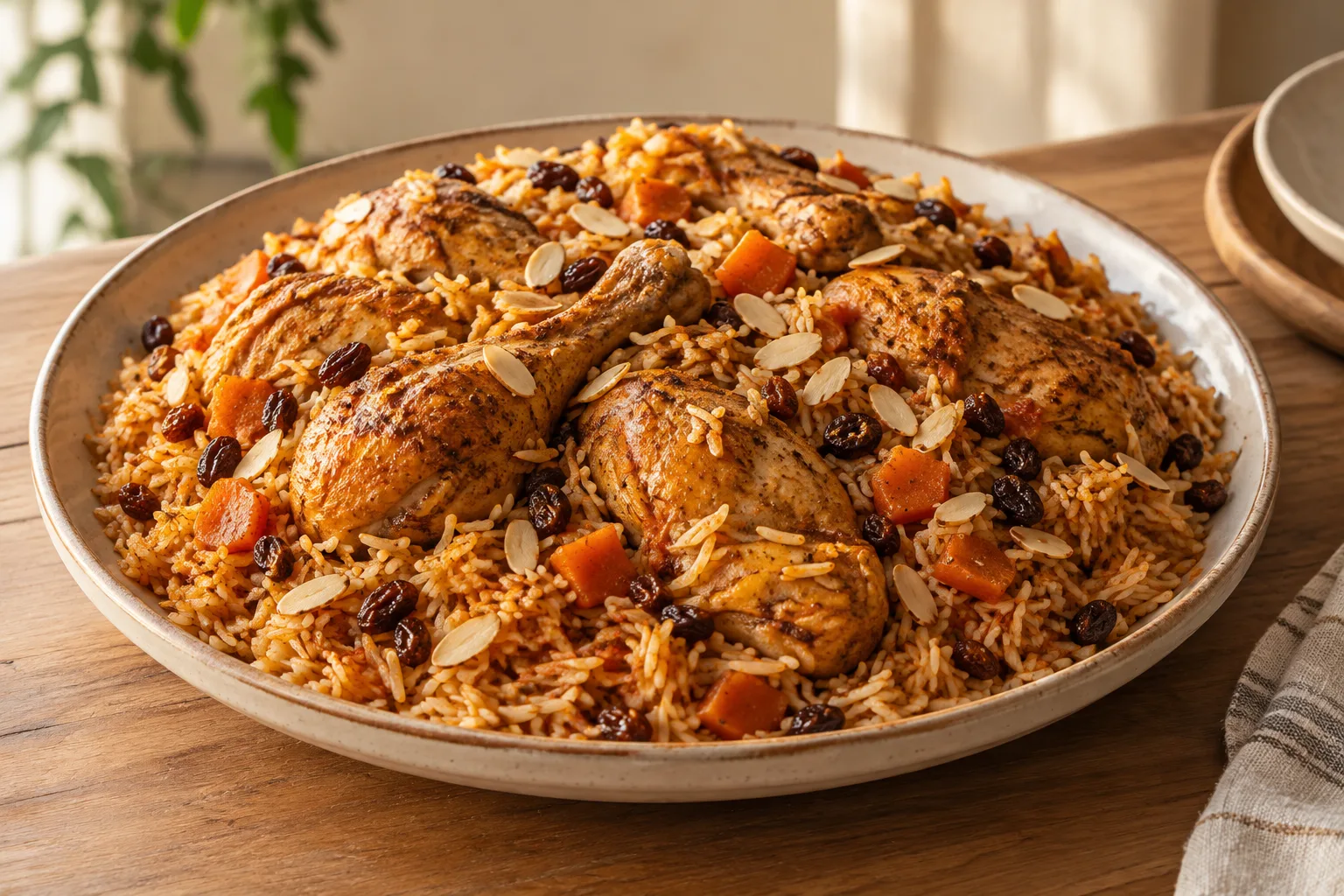
Long-grain rice, including basmati, is central to many kabsa preparations. It is cooked with a seasoned broth and served with meat; chicken and lamb are common choices, while descriptions also include camel, beef, and fish. Onion and tomato appear in the cooking base for some versions, and almonds, pine nuts, or raisins may be used as garnishes. These additions are options, not a fixed requirement for every family’s kabsa.
Wheat brings a different set of textures. Crushed or coarsely ground wheat is the foundation of jareesh, which is simmered until thick and soft. Wheat also appears in matazeez, where pieces of dough cook in a stew. Dates are both a notable food and a customary accompaniment to Saudi coffee. Fish and vegetables are part of the broader range of ingredients described, while ghee enriches some dishes. In saleeg, rice is cooked with broth and milk; its gentle, creamy character sets it apart from spiced rice dishes. The pantry supports both substantial shared meals and simpler foods, rather than one standard combination.
Warm spice, savoury broth, and contrasting textures
Kabsa’s flavour is built through the meeting of rice, meat, broth, and aromatic seasoning. Documented spices include black pepper, cardamom, saffron, cinnamon, cloves, bay leaves, and dried lime. Tomato and onion can form part of the cooking base, while the precise blend and its proportions vary. The result is not defined simply by heat: warm spice, savoury cooking juices, and the sharp citrus note of dried lime may all be present in different combinations.
Textures distinguish one dish from another. Kabsa’s rice takes up the flavours of its broth and is served with tender meat; optional nuts or raisins add crunch or sweetness. Saleeg is soft and creamy after rice cooks with milk and broth. In jareesh, crushed wheat loses its separate grain-like form as it simmers into a thick, porridge-like preparation. Mutabbaq contrasts a browned, crisp exterior with softer layers around its filling. These differences make the cuisine more than a succession of spiced rice dishes: dairy, grain, toasted garnishes, and folded dough each bring a distinct experience to the table.
Hospitality, the calendar, and family transmission
Welcoming guests with Saudi coffee, or gahwa, often accompanied by dates, is a documented expression of hospitality. Larger meals may centre on a shared preparation such as kabsa, while the exact dish and manner of serving depend on the household and occasion. The sources describe kabsa at family gatherings and celebrations, and jareesh at occasions including Ramadan, Eid, and weddings. Dates, meanwhile, are associated with breaking the fast during Ramadan.
These occasions do not make every meal ceremonial, nor do they prescribe one practice for every family. A dish may be festive in one setting and familiar at other times. The passing on of recipes is visible in the many household versions of kabsa: cooks differ in their choices of meat, seasoning, and garnish. Jareesh is also prepared in more than one way, including versions with meat or other accompaniments. Food traditions are sustained through repeated cooking and sharing, with variation forming part of that continuity rather than an exception to it.
Simmering, slow cooking, and cooking over stone
Kabsa is generally prepared in a pot on the stove. A seasoned broth is made with meat and aromatics, and rice is cooked in that liquid so it absorbs the flavour. Some methods remove the meat to brown or roast it separately before serving; others finish it with the rice. The order and details vary, so no single version should be treated as the only authentic method.
Long, gentle cooking is important to the texture of jareesh: crushed wheat simmers in broth, sometimes with meat, until it becomes thick and soft. In saleeg, rice cooks with broth and milk until creamy. Southern preparations use other methods. Mandi is associated in some areas with cooking in an underground oven, while haneeth is described as meat slowly roasted in a clay oven. In Aseer, madhbi is associated with chicken cooked on stone. These techniques are distinct from pot-cooked kabsa and should not be collapsed into a single method. For mutabbaq, thin dough is folded around a filling and cooked on a hot surface until browned.
Shared platters and meals for different occasions
Large platters of rice and meat are a familiar way to serve dishes such as kabsa and mandi to a group. A shared platter can make a meal part of hosting and gathering, though it is not an obligation or a description of every Saudi meal. Some accounts note eating with the right hand; customs depend on the people and setting. Coffee and dates may form part of a welcome, while the main meal can range from a festive spread to an everyday family dinner.
The dishes themselves suit different kinds of eating. Saleeg is served on a broad platter in some Hijazi settings and is associated with special occasions. Jareesh is described for large gatherings as well as particular calendar events. By contrast, mutabbaq is a street food and snack: its folded filling makes it easy to serve as an individual portion. These differences matter. The Saudi table is not only a feast of shared rice and meat; it also includes creamy grain dishes, smaller foods bought from markets, and meals shaped by the time of day, place, and company.
A glossary of dishes and ingredients
The names below refer to specific foods documented in Saudi culinary contexts. Recipes and uses may vary by region and household.
- Kabsa: A rice dish cooked with meat and aromatic spices; chicken and lamb are common choices, and other meats are also documented.
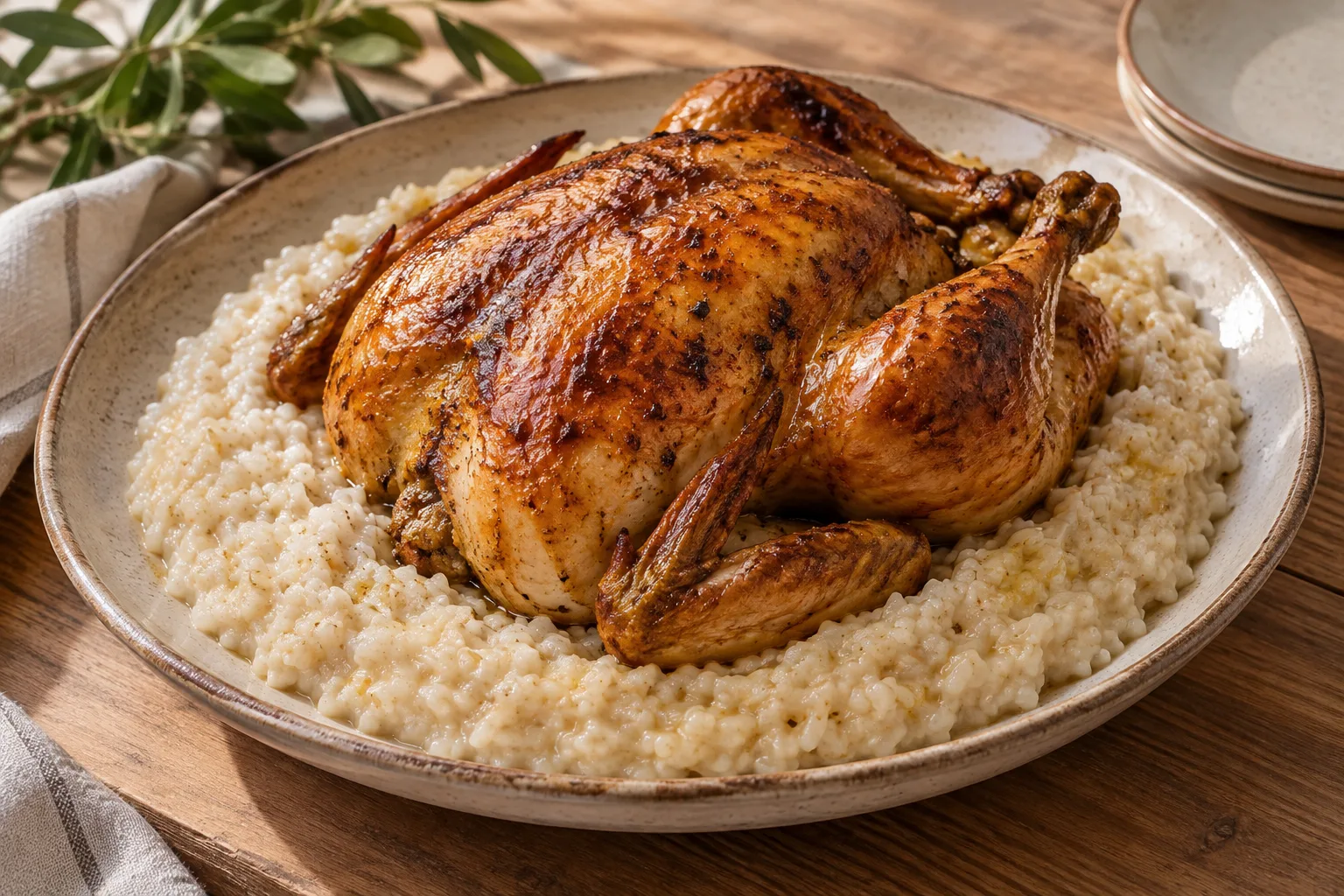
- Saleeg: A western Hijazi preparation of rice cooked with broth and milk until creamy, often served with chicken or lamb.
- Jareesh: Crushed or coarsely ground wheat simmered until thick and soft, sometimes cooked with meat.
- Mutabbaq: Thin dough folded around a filling and cooked on a hot surface; savoury and sweet versions are described.
- Mandi: A meat-and-rice dish associated in some southern areas with cooking in an underground oven.
- Haneeth: Meat, especially lamb, slowly roasted; a clay oven is described as a traditional method.
- Madhbi: A dish associated with Aseer in which chicken is cooked on stone.
- Gahwa: Saudi coffee served as a welcome, often alongside dates.
- Dried lime: A citrus seasoning used in some spice blends for rice dishes, adding a distinctive aromatic note.
One country, many cuisines
Najd and the Central Region
Central Saudi Arabia is associated with wheat dishes including jareesh and matazeez, as well as the widely known kabsa. Jareesh uses crushed wheat simmered to a soft, thick consistency, while matazeez combines stew with pieces of dough cooked in the broth. These are documented regional examples, not a complete or uniform menu for central households.
Hijaz and the Western Coast
The western Hijaz, including cities such as Jeddah, Mecca, and Medina, is associated with saleeg: rice cooked with broth and milk until creamy, often served with chicken or lamb. Mutabbaq is also documented as a street food in Jeddah, made from thin folded dough with varied fillings. These examples describe particular foods and do not represent every meal in the region.
Aseer and Other Southern Areas
Aseer is associated with madhbi, in which chicken is cooked on stone. Mandi is documented in Aseer and Al-Bahah with an underground-oven method, while haneeth is described as meat slowly roasted in a clay oven. These dishes and techniques identify examples of southern cooking without suggesting that they are shared uniformly by all communities in the south.
Cook