Documentary synthesis prepared with AI assistance. It does not replace specialist review or certify kitchen testing. · Updated 12 November 2026
An island city shaped by exchange
Singapore is an island city-state at the southern end of the Malay Peninsula, positioned along busy maritime routes in Southeast Asia. Its food reflects both this location and the movement of people through the port: Malay and Indonesian, Chinese, Indian, Peranakan, and Eurasian traditions all contribute to the country’s varied culinary life. These are not interchangeable strands, and no single dish or community represents the whole.
A walk through a hawker centre or coffee shop can bring different foodways into view at once. One stall might specialise in Hainanese chicken rice, another in roti prata or laksa; diners can choose from them in the same shared setting. The combination of distinct specialities and everyday access is central to how Singaporeans encounter food. The dishes themselves also vary between cooks and communities, reflecting adaptation over time rather than a single standard recipe.
The country’s culinary identity is therefore best understood as plural and evolving. Some dishes are associated with particular communities or migrant histories; others have become familiar across the city. Their coexistence in public eating places does not erase those differences. It makes Singapore a place where food offers a concrete view of cultural contact, migration, and local adaptation.
Trade, migration, and culinary adaptation
Singapore’s history as a trading place predates British rule. From the fourteenth century, the island and surrounding region were connected to maritime trade and shifting political powers. In 1819, Singapore became a British trading post, and its role as an entrepôt drew people from across Asia. Chinese migrants included Hokkien, Teochew, Cantonese, Hakka, and Hainanese communities; Malay, Indian, and Eurasian histories also shaped the city. Singapore became part of Malaysia in 1963 and an independent state in 1965.
Food traditions travelled with people and changed in their new setting. Hainanese chicken rice, for example, is linked to Hainanese migrant cooks and to a Hainan dish of poached chicken; the Singaporean plate brings chicken together with rice cooked in chicken stock and sauces. Peranakan food reflects the particular histories of Chinese and Malay cultural contact. Laksa is frequently associated with Peranakan cooking, but its beginnings and varieties should not be reduced to a single settled account.
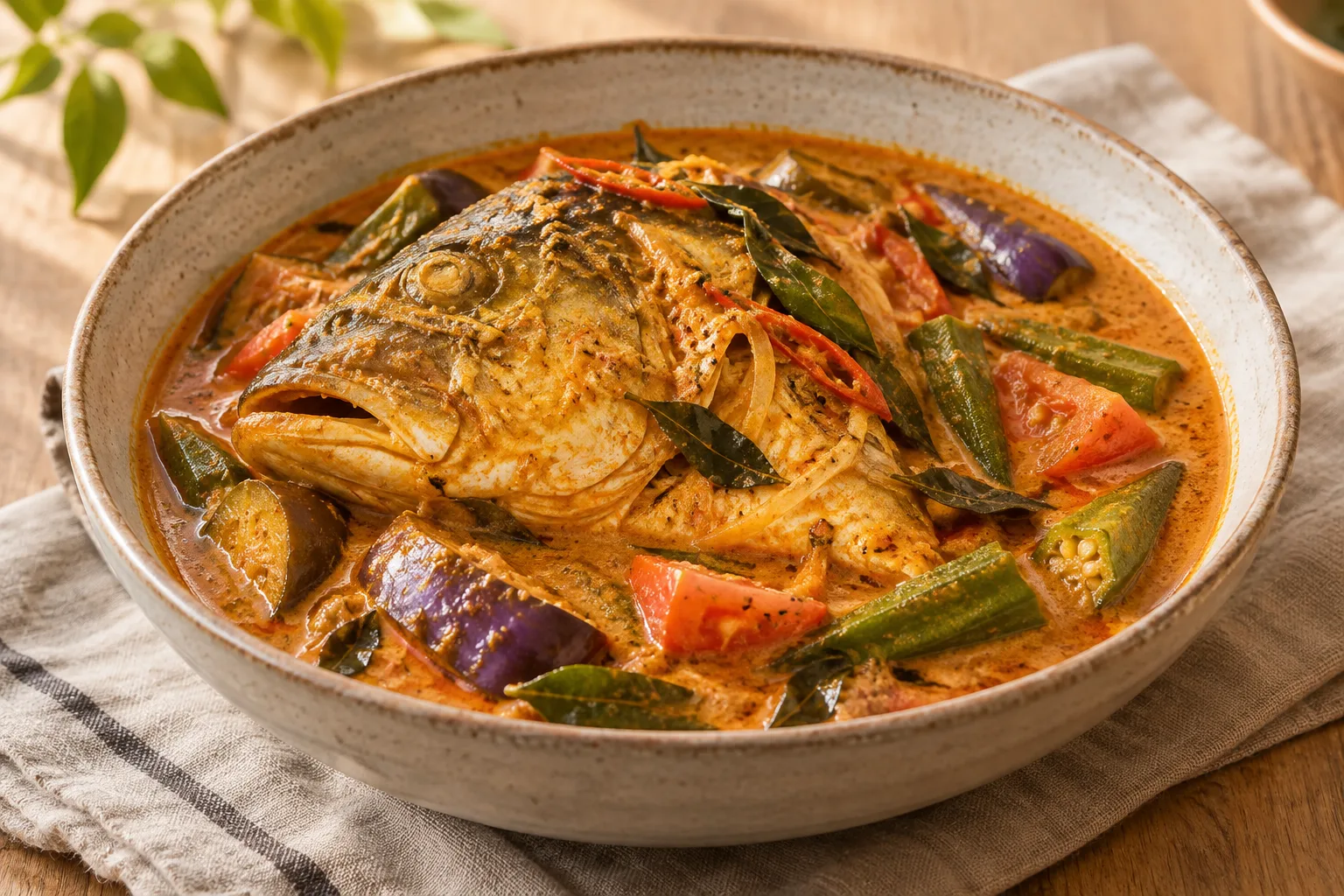
Other dishes are described as adaptations for local audiences. Fish head curry, associated with Indian culinary traditions in Singapore, became a distinctive local preparation, commonly cooked with vegetables and a tangy, spiced sauce. Accounts of its invention differ, so it is more useful to understand it as a dish shaped by culinary exchange than to assign it an exclusive origin. Migration and local change, rather than a simple story of invention, explain much of Singapore’s food history.
Rice, spices, coconut, and the sea
Rice and noodles are foundations for many Singaporean dishes, though the ingredients and methods vary by tradition. Jasmine rice is cooked in chicken stock for Hainanese chicken rice; rice for nasi lemak is cooked with coconut milk and often pandan. Flat rice noodles are stir-fried for char kway teow, while rice noodles appear in laksa and other soups. Seafood—from prawns and fish to crab—features in hawker and restaurant cooking, alongside poultry, pork, vegetables, and tofu.
Malay-influenced cooking often uses rempah, a ground or pounded spice paste. Its ingredients can include chilli, shallot, garlic, ginger, lemongrass, and turmeric. Coconut appears as milk or cream in savoury dishes and sweets; tamarind provides a sour note in some curries. Belacan, fermented shrimp paste, is used in certain condiments and spice mixtures. Pandan lends fragrance to rice and sweets, while peanuts and dried anchovies are familiar accompaniments to nasi lemak.
The broad family called kuih includes sweet and savoury small foods made with ingredients such as rice or glutinous rice, tapioca, coconut, and palm sugar. These ingredients are not a single national pantry: their combinations belong to different dishes and culinary traditions. Looking at them together shows the range of Singapore’s food, while keeping clear that a shared marketplace does not make every kitchen the same.
A spectrum of tastes and textures
There is no single Singaporean flavour profile. Meals and menus may move between mild, savoury, sour, sweet, fragrant, and hot preparations. In chicken rice, ginger, garlic, and chilli sauces offer a sharp counterpoint to gently poached chicken and savoury rice. Laksa’s spiced broth may be enriched with coconut milk, while tamarind lends fish head curry a sour edge. The balance depends on the cook and the version; a dish name does not promise identical heat or seasoning everywhere.
Texture is as important as seasoning. Chicken rice sets tender chicken and distinct, stock-seasoned grains beside dipping sauces and crisp cucumber. In char kway teow, soft rice noodles meet egg, sprouts, and seafood; a very hot wok can add toasted, smoky notes. Fish head curry pairs delicate fish with a sauce and vegetables that take on its spices. Kuih may be soft, springy, dense, or tender depending on the starches and preparation.
Some plates make contrast visible in a single serving. Nasi lemak brings fragrant coconut rice together with items such as sambal, anchovies, peanuts, egg, or cucumber. A spoonful can be creamy, crisp, salty, and spicy in succession. This variety is not a rule that every dish must follow, but it helps explain why Singaporean food resists being summarised as uniformly hot or richly spiced. Different textures and tastes can sit side by side, within one dish as well as across a meal.
Family knowledge, festive foods, and daily specialities
Singapore’s food traditions are sustained in households as well as in public food businesses. Family recipes preserve memories and particular ways of making familiar dishes; the ingredients and steps may differ from another family’s version. Heritage recipe collections record home-cooked preparations and the stories attached to them. At hawker stalls, cooks maintain specialist knowledge through repeated work, offering another way for recipes and techniques to continue in everyday life.
K ui h—more commonly written kuih—are eaten as snacks and sweets as well as at festive occasions. They are associated with celebrations including Hari Raya and Chinese New Year, but the category is not confined to festival tables: many kinds are eaten at different times of day. This mixture of ordinary and celebratory use is a useful reminder that a food’s significance can shift with the occasion, the household, and the community.
Singapore’s public calendar includes celebrations observed by different religious and cultural communities. Food traditions around them are varied, and should be described in their own contexts rather than combined into a single national ritual. Hawker centres, in contrast, are everyday places where people can eat together while choosing different foods. That shared setting supports contact without requiring everyone to eat the same dish. Transmission happens in more than one place: in family kitchens, specialist stalls, and the conversations and habits that gather around food.
Poaching, pounding, stir-frying, and steaming
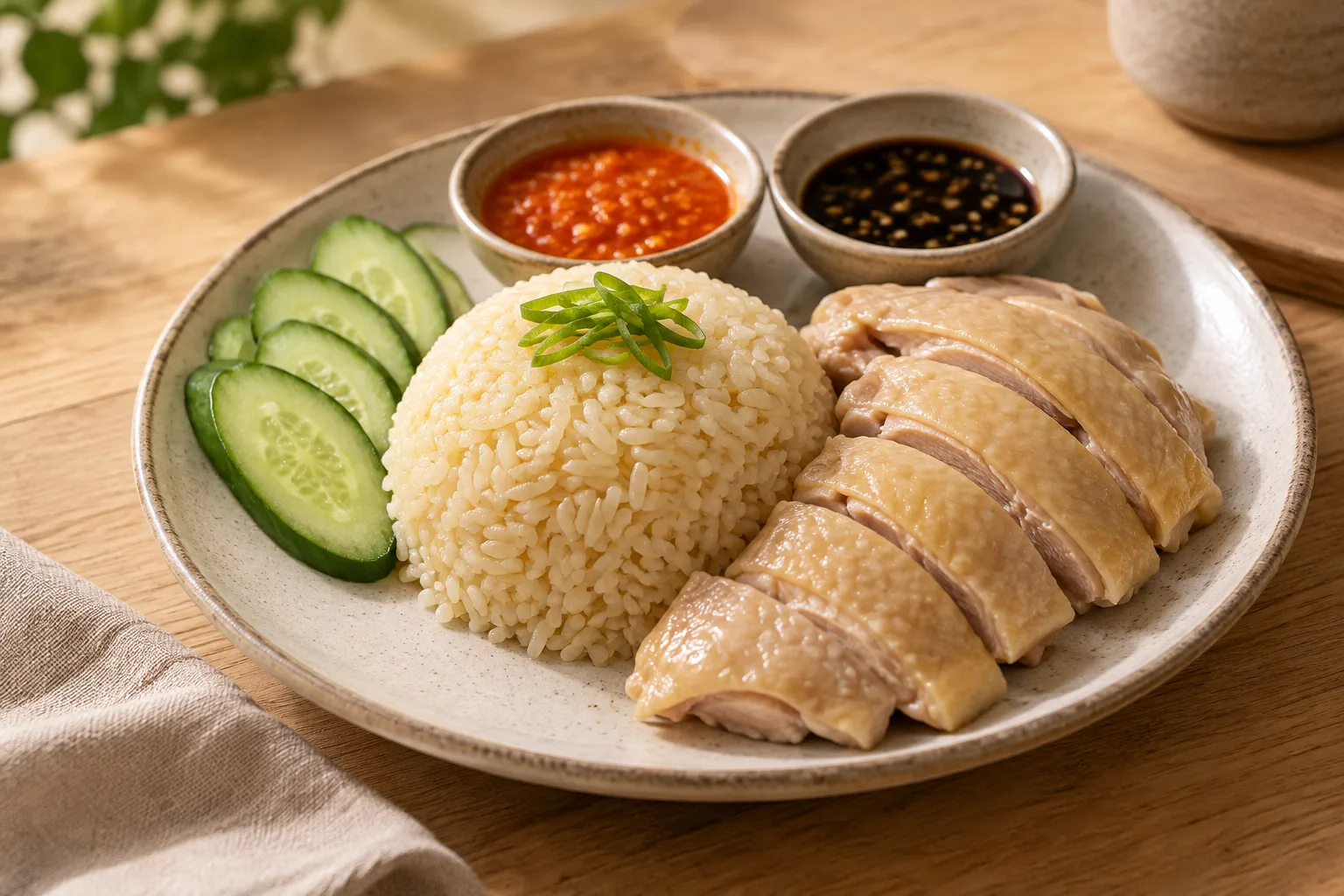
In Hainanese chicken rice, the chicken and rice are linked through their cooking liquid. Chicken is gently poached with aromatics, and the resulting stock is used to cook the rice. The dish is served with condiments, often including a chilli sauce and ginger-based sauce, and may include soup made from the same poaching liquid. Some stalls serve roasted chicken instead of poached chicken; accompaniments and precise methods differ. The result is not simply chicken beside plain rice, but a set of components designed to carry related aromas.
A wok is central to quick stir-fries such as char kway teow. Cooking over high heat can brown ingredients and create toasted notes, while keeping the noodles tender. Spice pastes for curries are pounded or ground before being cooked, helping distribute aromatics through the sauce. Fish head curry versions differ in their ingredients and sequence; fish is cooked in a spiced sauce that may include tamarind, coconut milk, and vegetables such as okra or eggplant.
Many kuih are steamed, although the family includes different kinds of foods and methods. Their textures depend on the starches and how each preparation is shaped and cooked. These techniques belong to particular dishes, not to one universal Singaporean method. Gentle poaching, pounding, intense wok heat, and steaming each produce recognisable results, and together they illustrate the varied technical knowledge found across the country’s kitchens and stalls.
Hawker centres, coffee shops, and eating together
Hawker centres bring numerous specialist stalls together in a shared eating place. Diners order from individual vendors and can assemble a meal from different offerings, whether a bowl of noodles, rice with accompaniments, or a cooked-to-order dish. Coffee shops, often called kopitiam, are another familiar setting for everyday meals and drinks. These places are part of ordinary food life, not a single formal dining ritual.
A meal may be a single plate or a group order. In zi char, a style of Chinese food-stall cooking, several dishes are prepared for a group to share. Fish head curry can be served with rice or flatbread to accompany its sauce; nasi lemak brings rice and a range of side items together on one plate. Chicken rice commonly arrives as sliced chicken and seasoned rice, with sauces and sometimes soup and cucumber. What is ordered depends on the stall, the occasion, and the people eating.
Hawker centres also make it possible for people with different preferences to sit in the same place and choose different food. This is a practical kind of shared table, not proof that every community follows the same customs or that every meal is communal. The historic movement of street vendors into more permanent food centres helped shape the present-day hawker landscape. Specialisation and choice remain visible: a stall may focus on a single dish, while diners decide how to combine offerings for themselves.
A glossary of Singaporean foods and food places
These terms refer to specific dishes, ingredients, and ways of eating found in Singapore. They are useful entry points into a varied food culture, not a complete catalogue. Individual stalls and households may interpret a dish differently, and some names are shared across the wider region.
- Hainanese chicken rice: Poached chicken served with rice cooked in chicken stock, commonly accompanied by sauces and sometimes soup and cucumber. Roasted-chicken versions also exist.
- Laksa: A family of spiced noodle soups. Singapore versions vary; some are associated with Peranakan cooking and use coconut-rich broth.
- Nasi lemak: Coconut rice, often scented with pandan, served with accompaniments such as sambal, anchovies, peanuts, egg, or cucumber.
- Char kway teow: Flat rice noodles stir-fried with ingredients that can include egg, sprouts, and seafood.
- Kuih: A broad term for small sweet or savoury foods, often made with rice, glutinous rice, tapioca, or coconut; many are steamed.
- Zi char: Chinese food-stall cooking in which a range of dishes may be ordered, often for a group to share.
- Kopitiam: A local coffee shop; distinct from a hawker centre, which gathers many food stalls in one place.
- Singapore noodles: A curry-seasoned rice-vermicelli dish found in Cantonese-style restaurants in Hong Kong and elsewhere; despite the name, it is not a defining Singapore hawker dish.
One country, many cuisines
Peranakan communities (Nyonya)
Peranakan, or Nyonya, cooking is associated with communities whose histories connect Chinese and Malay traditions around the Straits of Malacca. In Singapore, laksa is often linked with Peranakan food, alongside dishes such as ayam buah keluak. These associations describe one important strand of the country’s cuisine, not a complete account of Singaporean food or of all Peranakan cooking.
Cook