Europe · Southern Europe

Slovenia

Slovenia’s varied landscapes meet in a compact culinary world shaped by Alpine, Mediterranean, Karst and Pannonian settings, as well as long exchange with neighbouring countries. Buckwheat žganci, filled doughs, stews, cured meats, coastal fish and layered pastries reveal how local ingredients, seasons and household traditions give dishes distinct regional identities.

Food and eating habits

How people eat in Slovenia

50 indicators exploring everyday meals, ingredients and food culture. Information is completed progressively from documented evidence.

0 of 50 indicators with documented information

Not all data are comparable: food supply, purchases and intake are different measures. Check the period, population and method for each finding. Qualitative descriptions do not establish percentages or amounts.

Timing and company

0/8
Timing and company — Slovenia
IndicatorFindings and context
Meal times Awaiting research
Meals per day Awaiting research
Meal duration Awaiting research
Daily energy distribution Awaiting research
Weekdays and weekends Awaiting research
Eating at home and away Awaiting research
Cooking frequency Awaiting research
Eating together Awaiting research

Pantry and recipes

0/2
Pantry and recipes — Slovenia
IndicatorFindings and context
Most consumed ingredients Awaiting research
Ingredient prevalence in recipes Awaiting research

Cereals and plant foods

0/6
Cereals and plant foods — Slovenia
IndicatorFindings and context
Cereals and cereal products Awaiting research
Bread Awaiting research
Pulses Awaiting research
Vegetables Awaiting research
Fruit Awaiting research
Potatoes, roots and tubers Awaiting research

Protein foods

0/5
Protein foods — Slovenia
IndicatorFindings and context
Meat Awaiting research
Fish and seafood Awaiting research
Eggs Awaiting research
Milk and dairy products Awaiting research
Protein sources Awaiting research

Fats, flavours and condiments

0/3
Fats, flavours and condiments — Slovenia
IndicatorFindings and context
Cooking fats Awaiting research
Herbs and spices Awaiting research
Sauces and condiments Awaiting research

Meal composition

0/6
Meal composition — Slovenia
IndicatorFindings and context
Breakfast composition Awaiting research
Main meal composition Awaiting research
Dinner composition Awaiting research
Appetisers and snacks Awaiting research
Desserts and sweets Awaiting research
Portion sizes Awaiting research

Techniques and equipment

0/5
Techniques and equipment — Slovenia
IndicatorFindings and context
Cooking techniques Awaiting research
Vegetable preparation Awaiting research
Food preservation Awaiting research
Fermented foods Awaiting research
Kitchen equipment Awaiting research

Drinks

0/3
Drinks — Slovenia
IndicatorFindings and context
Everyday drinks Awaiting research
Coffee and tea preparation Awaiting research
Drinks with meals Awaiting research

Nutrition and dietary patterns

0/3
Nutrition and dietary patterns — Slovenia
IndicatorFindings and context
Energy and nutrients Awaiting research
Salt and sugars Awaiting research
Dietary patterns Awaiting research

Shopping, prices and waste

0/7
Shopping, prices and waste — Slovenia
IndicatorFindings and context
Food expenditure Awaiting research
Cost of a common basket Awaiting research
Cost of specific meals Awaiting research
Grocery shopping locations Awaiting research
Shopping frequency Awaiting research
Prepared food and delivery Awaiting research
Household food waste Awaiting research

Seasons and celebrations

0/2
Seasons and celebrations — Slovenia
IndicatorFindings and context
Seasonal produce Awaiting research
Celebration food Awaiting research
Explore its cuisines

Slovenia’s Culinary Atlas: Alpine Pastures, Adriatic Shores and Regional Tables

Documentary synthesis prepared with AI assistance. It does not replace specialist review or certify kitchen testing. · Updated 12 November 2026

Landscapes and a richly varied table

Slovenian cooking reflects a country where the Alps, the Adriatic, the Karst and the Pannonian Plain lie within relatively short distances. The terrain and its produce help explain why a national food culture is better understood as a collection of local traditions than as one fixed menu. Alpine tables are associated with mountain cheeses, dairy foods, buckwheat and other flour-based dishes; the coast and Karst bring fish, olive oil and cured meats into view; eastern plains are known for farinaceous foods, breads and pumpkin-seed oil. Central Slovenia, including Ljubljana, gathers influences from several directions.

This diversity appears in everyday dishes as well as specialities. Žganci made from buckwheat flour, barley-and-bean ričet, sour-cabbage or turnip jota, and stuffed or rolled doughs sit alongside sausages, fish preparations and festive cakes. Some dishes travel well beyond their home areas, while their names and customary versions retain a strong link to particular places. Season, landscape and household practice matter as much as national labels: the same broad family of food can take different forms across the country.

Exchange, adaptation and culinary memory

Slovenia’s position between Germanic-speaking central Europe, Roman-influenced regions to the west, the Slavic Balkans to the south and Hungary to the east has made it a meeting place for culinary ideas. The country’s foodways share affinities with neighbouring cuisines, including pasta and other dough preparations, sausages, goulash-like stews and Balkan-style grilled foods. Such likenesses describe exchange and adaptation; they do not by themselves establish a single origin for a dish. Local names, ingredients and methods give familiar forms their Slovenian and regional character.

Written and household food histories offer other glimpses of change. The first cookbook in Slovenian, published by Valentin Vodnik in 1799, is described as listing ingredients with few precise quantities, leaving room for the cook’s judgement. Recipes passed through families could likewise depend on experience rather than standardized measures. A potato-and-pasta preparation called grenadirmarš is associated with the First World War and soldiers on the Soča Front, illustrating how a practical combination of pantry staples entered culinary memory. Together, these examples point to a history made through everyday adaptation, not a single national origin story.

Grains, garden produce and local provisions

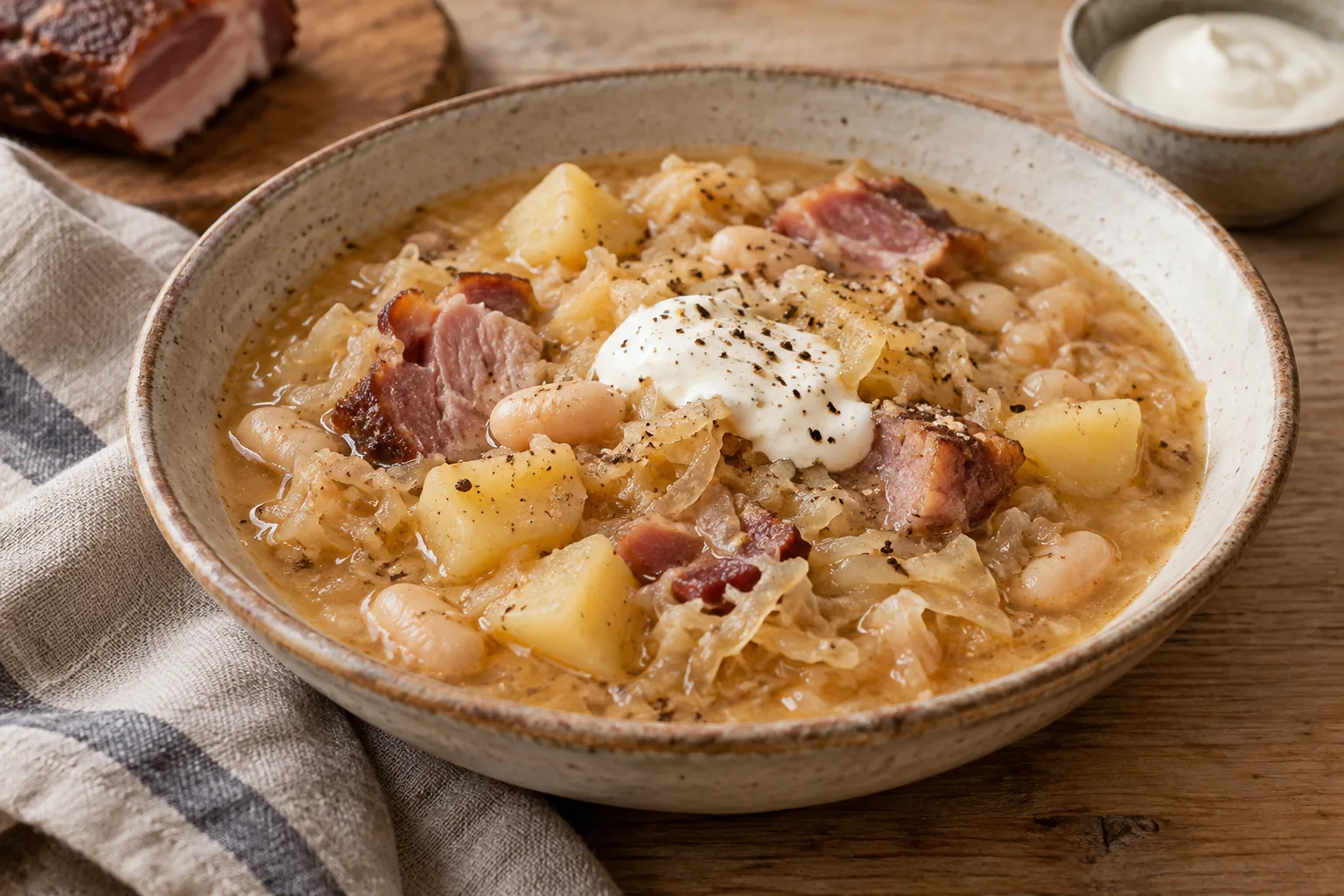
Grains and flour are central to many Slovenian preparations. Buckwheat becomes žganci, a firm, spoonable dish often paired with sour milk or a stew; wheat and other flours are used for noodles, dumplings, breads and rolled pastries. Barley, beans and vegetables come together in ričet, while potatoes appear in dishes as different as filled žlikrofi and the meat-and-potato stew bograč. Fermented cabbage and turnip give stews such as jota their characteristic tartness, alongside beans, potatoes and, in some versions, smoked meat.

The pantry changes with place. Alpine areas are noted for cheeses and other mountain dairy foods. Mediterranean and Karst cooking draws on fish, salt, olive oil and cured meats; the Pannonian setting is associated with pumpkin-seed oil, breads and other flour-based foods. Gardens, fields, orchards, forests and waters contribute to a broader seasonal larder, including mushrooms and wild plants. Honey is another valued ingredient, connected with Slovenia’s beekeeping tradition and its Carniolan grey bee. These products are not uniform national staples in every household: their importance and use depend on local availability and cooking customs.

Savoury depth, sour notes and contrasting textures

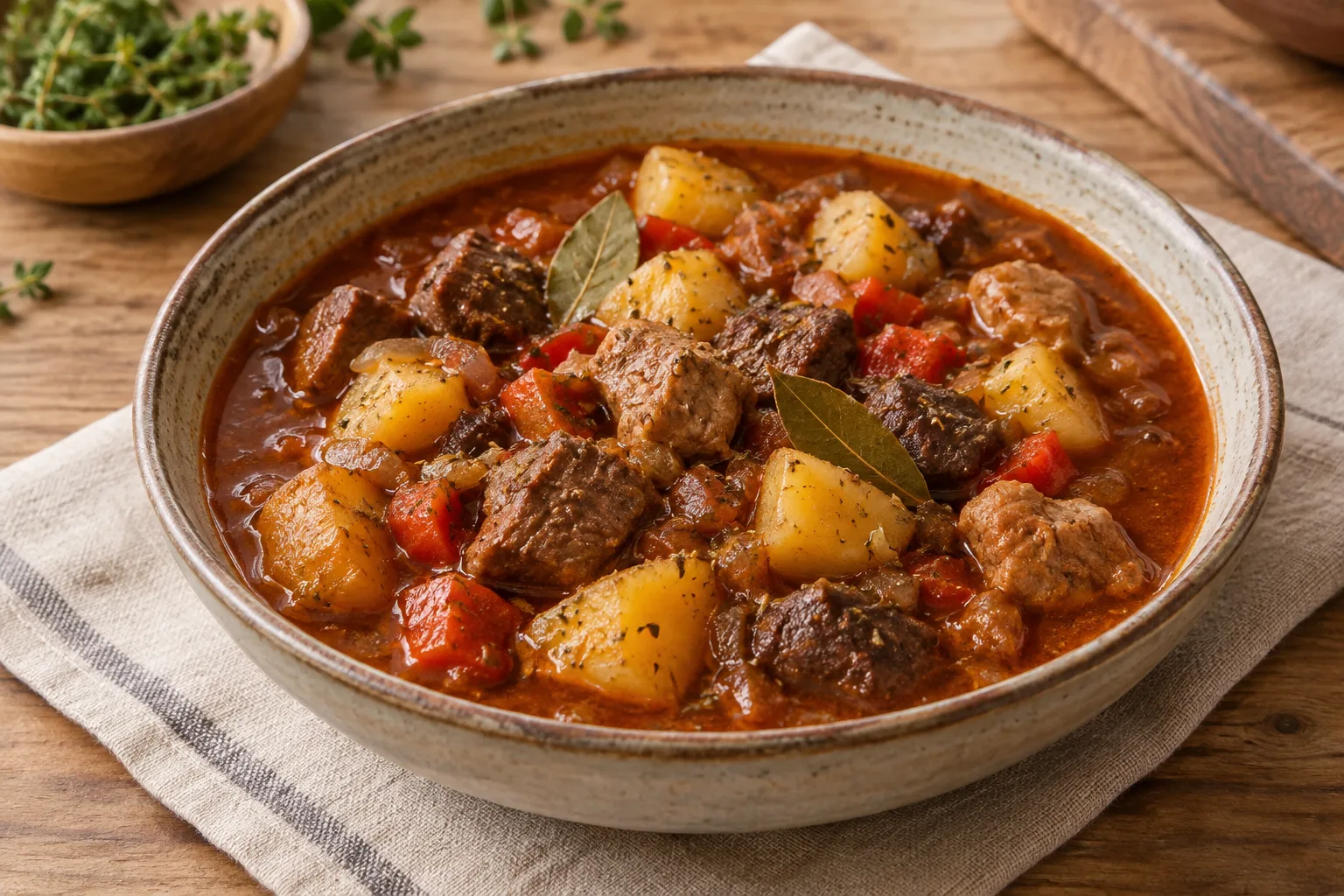
Many familiar Slovenian dishes balance hearty ingredients with a distinctive texture or tang. In bograč, onion, paprika, herbs, potatoes and several meats become a slow-cooked, substantial stew. Ričet combines barley, beans, vegetables and smoked meat; jota brings beans and potatoes together with sauerkraut or fermented turnip. The sourness of fermented vegetables offsets the weight of legumes and meat, while stews offer a soft, cohesive contrast to bread or other flour-based accompaniments.

Dough preparations create a different set of contrasts. Idrijski žlikrofi have a thin casing around potato, onion and herbs; their hand-shaped form contrasts with a soft filling. Štruklji are rolled around fillings that may be savoury or sweet, including curd cheese, walnuts, apples or spinach. In prekmurska gibanica, layers hold poppy seed, walnuts, apples and curd cheese, making a richer, more varied bite than a simple roll. Coastal fish, olive oil and cured meats offer another regional register. No single flavour profile defines the whole country: sour, smoky, nutty, dairy-rich and sweet notes belong to different preparations and settings.

Seasonal cooking and occasions for sharing

Food traditions connect household routines with the calendar. Potica, a yeast dough rolled around a filling, is associated with festive meals and family celebrations; walnut is a well-known filling, but it is not the only one. Some Slovenian accounts also describe prekmurska gibanica as a special-occasion cake, its many layers making it a more elaborate preparation than everyday fare. These associations vary among families and places rather than prescribing one identical celebration across the country.

Seasonality shapes other practices. Young dandelion leaves are gathered in spring and served as a salad; a home-style version may combine them with warm potatoes, egg and cracklings or bacon. In Slovenian Istria, small fried sweets called fritole or fritule are linked with the carnival season. A traditional Sunday lunch described around Ljubljana centres on beef soup, followed by the cooked meat and accompaniments such as vegetables and sautéed potatoes. Such meals place preparation and eating within family life. Community cooking also has a public form: large pots of bograč are prepared for gatherings and competitions in Prekmurje, making the simmering pot a focus for cooks and guests alike.

Shaping dough and tending the pot

Handwork is especially visible in Slovenia’s filled and rolled doughs. For idrijski žlikrofi, dough is rolled thin, small portions of potato filling are placed at intervals, and the dough is folded and sealed around them. Each piece is pressed into a characteristic hat-like shape before being boiled. The dumplings may be served with a meat sauce, gravy or cracklings. Štruklji use another approach: dough is spread thin, covered with a filling, then rolled; depending on the local preparation, the roll may be boiled, baked or fried. Potica is made from leavened dough rolled around a filling and baked, while gibanica is assembled in layers rather than formed as a roll.

Stews depend on patient cooking and attention to ingredients. Bograč is cooked in one pot, with its components added in a sequence that allows the meat and potatoes to become tender. Outdoor cooking in a large cauldron is associated with the dish, though a heavy pot can also be used. Jota brings cooked beans, potatoes and fermented vegetables together in a hearty soup or stew; regional versions, such as the Vipava preparation with turnip fermented in grape pomace, have their own particular methods. These are techniques tied to specific dishes, not universal rules for Slovenian cooking.

From family lunches to the shared cauldron

The structure of a meal depends on household and region. A Sunday lunch may begin with clear beef soup, with the meat from the broth served afterward alongside cooked vegetables and sautéed potatoes. In other settings, a filling stew such as bograč takes the central place as a one-pot meal. It is suited to outdoor preparation and gatherings where people share the food after it has cooked slowly. In Prekmurje, large cauldrons at communal gatherings and competitions give the cooking itself a social focus.

Filled doughs can shift roles at the table. Žlikrofi may be served as a main dish or a side, and štruklji can be savoury or sweet depending on their filling and preparation. The warm, salted and cumin-topped belokranjska pogača is described as a welcoming bread traditionally shared by breaking it into portions. On the coast, fish preparations reflect a different local larder from the meat, grain and dairy dishes found inland or in the mountains. Slovenia’s gostilna, a traditional inn with family and regional cooking, offers one setting for local dishes and wines. Across these occasions, serving customs follow the dish and the place rather than a single national table ritual.

A glossary of Slovenian dishes

These names point to particular preparations and the places or food traditions with which they are associated:

  • Bograč: A Prekmurje one-pot stew combining meat, potatoes, onion, paprika and herbs; some versions use several kinds of meat.
  • Idrijski žlikrofi: Small, hat-shaped dumplings filled chiefly with potato, onion and herbs, then boiled.
  • Jota: A substantial stew or soup combining beans and potatoes with fermented cabbage or turnip; ingredients vary by area.
  • Potica: Leavened dough rolled around a filling and baked, commonly associated with festive meals.
  • Prekmurska gibanica: A layered cake from Prekmurje with fillings that include poppy seed, walnuts, apples and curd cheese.
  • Ričet: A barley-based stew with beans, vegetables and smoked meat.
  • Žganci: A firm flour-based dish, often made with buckwheat and served with sour milk or stew.
  • Štruklji: Rolled dough preparations with sweet or savoury fillings, cooked in different ways according to the version.

One country, many cuisines

Prekmurje

In northeastern Slovenia, Prekmurje is associated with bograč, a one-pot stew of meat, potatoes, onion, paprika and herbs. Some versions combine beef, pork and game, with the ingredients cooked in stages. The region also gives its name to prekmurska gibanica, a layered cake filled with poppy seed, walnuts, apples and curd cheese. Large cauldrons of bograč are prepared for communal gatherings and competitions.

Idrija

The town of Idrija is known for idrijski žlikrofi, small dumplings filled principally with potato, onion and herbs. Their thin dough is folded and sealed around the filling, then pressed into a distinctive hat-like shape and boiled. They may be served as a main dish or accompaniment, with gravy, meat sauce or cracklings. The dumplings are associated with Idrija but are also eaten in households elsewhere in Slovenia.

Upper Carniola (Gorenjska)

Gorenjska is associated with buckwheat žganci, traditionally served with sour milk, as well as mountain cheeses and other flour-based foods. A festive preparation known as gorenjska prata or budl combines seasoned bread and meat, wrapped in pork caul and served hot or cold; it is often linked with Easter. These dishes show regional uses of grains, dairy and substantial foods without defining every household meal in the area.

Slovenian Istria

In Slovenian Istria, fritole—also called fritle or fritule—are small fried sweets associated with the carnival season. Some versions include raisins soaked in rum or pine nuts. The wider Slovenian coast is also associated with fish preparations such as marinated sardines, reflecting the Adriatic setting. These examples document particular coastal foods and occasions, rather than a uniform menu for every place along the shore.

Cook
Read as an article ↗
Places and communities

One country, many cuisines

An initial selection of regions to explore. Culinary boundaries may differ from administrative divisions.

Slovenia

Prekmurje

In northeastern Slovenia, Prekmurje is associated with *bograč*, a one-pot stew of meat, potatoes, onion, paprika and herbs. Some versions combine beef, pork and game, with the ingredients cooked in stages. The region also gives its name to *prekmurska gibanica*, a layered cake filled with poppy seed, walnuts, apples and curd cheese. Large cauldrons of bograč are prepared for communal gatherings and competitions.

Slovenia

Idrija

The town of Idrija is known for *idrijski žlikrofi*, small dumplings filled principally with potato, onion and herbs. Their thin dough is folded and sealed around the filling, then pressed into a distinctive hat-like shape and boiled. They may be served as a main dish or accompaniment, with gravy, meat sauce or cracklings. The dumplings are associated with Idrija but are also eaten in households elsewhere in Slovenia.

Slovenia

Upper Carniola (Gorenjska)

Gorenjska is associated with buckwheat *žganci*, traditionally served with sour milk, as well as mountain cheeses and other flour-based foods. A festive preparation known as *gorenjska prata* or *budl* combines seasoned bread and meat, wrapped in pork caul and served hot or cold; it is often linked with Easter. These dishes show regional uses of grains, dairy and substantial foods without defining every household meal in the area.

Slovenia

Slovenian Istria

In Slovenian Istria, *fritole*—also called *fritle* or *fritule*—are small fried sweets associated with the carnival season. Some versions include raisins soaked in rum or pine nuts. The wider Slovenian coast is also associated with fish preparations such as marinated sardines, reflecting the Adriatic setting. These examples document particular coastal foods and occasions, rather than a uniform menu for every place along the shore.

Cook
Recipes connected with Slovenia

Each recipe documents one version. Geographic associations do not imply an exclusive origin.

Slovenian Jota with Sauerkraut and Smoked Meat
Image generated by the Kitchenpause team
80 minIntermediate

Slovenian Jota with Sauerkraut and Smoked Meat

A Slovenian stew of sauerkraut, beans, potatoes, and smoked meat, thickened with an onion-and-flour sauté and finished with sour cream. Makes 4 servings; times are approximate, and the vegetables should be cooked until tender.

View recipe
Slovenian Bograč
Image generated by the Kitchenpause team
200 minIntermediate

Slovenian Bograč

A Slovenian stew of beef, venison and pork with potatoes, paprika and red wine. Serves 4; hands-on preparation is estimated at 20 minutes and cooking at 3 hours.

View recipe

Sources consulted

Read the sources and each document’s scope. A heritage inscription concerns a particular practice, not all of a country’s cuisine.

  1. Sundays with traditional Slovenian recipes - Idrijski žlikrofi | Slovenia.si slovenia.si/this-is-slovenia/sundays-with-traditional-slovenian-recipes slovenia.si Consulted: October 29, 2026
  2. Slovenia’s National Dish and Alpine-Adriatic Fusion | Remitly www.remitly.com/blog/en-au/food/national-dish-of-slovenia/ remitly.com Consulted: October 29, 2026
  3. Traditional Slovenian Food & Drink Guide | Inghams www.inghams.co.uk/summer-holidays/inspiration/insider-guides/traditional-slovenian-food inghams.co.uk Consulted: October 29, 2026
  4. Traditional Slovenian Food | Visit Ljubljana www.visitljubljana.com/sl/obiskovalci/aktualno/blog/traditional-slovenian-food visitljubljana.com Consulted: October 29, 2026
  5. Slovenian Kitchen sloveniankitchen.com/blogs/main-course-recipes sloveniankitchen.com Consulted: October 29, 2026
  6. Traditional Slovenian food: a cuisine permeated by the mountains and valleys - Barceló Experiences www.barcelo.com/guia-turismo/en/slovenia/ljubljana/things-to-do/typical-slovenian-food/ barcelo.com Consulted: October 29, 2026
  7. Slovenian Cuisine And Traditional Recipes - TRAVELSLOVENIA.ORG – All You Need To Know To Visit Slovenia travelslovenia.org/slovenian-cuisine-recipes/ travelslovenia.org Consulted: October 29, 2026
  8. Slovenian Meat Stew (Bograč) | Jernej Kitchen jernejkitchen.com/recipes/slovenian-meat-stew-bograc jernejkitchen.com Consulted: October 29, 2026
  9. Recetas eslovenas para chuparse los dedos | I feel Slovenia www.slovenia.info/es/historias/mi-manera-de-crear-siguiendo-las-recetas-locales slovenia.info Consulted: October 29, 2026
  10. Comida típica de Eslovenia: Postre tradicional – “potica” - Ekorna www.ekorna.net/comida-tipica-de-eslovenia-postre-tradicional-potica/ ekorna.net Consulted: October 29, 2026
  11. Bloomsbury Food Library - Bograč (Slovenia) doi.org/10.5040/9798216171638-0078 doi.org Consulted: October 29, 2026
  12. Slovenian Stew: Prekmurski Bograc foodforhunters.blogspot.com/2012/06/slovenian-stew-prekmurski-bograc.html foodforhunters.blogspot.com Consulted: October 29, 2026
  13. Traditional Bograč Recipe | Authentic Slovenian Food www.theworldonaplate.co.uk/recipes/bograc theworldonaplate.co.uk Consulted: October 29, 2026
  14. Real Prekmurje Bograč with Three Types of Meat | 28.7g protein · 30 min | Healthy recipe advancedu.co/us/recipes/real-prekmurje-bograc-with-three-types-of-meat advancedu.co Consulted: October 29, 2026
  15. Bograč Authentic Recipe | TasteAtlas www.tasteatlas.com/bograc/recipe tasteatlas.com Consulted: October 29, 2026
  16. Bograč - Slovenian goulash stew over open fire - MadGuru madguru.dk/opskrift/bogracs-golas-slovensk-gullashgryde-i-gryde/?lang=en madguru.dk Consulted: October 29, 2026
  17. Sundays with traditional Slovenian recipes - Bograč | Slovenia.si slovenia.si/this-is-slovenia/sundays-with-traditional-slovenian-recipes-bograc slovenia.si Consulted: October 29, 2026
  18. Vipava Jota with Turnip Fermented in Pomace | I feel Slovenia www.slovenia.info/en/places-to-go/regions/mediterranean-karst-slovenia/nova-gorica-and-the-v… slovenia.info Consulted: November 2, 2026
  19. Zdole mushroom soup I Krško I Slovenian Historical Towns www.zgodovinska-mesta.si/en/tastes-of-towns/mushroom-soup-from-zdole/ zgodovinska-mesta.si Consulted: November 2, 2026
  20. Idrijski žlikrofi (dumplings) with meat sauce | Slovensko podeželje | Združenje turističnih kmetij Slovenije www.farmstays-slovenia.si/gastronomy/recipe/idrijski-zlikrofi-z-mesno-omako farmstays-slovenia.si Consulted: November 2, 2026
  21. Mavželj - Wikipedia, la enciclopedia libre es.wikipedia.org/wiki/Mav%C5%BEelj es.wikipedia.org Consulted: November 2, 2026
  22. Inside the Kitchen: Chef Simo Komel at Grad Štanjel Restaurant & Lounge (Slovenia) guide.michelin.com/hr/en/article/dining-out/Inside%20the%20Kitchen%3A%20Chef%20Simo%20Komel%… guide.michelin.com Consulted: November 2, 2026
  23. Taste excellence · Taste Slovenia www.tasteslovenia.si/en/slovenian-gastronomy tasteslovenia.si Consulted: November 2, 2026
  24. Abundance of heavenly flavours | Vipava Valley | Official tourist web portal www.vipavskadolina.si/en/zgodbe/vino-in-kulinarika/razkosje-rajskih-okusov vipavskadolina.si Consulted: November 2, 2026
  25. The Many Tastes of Slovenia: A Culinary Journey - Nomago DMC www.nomago.si/en/dmc/blog/the-many-tastes-of-slovenia-a-culinary-journey nomago.si Consulted: November 2, 2026
  26. Culinary Štajerska | Urbanatural pleasure www.stajerska.si/en/culinary-stajerska stajerska.si Consulted: November 2, 2026

We use session and security technologies to provide our features. Only with your permission do we load Google Analytics to measure visits and Google Maps on Contact. Choose separately, reject or accept both.

Withdraw either permission here. Withdrawing analytics reloads the page to unload the running tag.

Cookie policy