- Category
- Herbs and spices
- State
- Other
- Usual unit
- g
What it is
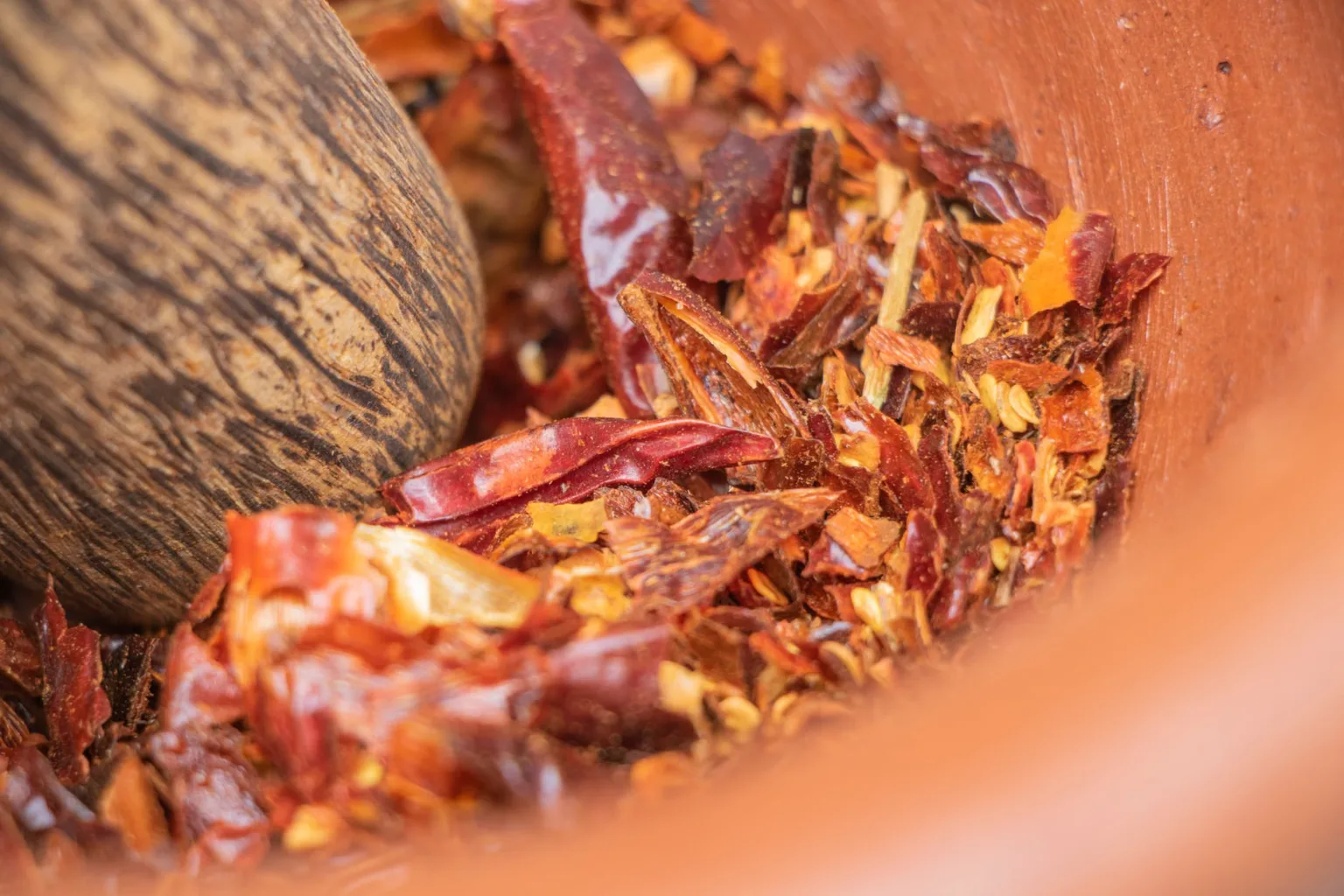
Crushed hot pepper is chilli broken into small pieces for use as a seasoning. The name does not identify a particular variety or establish whether the product is fresh or dried. Hot peppers belong to the Capsicum genus, which includes different types that vary in shape, colour and heat. Peppers may be used fresh or dried, as a seasoning or in sauces. As a result, the appearance and intensity of a particular product depend on its variety and form; check the packaging when those details matter.
When to use it
Use it when you want to add heat to a sauce or cooked dish, or when a recipe calls for a chilli seasoning. It can accompany fish dishes with lemon, as well as chicken or potatoes. Since the name does not specify the variety or its heat level, start with a small amount, mix and taste before adding more. If you need a particular flavour or texture, check the packaging to see what kind of pepper you have.
How to use it
Add a small amount to the dish and mix well so the heat is distributed. Taste before increasing the amount: heat can vary between pepper types and product forms. Stir it into a sauce or cooked preparation, or use it to season a dish. If a recipe calls for fresh chilli and you have pepper paste instead, remember that the texture and form differ; adjust gradually rather than assuming an exact quantity match. Check the package to identify the product form and follow its directions for use.
Flavour and texture
It adds heat, although the intensity depends on the pepper type. Crushed pepper consists of small pieces, but their size and texture depend on the product. The name alone does not establish whether it is fresh or dried.
How to choose it
Read the package description to check whether the product is dried, fresh or a chilli preparation, and look for a variety name if one is given. Peppers can differ in colour and heat; do not assume that two products labelled “hot” have the same intensity.
Storage
Product forms and storage directions can vary. Follow the label instructions and close the package between uses. Do not infer a storage duration or a specific temperature from the name “crushed hot pepper” alone.
Substitutions
Chopped fresh chilli or pepper paste can add heat to a dish, but they change its moisture or texture compared with crushed pepper. Add the alternative gradually and taste; there is no fixed quantity equivalence supported for every variety.
Common mistakes
Adding a large amount all at once can make a dish hotter than intended. Another mistake is assuming that all crushed hot peppers have the same variety, form or intensity. Start with a little, mix and taste before adjusting.
Safety and allergens
If you have a food allergy, check the ingredient list on packaged products and ask for available information about unpackaged foods. The composition of a particular commercial product cannot be established from its name alone.
Culinary uses
- Añadir picor como condimento
- Dar intensidad a salsas y guisos
Recommended techniques
- Incorporar como condimento seco o fresco, según la presentación
- Añadir a salsas o preparaciones cocinadas
Pairs well with
- Pescado y preparaciones con limón
- Pollo y patata
Frequently asked questions
Is crushed hot pepper always dried?
The name alone does not tell you. Check the packaging to see whether it is dried, fresh or a chilli preparation.
How much crushed hot pepper should I use?
Start with a small amount, mix and taste. Heat varies with the pepper type and the product.
Can I substitute pepper paste?
It can add heat, but its texture and moisture differ. Add it gradually and adjust to the dish rather than assuming an exact equivalent.
Ingredient allergens
Allergen listThere are no verified associations for these ingredients yet.
Estimated nutrition
- Fat
- 5.81 g
- Saturates
- 0.81 g
- Carbohydrate
- 69.9 g
- Sugars
- 41.1 g
- Fibre
- 28.7 g
- Protein
- 10.6 g
- Salt
- 0.23 g
Sources and review
Automatically researched, cross-checked and validated content. Sources consulted:
- Alérgenos alimentarios | EFSA www.efsa.europa.eu/es/safe2eat/food-allergens
- Client Challenge doi.org/10.2307/jj.27939689.16
- Etiquetado de sustancias que causan alergias e intolerancias alimentarias www.aesan.gob.es/seguridad-alimentaria/informacion-alimentaria/etiquetado-sustancias
- Ají - Wikipedia, la enciclopedia libre es.wikipedia.org/wiki/Aj%C3%AD
- ¿Qué es el ají? Usos y Recomendaciones ronda14.com/que-es-el-aji/
- El amaranto, propiedades, usos y aplicación en la gastronomía | OpenAlex openalex.org/W20082531
- Allergies - Food Safety - European Commission food.ec.europa.eu/food-safety/campaign-2026/allergies_en
- Food Allergies | FDA www.fda.gov/food/nutrition-food-labeling-and-critical-foods/food-allergies
- Food allergens | Food Safety and Quality | FAO www.fao.org/food-safety/scientific-advice/food-allergens/en
- RISK ASSESSMENT OF FOOD ALLERGENS - IRIS iris.who.int/server/api/core/bitstreams/6c71a3db-88b8-4fcd-a807-f5220eb4fc34/content
- Food allergen labelling and information requirements technical guidance - GOV.UK www.gov.uk/government/publications/food-allergen-labelling-and-information-requirements-tech…
- Food Production and Processing Considerations of Allergenic Food Ingredients: A Review - PMC pmc.ncbi.nlm.nih.gov/articles/PMC3236470/
- Ají, aprende más en Canal Cocina - Canal Cocina canalcocina.es/sabias-que/glosario/aji-1