- Category
- Vegetables
- State
- Fresh
- Usual unit
- mazorca
What it is
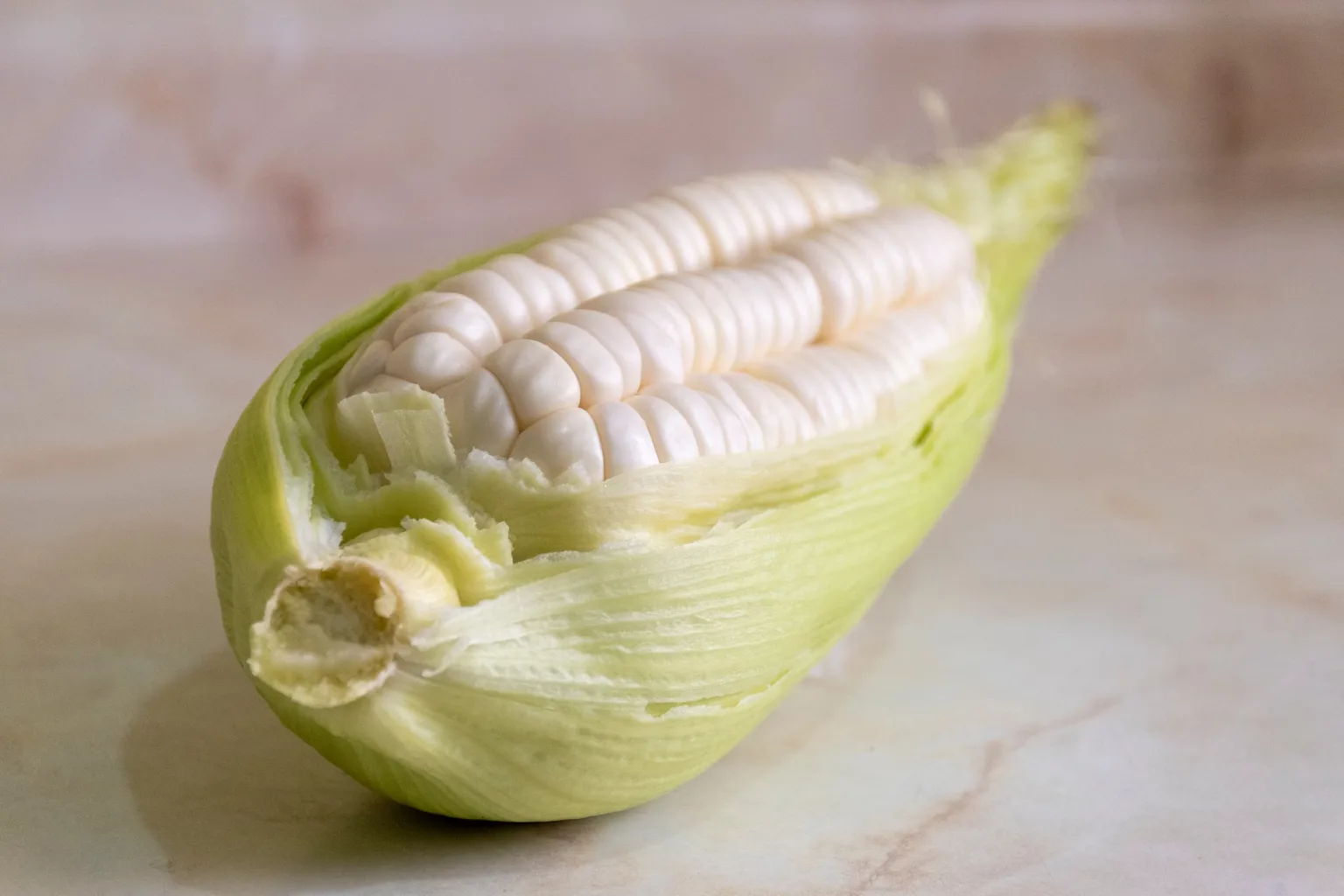
Fresh corn on the cob is an ear of maize with kernels that still retain moisture and have not fully dried. It can be served as a whole ear or stripped of its kernels for other dishes. The size, colour and texture vary among types of maize, so one ear may not look or taste as sweet as another. Fresh ears can be boiled or grilled, and their kernels can be used in dishes such as esquites, soups and breads. Regional names vary; the food may be called corn on the cob, fresh maize or, in some places, elote or choclo. This profile concerns fresh, tender corn, not dried maize or products made from cornmeal.
When to use it
Choose fresh corn when you want to serve a whole boiled or grilled ear, or need moist kernels for a dish. It can be used for esquites, soups and breads, and some preparations are sweet. Varieties differ in size, colour, sweetness and texture, so consider the result you want rather than assuming every ear behaves the same way. If a recipe calls for kernels, remove them before cooking; if serving whole, keep the ear intact during preparation. Harvest seasons vary by location and growing conditions, so availability is not the same everywhere.
How to use it
Remove the husk and silk before cooking if you want to serve a clean ear; if a preparation calls for cooking it with its husk, follow that method. For a simple serving, boil the ear whole or grill it over coals. You can also remove the tender kernels and use them in esquites, soups or breads. Taste and season when serving; chilli, lime, epazote and grated cheese are possible accompaniments. Butter or mayonnaise offer other topping options. Kernel size and texture differ among varieties, so observe how the particular ear cooks rather than assuming that every type needs the same time. Check allergen information for any added toppings or accompaniments.
Flavour and texture
Tender corn can taste sweet, with kernels that are soft, moist or juicy. Sweetness and texture vary by variety: some types are described as especially soft and sweet, while others have large or more floury kernels. Grilling or boiling also affects the result, and different varieties may not give the same texture.
How to choose it
Choose fresh ears that look intact and whose kernels retain the moisture associated with tender corn. If comparing several ears, remember that kernel size, colour and shape vary among varieties and do not by themselves establish uniform quality. Tender corn is not the same as a dried ear; for dishes that call for soft kernels, look for produce sold as fresh or tender.
Storage
The evidence available for this profile does not establish a specific storage period or conditions for fresh corn on the cob. If it is packaged, follow the directions on its label; if it is sold loose, ask the seller for handling guidance. Do not judge its condition from the outside alone or apply an unverified storage period to this ingredient.
Substitutions
There is no universal equivalence between a whole ear and other corn products. For a dish such as esquites, remove the kernels and use them; for soups or breads that call for tender corn, kernels can be used instead of serving the ear whole. Dried corn, cornmeal and fresh tender corn can produce different results, so they should not be treated as automatic substitutes.
Common mistakes
Do not confuse tender corn with dried maize: their moisture and texture differ and affect the result. Do not assume that every variety has the same size, sweetness or softness, or that all ears need identical cooking. If replacing a whole ear with kernels, adjust the recipe's presentation rather than treating the two forms as identical.
Safety and allergens
If you add toppings or accompaniments, check their ingredients and allergen information, especially when serving someone with an allergy or intolerance. Their composition can vary by product; do not infer the presence or absence of an allergen from a topping's general name.
Culinary uses
- Mazorca entera para servir como aperitivo o guarnición
- Granos tiernos para esquites, sopas, panes y preparaciones dulces
Recommended techniques
- Hervir la mazorca entera
- Asar la mazorca a la brasa
- Desgranar para añadir los granos a otras preparaciones
Pairs well with
- Chile y limón
- Epazote
- Queso rallado
- Mantequilla o mayonesa
Frequently asked questions
Is fresh corn on the cob the same as dried corn?
No. Fresh corn has kernels that still retain moisture; it is not a dried ear or cornmeal.
How can a fresh ear of corn be cooked?
Boil it whole or grill it over coals. You can also remove the kernels for esquites, soups or breads.
Do all tender ears have the same sweetness and texture?
No. Size, colour, sweetness and texture vary among types of maize, so consider the particular ear.
Ingredient allergens
Allergen listThere are no verified associations for these ingredients yet.
Sources and review
Automatically researched, cross-checked and validated content. Sources consulted:
- Alérgenos alimentarios | EFSA www.efsa.europa.eu/es/safe2eat/food-allergens
- Client Challenge doi.org/10.2307/jj.27939689.16
- ¿Representa el turismo culinario una oportunidad para valorizar el patrimonio agroalimentario? El caso del centro histórico de Quito | OpenAlex openalex.org/W3044886804
- Food Allergies | FDA www.fda.gov/food/nutrition-food-labeling-and-critical-foods/food-allergies
- Food allergens | Food Safety and Quality | FAO www.fao.org/food-safety/scientific-advice/food-allergens/en
- Food Allergy Labeling Laws: International Guidelines for Residents and Travelers - PMC pmc.ncbi.nlm.nih.gov/articles/PMC10169132/
- Food allergen portal | Food Standards Australia New Zealand www.foodstandards.gov.au/consumer/foodallergies/food-allergen-portal
- Etiquetado precautorio de alérgenos NO intencionados < Tecoal ® tecoal.net/seguridad-alimentaria/etiquetado-precautorio-alergenos-no-intencionados/
- Allergen guidance for food businesses - GOV.UK www.gov.uk/government/publications/allergen-guidance-for-food-businesses/allergen-guidance-f…
- Información alimentaria www.aesan.gob.es/seguridad-alimentaria/informacion-alimentaria
- Elote - Wikipedia, la enciclopedia libre es.wikipedia.org/wiki/Elote
- Elote, el alimento que crearon nuestros antepasados - México Desconocido www.mexicodesconocido.com.mx/elote.html
- - YouTube www.youtube.com/watch?v=4V-DbJnLJak
- Cinco elotes para disfrutar en esta temporada fundaciontortilla.org/Cocina/cinco_elotes_para_disfrutar_en_esta_temporada