- Category
- Dairy and eggs
- State
- Fresh
- Usual unit
- g
What it is
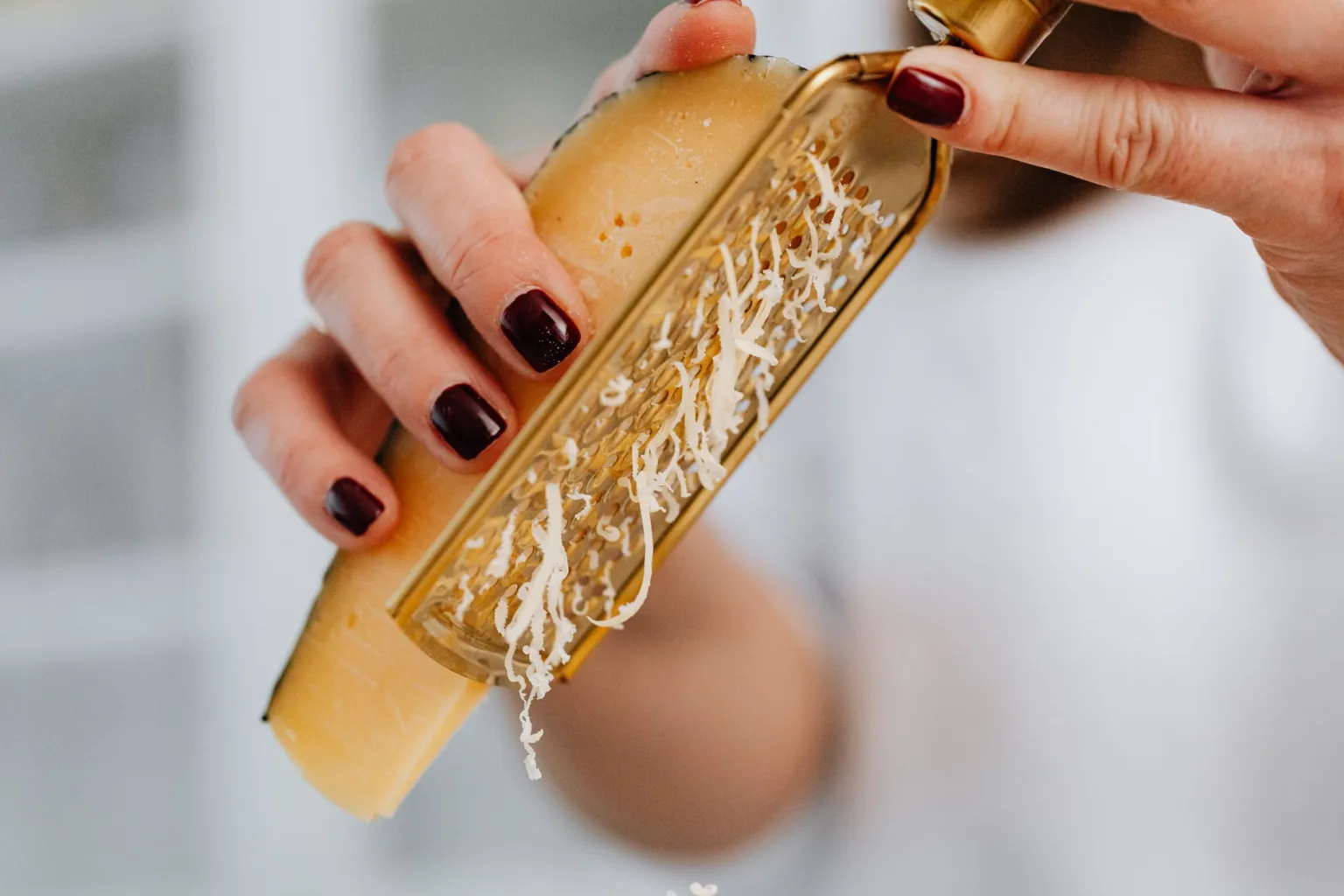
Caciocavallo is an Italian pasta-filata cheese, a style made by stretching and working the curd. It comes in different varieties and degrees of maturation, so products do not all have the same flavour or firmness. In grated form, it is convenient to distribute over dishes or add during cooking, especially pasta, pizza and other hot preparations. Some descriptions mention aged caciocavallo that can be grated, while others distinguish a milder, more delicate young cheese from one that develops a stronger flavour with age. The name alone does not establish the degree of maturation, the variety or the exact composition of a packaged grated product. Check the label for its ingredients, variety and the storage directions provided for that particular product.
When to use it
Use it when you want to scatter grated cheese over pasta, pizza or another dish, or add a cheese flavour to a hot preparation. Its profile may be more delicate when made from younger cheese and more pronounced, sometimes slightly piquant, when more mature. Bear this variation in mind when choosing it: a more mature cheese may stand out in a simple recipe, while a milder one can play a quieter role. Caciocavallo is also served on cheese boards and used in cooked dishes. The grated format makes it easy to add, but does not by itself tell you how it will melt or how strong it will taste.
How to use it
Start by checking the package: the variety, degree of maturation and manufacturer’s instructions can differ between products. Add the grated cheese to a dish or sprinkle it over pasta, pizza or another hot preparation. If you want it melted or browned, use it as a topping and watch how it behaves during cooking; melting and gratinating are described uses, but no universal cooking times or temperatures are established for every product. In a dish where the cheese is meant to stand out, remember that a more mature caciocavallo may taste stronger than a young one. If a recipe depends on a particular flavour profile, choose by the product description rather than the cheese name alone. Follow the package directions for storage after opening.
Flavour and texture
Young caciocavallo may taste delicate, while maturation can produce a more pronounced, slightly piquant flavour. It is described as a firm, semi-hard pasta-filata cheese; some more mature examples can be grated. Flavour, firmness and melting behaviour vary with the variety and degree of maturation, so products may differ.
How to choose it
Read the product name and ingredient list: caciocavallo includes different varieties and degrees of maturation. If you want a stronger flavour, look for information about maturity; for a gentler profile, choose a product described as young or mild. Also check the manufacturer’s directions for storage and use after opening.
Storage
The available information does not establish one shelf life or exact storage conditions for every grated caciocavallo product. Follow the package instructions, especially after opening, and observe the date given by the manufacturer. If the label is unclear, ask the seller or manufacturer rather than assuming that all formats keep in the same way.
Substitutions
Provolone may serve a similar role in some cooked dishes, but its flavour can be more pronounced. Oaxaca cheese has been suggested for a melted topping; it will not necessarily reproduce the character of aged caciocavallo. Choose according to the quality you need, such as melting or mature flavour, rather than assuming an exact replacement.
Common mistakes
Do not assume that every grated caciocavallo has the same flavour, maturity or behaviour when heated. Variety and ageing can change the result. Also, do not infer the ingredients of a commercial product from the cheese name alone: check its label, especially if you need to avoid a particular ingredient.
Safety and allergens
If you have a food allergy, check the ingredient list and allergen information for the specific product before eating it. This is particularly important for packaged grated cheese, whose composition may vary by brand and variety. Follow the storage instructions printed on the package.
Culinary uses
- Queso rallado para pasta y otros platos calientes
- Cobertura para fundir o gratinar
Recommended techniques
- Rallar y espolvorear sobre el plato
- Fundir o gratinar en una preparación caliente
Pairs well with
- Pasta
- Pizza
Frequently asked questions
Does grated caciocavallo always have a strong flavour?
No. Young caciocavallo may be more delicate, while maturation can make it stronger and slightly piquant. Check the product description.
How can I use grated caciocavallo?
Sprinkle it over pasta or pizza, or add it to hot dishes. Melting and gratinating are also described uses, though the result can vary by product.
How should I store grated caciocavallo?
Follow the package instructions, including directions for after opening. There is no single storage period established for every product format.
Ingredient allergens
Allergen listThere are no verified associations for these ingredients yet.
Sources and review
Automatically researched, cross-checked and validated content. Sources consulted:
- Alérgenos alimentarios | EFSA www.efsa.europa.eu/es/safe2eat/food-allergens
- Client Challenge doi.org/10.2307/jj.27939689.16
- Agencia Española de Seguridad Alimentaria y Nutrición www.aesan.gob.es/
- Eurial Ibérica Tipos de queso: variedades, sabores y usos profesionales eurial.es/tipos-de-quesos-2/
- La cocina fusión: antecedentes y nuevas propuestas en 8 recetas aplicada en la cocina Italiano-Ecuatoriano | OpenAlex openalex.org/W84058138
- Etiquetado precautorio de alérgenos NO intencionados < Tecoal ® tecoal.net/seguridad-alimentaria/etiquetado-precautorio-alergenos-no-intencionados/
- Caciocavallo - Wikipedia, la enciclopedia libre es.wikipedia.org/wiki/Caciocavallo
- Vesuvio vesuvio.mx/blog/caciocavallo-un-queso-con-historia
- Caciocavallo: 10 Curiosidades Maravillosas en Madrid y León pagus.restaurant/10-curiosidades-del-caciocavallo-y-pruebalo/
- Caciocavallo Silano - Mundoquesos www.mundoquesos.com/caciocavallo-silano/
- Queso 'caciocavallo, ¿un queso de leche de caballo? www.hola.com/cocina/noticias/20250131810836/queso-caciocavallo-que-es/
- Caciocavallo, quesillo típico del sur de Italia. www.spaghettiemandolino.it/es/blog/557-caciocavallo-formaggio-stagionato-pasta-filata-vaccin…
- Caciocavallo: Un queso presente en las sierras de Córdoba - itCórdoba cordoba.italiani.it/caciocavallo-un-queso-presente-en-las-sierras-de-cordoba/
- Caciocavallo (queso italiano) es.gastronomiac.com/cpt_productos_ingre/caciocavallo-queso-italiano/
- Cachocavalo, ¿cómo es esta delicia italiana? | Alquería www.alqueria.com.co/blog-nutricion-bienestar/queso-cachocavalo
- Caciocavallo Silano: sabor, textura y origen | Cheesepedia www.cheesepedia.app/es/queso/caciocavallo-silano/
- Caciocavallo joven o curado: cocinar con Oaxaca mercamx.es/caciocavallo-joven-curado-oaxaca/