- Category
- Vegetables
- State
- Fresh
- Usual unit
- head
What it is
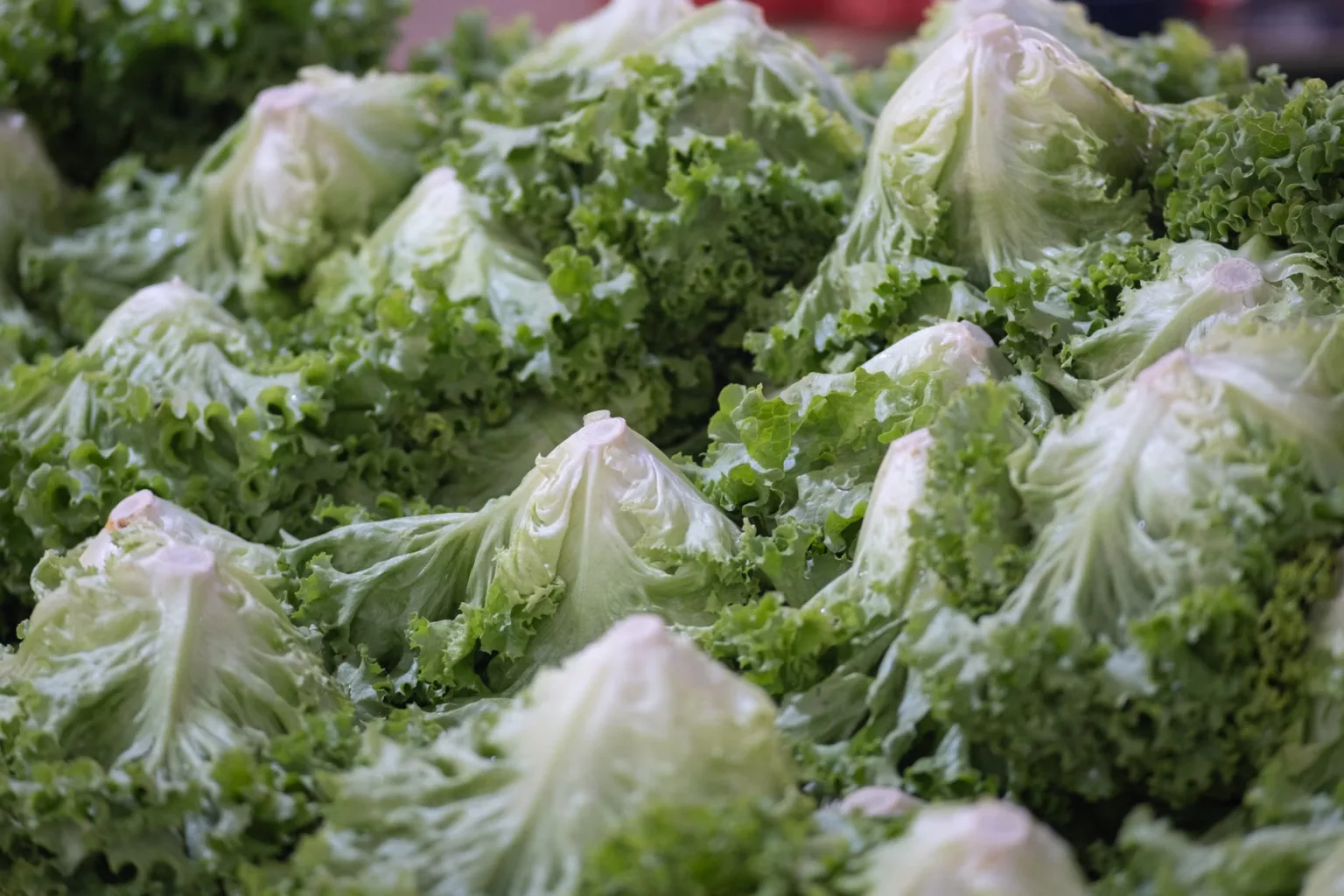
Iceberg lettuce is a variety of lettuce that forms a round, tightly packed head of overlapping leaves, with the inner leaves usually paler than the outer ones. It is valued chiefly for its firm, crisp texture and mild, watery flavor, which tends not to compete with other ingredients. This combination makes it useful when a dish needs fresh volume and crunch. Slice it for salads, or keep the leaves whole to hold fillings, wrap them, or add a crisp layer to burgers, sandwiches and tacos. It does not behave exactly like softer lettuce varieties: its defining culinary feature is the way its firm leaves provide a pronounced crunch.
When to use it
Choose iceberg lettuce when you want a distinct crunch and a restrained, mild flavor, especially in dishes with fillings or sauces that might soften more delicate leaves. It works well in simple salads, burgers, sandwiches and tacos, adding freshness without masking the filling. Whole leaves can also wrap ingredients or hold them like small cups. If you want the leaves themselves to contribute a stronger flavor or a tender texture, another variety may be a better fit; iceberg is particularly useful for its firmness and mild character.
How to use it
Remove any outer leaves that are damaged and separate the leaves you need. For a salad, slice the head into strips or pieces and combine it with your chosen ingredients and dressing. For burgers and sandwiches, add a whole leaf or a cut portion alongside the filling for a fresh, crisp layer. Whole leaves can be used as wrappers or as supports for fillings in tacos and wraps. You can also serve chopped iceberg as a salad base or side. Its mild flavor pairs readily with more assertive ingredients and creamy additions. If you cut it ahead, avoid leaving it mixed with dressing for a long time when you want to preserve its crisp bite at serving.
Flavour and texture
The flavor is usually mild, fresh and watery, with little bitterness. Its leaves are firm and crisp, and the center of the head is generally paler. That structure makes iceberg useful in filled dishes and with sauces, where a more delicate leaf might quickly lose its distinct bite.
How to choose it
Look for a compact, firm head with outer leaves held close rather than loose or limp. The color can range from light green outside to paler shades inside. Do not judge it by size alone: choose a head that feels intact and whose leaves are not separating. Differences in color reflect the position of the leaves within the head.
Storage
Keep the lettuce whole and uncut until you are ready to use it to help preserve its crisp structure. Protect the head and avoid crushing it, as the tightly packed leaves can be damaged by pressure. If it has already been cut, keep it covered and use it soon; the available evidence does not establish a specific storage period for every form or refrigerator.
Substitutions
Romaine can stand in when you want a firm leaf with a more noticeable lettuce flavor; batavia is another option with more body. Neither reproduces iceberg’s exact combination of mild flavor and crunch. Choose according to the dish, and adjust the cut or use whole leaves if you need to hold a filling.
Common mistakes
Do not expect iceberg lettuce to provide a strong flavor: its character is notably mild. Nor should you assume that softer lettuce will support fillings or stay as crisp, or that every alternative has the same crunch. To retain its crisp quality, add dressing close to serving time.
Safety and allergens
If you have a food allergy, check allergen information on packaged foods and ask about the ingredients in prepared dishes. The composition of other ingredients or sauces served with lettuce can vary.
Culinary uses
- Crisp, mild base for salads
- Fresh, crunchy layer or leaf wrapper for sandwiches, burgers, tacos and filled wraps
Recommended techniques
- Separate the leaves and use them whole as wrappers or sturdy serving cups
- Slice or shred the leaves for salads, sandwiches, burgers and tacos
Pairs well with
- Goat cheese
- Avocado
- Salmon
- Sandwich and taco fillings
Frequently asked questions
What does iceberg lettuce taste like?
It has a mild, fresh flavor that is usually not very bitter. Its crisp texture is more prominent than an intense lettuce flavor.
How can I use iceberg lettuce?
Slice it for salads or use whole leaves in burgers, sandwiches, tacos and wraps. The leaves can also hold fillings.
What can I use instead?
Romaine or batavia may work, depending on the dish, but neither has exactly the same flavor and texture. Romaine is generally more pronounced, and the crunch will differ.
Ingredient allergens
Allergen listThere are no verified associations for these ingredients yet.
Estimated nutrition
- Fat
- 0.14 g
- Saturates
- 0.02 g
- Carbohydrate
- 2.97 g
- Sugars
- 1.97 g
- Fibre
- 1.2 g
- Protein
- 0.9 g
- Salt
- 0.02 g
Sources and review
Automatically researched, cross-checked and validated content. Sources consulted:
- Alérgenos alimentarios | EFSA www.efsa.europa.eu/es/safe2eat/food-allergens
- Client Challenge doi.org/10.2307/jj.27939689.16
- Etiquetado de sustancias que causan alergias e intolerancias alimentarias www.aesan.gob.es/seguridad-alimentaria/informacion-alimentaria/etiquetado-sustancias
- Guía práctica de lechugas: historia, tipos y cómo elegir la mejor para cada plato | Gastronomía & Cía www.gastronomiaycia.com/guia-practica-de-lechugas-historia-tipos-y-como-elegir-la-mejor-para…
- - YouTube www.youtube.com/watch?v=KCoVpUIIv4U
- Food Allergies | FDA www.fda.gov/food/nutrition-food-labeling-and-critical-foods/food-allergies
- Food allergen labelling and information requirements technical guidance - GOV.UK www.gov.uk/government/publications/food-allergen-labelling-and-information-requirements-tech…
- Allergen labelling for consumers | Food Standards Australia New Zealand www.foodstandards.gov.au/consumer/labelling/allergen-labelling
- Lechuga iceberg - Florette www.florette.es/ingredientes/lechuga-iceberg/
- Descubre los beneficios de la lechuga iceberg - Peregrín peregrin.es/lechuga-iceberg-2/
- Tipos de lechugas y sus beneficios infowod.com/tipos-de-lechuga-y-sus-beneficios/
- Deficiente, pero irreemplazable: cómo la lechuga iceberg conquistó el mundo www.directoalpaladar.com/ingredientes-y-alimentos/deficiente-irreemplazable-como-lechuga-ice…
- Tipos de lechugas, características y variedades 1ªParte | Burruezo cocinaconburruezo.es/tipos-de-lechugas-caracteristicas-variedades/
- Lechuga Iceberg: cultivo, riego y cosecha en 60 días plotmygarden.com/es/plants/lettuce-iceberg
- Seis tipos de lechugas que poner a tus platos | Sol de Levante www.soldelevante.com/seis-tipos-de-lechugas-que-poner-a-tus-platos/
- Evaluación del método de ultrasonido sobre la influencia en el recuento de Escherichia coli y características sensoriales objetivas en lechuga crespa (Lactuca sativa L.) mínimamente procesada | OpenAlex openalex.org/W2921689525
- Escarola vs lechuga: diferencias de sabor, textura y usos - El Mercado de Origen www.elmercadodeorigen.com/escarola-vs-lechuga-diferencias-sabor-textura-usos/