- Category
- Vegetables
- State
- Preserved
- Usual unit
- g
What it is
Kimchi is a preparation of seasoned, fermented vegetables. Cabbage is a common base, though versions made with other vegetables also exist; recipes can include many different seasonings and additional ingredients. In this profile, “kimchi with its juice” means the product together with its accompanying liquid, not a sauce with one fixed composition. Flavor, heat, saltiness, texture and ingredients depend on the variety and how it was made. Some recipes include fermented fish or seafood, while others do not. Check the ingredient list for the specific product rather than assuming that all kimchi is made the same way.
When to use it
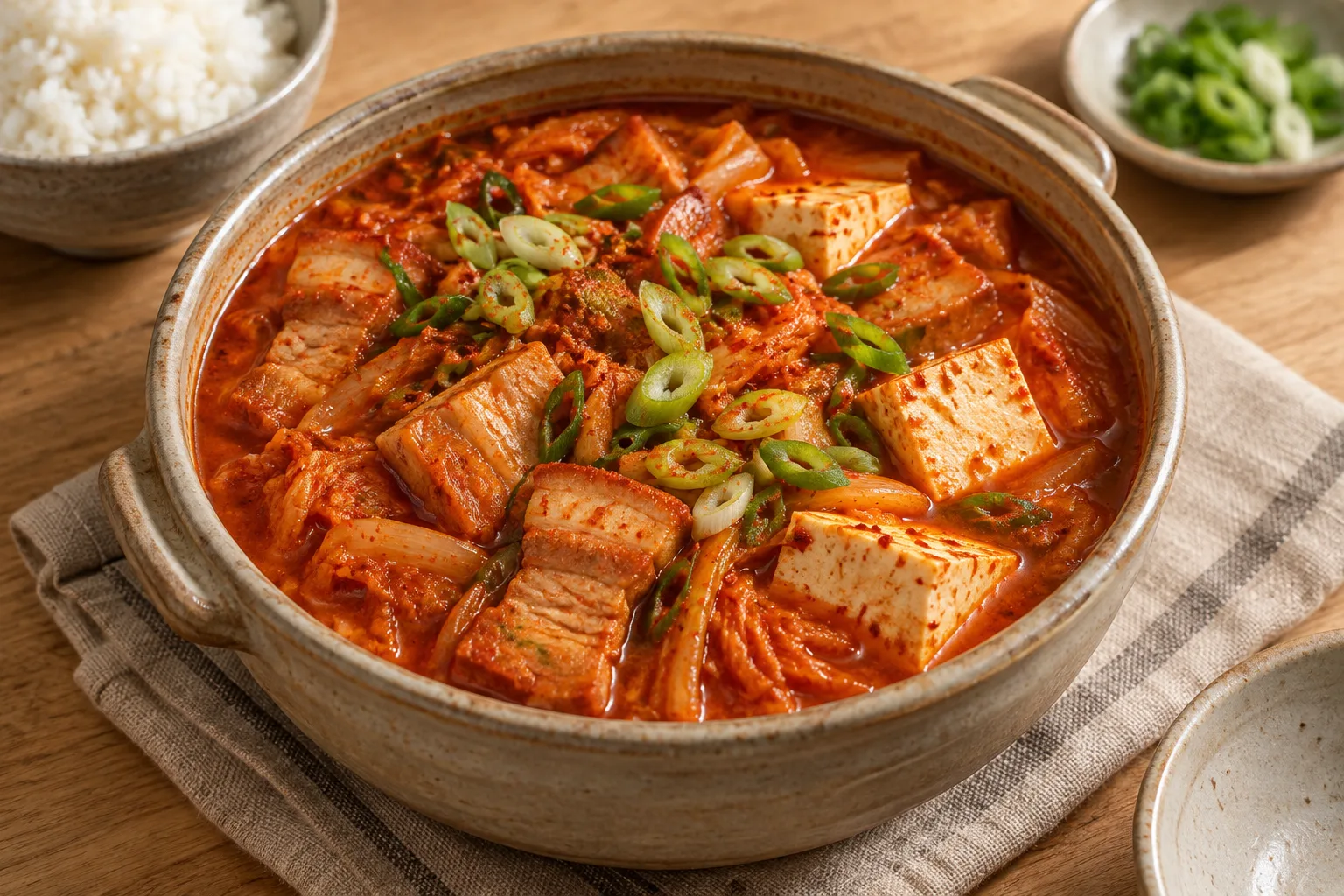
Use it when you want to add fermented, tangy, spicy or savory notes to a meal, bearing in mind that intensity varies between products. It can be served as a side and added to soups, stews, fried rice or noodles. If you want the vegetables to keep more of their texture, add them near the end or serve them separately; to spread their flavor through a dish, chop them and mix in a little juice as well. Taste before adding more salt or seasoning: kimchi may already be salty and strongly flavored.
How to use it
Stir the contents of the container to distribute the vegetables and juice, then taste a small amount before deciding how much to use. Serve it as a side, or drain it lightly if you do not want to add much liquid to a dish. For fried rice, noodles, soups or stews, chop it if you want it evenly distributed; add the vegetables first and adjust the juice gradually to control acidity, heat and moisture. It pairs well with milder foods such as rice, tofu or potatoes. For a firmer texture or fresher flavor, use it as a finishing touch or serve it separately rather than cooking it for a long time.
Flavour and texture
Its profile can combine acidity, heat, saltiness and savory notes, but it varies with the vegetables, seasonings and fermentation process. The vegetables may retain some firmness or become softer; the juice adds flavor and moisture. Do not assume every variety has the same heat level or ingredients.
How to choose it
Read the ingredient list and package information: recipes vary, and some include fish sauce or fish or seafood ingredients. Check the heat level and product format too. If you have a particular texture in mind, notice whether the pieces are whole or chopped and choose a variety suited to how you plan to use it.
Storage
Follow the storage directions on the product label. For homemade kimchi, after the initial fermentation stage, a university extension guide advises keeping it refrigerated at 5 °C or below. Discard kimchi if mold appears, it develops an odor unlike its usual fermented aroma, or its texture becomes unusual.
Substitutions
Another kimchi can serve a similar purpose, but a cabbage, radish or other vegetable variety will change the texture and flavor. A milder kimchi may reduce the heat, but not necessarily the acidity or saltiness. Adjust the amount and taste as you go; these choices are not exact equivalents.
Common mistakes
Adding all the juice without tasting can make a dish too acidic, salty or wet. It is also easy to assume that kimchi always contains the same ingredients or has the same heat level. Start with a small amount, check the label and adjust at the end.
Safety and allergens
Follow the package directions. For homemade kimchi, refrigerate it after the initial fermentation stage and discard it if it shows mold, an unpleasant odor unlike its usual fermented aroma, or an unusual texture.
Culinary uses
- Acompañamiento listo para servir
- Condimento ácido, picante y sabroso para platos cocinados
Recommended techniques
- Servir escurrido o con un poco de su jugo
- Picar y añadir a guisos, sopas, arroz salteado o fideos
Pairs well with
- Arroz
- Tofu
- Patatas
- Platos salteados y fideos
Frequently asked questions
What can I do with kimchi juice?
It adds flavor and moisture. Add it gradually to soups, rice or stir-fries, or drain the kimchi if you want to limit liquid in the dish.
Is all kimchi spicy?
Not necessarily. Heat depends on the recipe; check the package and taste a small amount first.
Does kimchi always contain fish?
No. Some recipes include fish sauce, fish or seafood ingredients, and others do not. Check the ingredient list for the specific product.
Ingredient allergens
Allergen listThere are no verified associations for these ingredients yet.
Sources and review
Automatically researched, cross-checked and validated content. Sources consulted:
- Client Challenge doi.org/10.2307/jj.27939689.16
- Agencia Española de Seguridad Alimentaria y Nutrición www.aesan.gob.es/
- Desde la raíz. Cocina singular: creaciones a base de zanahorias de la agrobiodiversidad presente en el Oriente antioqueño | OpenAlex openalex.org/W7143360630
- Homemade Kimchi: A Science-Based Guide to Safe Fermentation | CAES Field Report fieldreport.caes.uga.edu/publications/C1362/homemade-kimchi-a-science-based-guide-to-safe-fe…
- Kimchi - Wikipedia, la enciclopedia libre es.wikipedia.org/wiki/Kimchi
- El kimchi de forma sencilla: origen, sabor y efectos | FreshMAG de Liebherr www.liebherr.com/es-es/refrigeradores-congeladores/freshmag/ideas-de-refrigeraci%C3%B3n/kimc…
- CODEX STANDARD FOR KIMCHI www.fao.org/input/download/standards/365/CXS_223e.pdf
- Día mundial del Kimchi | CocinaSinReceta.com www.cocinasinreceta.com/tecnicas/dia-mundial-del-kimchi/
- - YouTube www.youtube.com/watch?v=wXkp_NXB7QE
- Todo sobre el Kimchi: Beneficios, Recetas y Curiosidades... www.cocinista.es/web/es/enciclopedia-cocinista/ingredientes-del-mundo/kimchi.html
- La preparación tradicional del ''kimchi'' en la República Popular Democrática de Corea - UNESCO Patrimonio cultural inmaterial ich.unesco.org/es/RL/la-preparacion-tradicional-del-kimchi-en-la-republica-popular-democrati…
- Qué es el kimchi: ingredientes, sabor y cómo se hace – PrimarioEd primarioed.com/blogs/materia-prima/100-kilos-de-kimchi-en-familia?srsltid=AYCX9vK9VsohpSnHsH…
- Kimchi casero - Danza de Fogones danzadefogones.com/kimchi/
- Mi variación del Kimchi | alimento y conciencia alimentoyconciencia.com/mi-variacion-del-kimchi/