- Category
- Dairy and eggs
- State
- Fresh
- Usual unit
- g
What it is
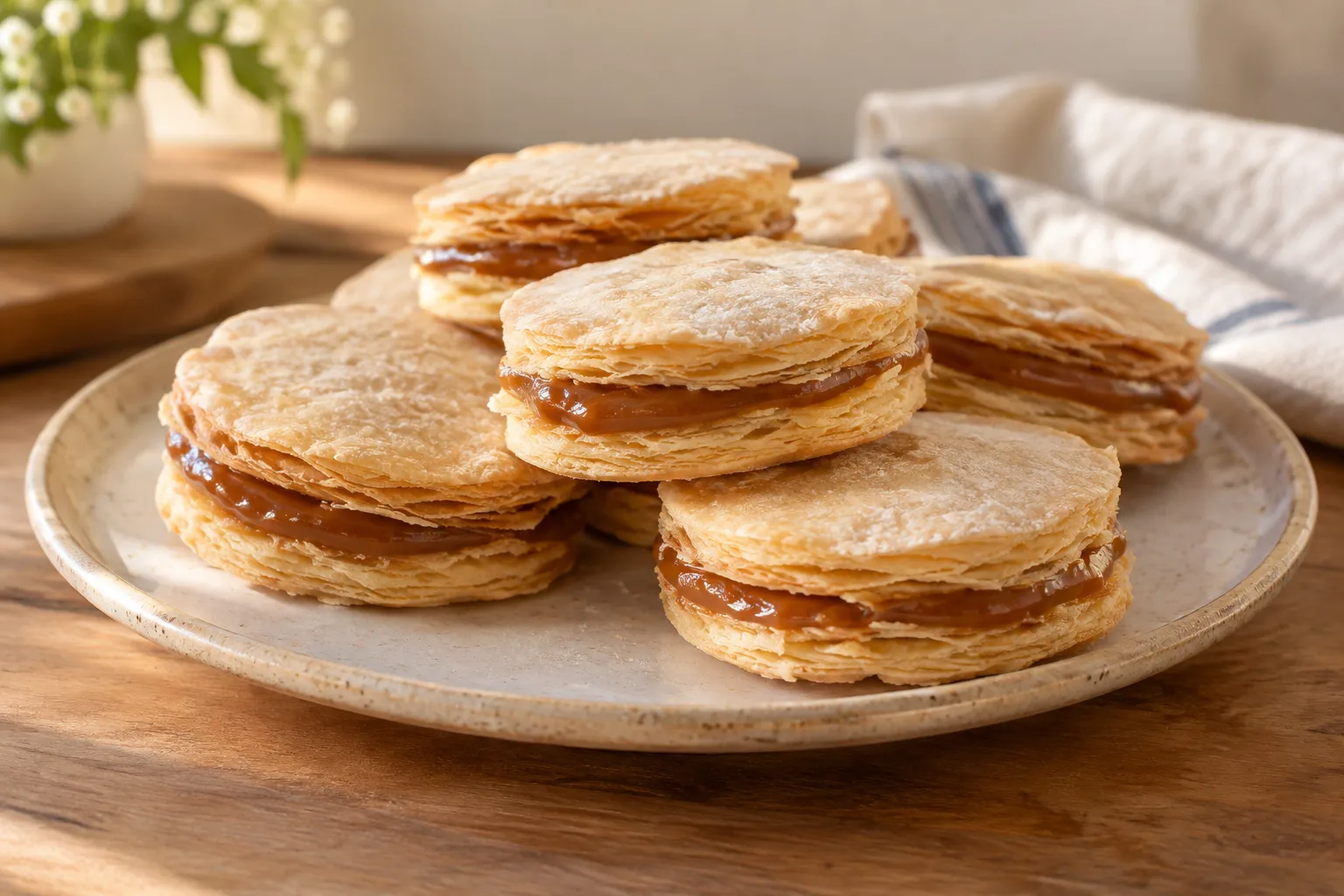
Here, manjar refers to milk caramel, also called dulce de leche in some regions. It is distinct from other preparations called manjar blanco: the name does not always identify the same food. A preparation described as dulce de leche is made with milk and sugar and may be cooked for a prolonged time while being stirred. Commercial products can be presented in different ways; check the product name and ingredient list to confirm what you have. This guide does not assume a single recipe or identical formulation and texture everywhere.
When to use it
Use it when a recipe specifically calls for manjar in the sense of milk caramel or dulce de leche. It can be used in sweet preparations and served as a dessert; some manjar preparations are eaten chilled. Because the name manjar is also used for other desserts, especially cream-like preparations, confirm which product the recipe means before you begin. If the recipe needs a particular consistency, check the product you have and follow the recipe’s directions rather than assuming that every brand behaves the same way.
How to use it
Before cooking or serving, read the product name and ingredient list to confirm that it is milk caramel. Use it in the sweet preparation specified by your recipe, keeping in mind that consistency can vary between products. A homemade preparation described as dulce de leche uses milk and sugar and is cooked while being stirred; prolonged cooking and cooling are also described for homemade manjar preparations. These are descriptions of preparations, not universal timings for every product. For a packaged product, follow its label and your recipe, and do not assume it needs further cooking or can replace every cream.
Flavour and texture
Manjar understood as milk caramel is sweet, with a milky, caramelized character. Preparations described as dulce de leche are cooked to a creamy consistency; the exact thickness depends on the preparation and the product. Do not confuse this description with regional manjar blanco cream, which may have different ingredients and texture. Check the actual product’s appearance and consistency before adding it to a recipe.
How to choose it
Look for a clear product name such as milk caramel or dulce de leche, because manjar can refer to different preparations. Read the ingredient list and allergen information; the homemade milk-caramel preparation described uses milk, while other product details depend on the individual item. Also check that the packaging is intact and consult its use and storage instructions.
Storage
There is no single storage life established here for every form of manjar. Follow the directions on the specific product, especially after opening, and use any refrigeration or use-by guidance given on the label. Keep the product in its packaging or a suitable container as directed. If reliable storage information is unavailable for a particular presentation, do not guess a time limit or temperature.
Substitutions
Dulce de leche can be an equivalent name when manjar is used regionally for the same milk-caramel product. Check the label before substituting: manjar can also name different desserts, such as a thickened cream. Texture and composition can vary, so an exact replacement cannot be assumed in every recipe.
Common mistakes
A common mistake is treating manjar as a universal name for one product. Depending on regional context, it can mean milk caramel or a different manjar blanco preparation. Check the full product name and ingredients before using it. Also avoid assuming cooking times, consistency, or storage conditions that are not specified for the product in hand.
Safety and allergens
The homemade preparation described as milk caramel uses milk. If you have an allergy, check the product’s ingredient list and allergen information; composition can vary between products. Follow the manufacturer’s storage directions.
Culinary uses
- Dessert ingredient
- Chilled sweet dessert
Recommended techniques
- Slow cooking while stirring for a homemade preparation
- Cooling before serving
Pairs well with
- Other sweet preparations
- Chilled desserts
Frequently asked questions
Are manjar and dulce de leche always the same?
No. In some places manjar means dulce de leche or milk caramel; elsewhere, manjar blanco can be a different cream dessert. Check the name and ingredients.
What ingredients are used in milk-caramel manjar?
The preparation described as dulce de leche uses milk and sugar. Commercial products may vary, so check the ingredient list on the package.
How should I store manjar?
Follow the directions on the specific product’s packaging. No single storage time or temperature applies to every presentation.
Ingredient allergens
Allergen listThere are no verified associations for these ingredients yet.
Estimated nutrition
- Fat
- 20.9 g
- Saturates
- 14.5 g
- Carbohydrate
- 68 g
- Sugars
- 63.9 g
- Fibre
- 0.9 g
- Protein
- 5.08 g
- Salt
- 0.47 g
Sources and review
Automatically researched, cross-checked and validated content. Sources consulted:
- Alérgenos alimentarios | EFSA www.efsa.europa.eu/es/safe2eat/food-allergens
- Client Challenge doi.org/10.2307/jj.27939689.16
- Agencia Española de Seguridad Alimentaria y Nutrición www.aesan.gob.es/
- Evolución del léxico culinario desde 1932 a 1972 | OpenAlex openalex.org/W2291578502
- Food Allergies | FDA www.fda.gov/food/nutrition-food-labeling-and-critical-foods/food-allergies
- Food allergens | Food Safety and Quality | FAO www.fao.org/food-safety/scientific-advice/food-allergens/en
- Allergen labelling for food businesses | Food Standards Australia New Zealand www.foodstandards.gov.au/business/labelling/allergen-labelling
- Allergen guidance for food businesses - GOV.UK www.gov.uk/government/publications/allergen-guidance-for-food-businesses/allergen-guidance-f…
- Allergen labelling for consumers | Food Standards Australia New Zealand www.foodstandards.gov.au/consumer/labelling/allergen-labelling
- Impact of Food Allergies on the Food Safety and Life Quality of Adults in Spain - PMC pmc.ncbi.nlm.nih.gov/articles/PMC11940975/
- Manjar blanco - Wikipedia, la enciclopedia libre es.wikipedia.org/wiki/Manjar_blanco
- El Manjar Blanco y su Larga Historia – Le-Fort le-fort.org/cocina/el-manjar-blanco-y-su-larga-historia/
- Adopta un postre: manjar blanco | Recetas | Gastronomía | EL PAÍS elpais.com/gastronomia/recetas/2015/09/18/receta/1442585954_268348.html
- RECETAS CON HISTORIA E HISTORIA DE LA GASTRONOMíA: Manjar Blanco historiasdelagastronomia.blogspot.com/2006/09/manjar-blanco.html
- - YouTube www.youtube.com/watch?v=3AlXJ4qbnL0
- EL MANJAR BLANCO EN LA ACTUALIDAD, PORTADOR DE UNA LARGA HISTORIA | Mi Europa SABE a Mediterráneo mieuropasabeamediterraneo.com/el-manjar-blanco-en-la-actualidad-portador-de-una-larga-histor…
- Manjar blanco – Mis Memorias de Cocina memoriasdecocina.wordpress.com/2015/02/24/manjar-blanco-3/
- - YouTube www.youtube.com/watch?v=8o65ZcAX1g4
- Manjar blanco, un postre con historia - Cocinando Entre Olivos cocinandoentreolivos.com/2021/05/manjar-blanco-receta.html
- El olvidado manjar blanco – El Cuaderno elcuadernodigital.com/2019/08/09/el-olvidado-manjar-blanco/
- ¿Cómo modificar la textura de los alimentos? - FMC. Formación Médica Continuada en Atención Primaria fmc.es/es-como-modificar-textura-alimentos-articulo-S1134207219302324