- Category
- Grains, flour and pasta
- State
- Other
- Usual unit
- kg
What it is
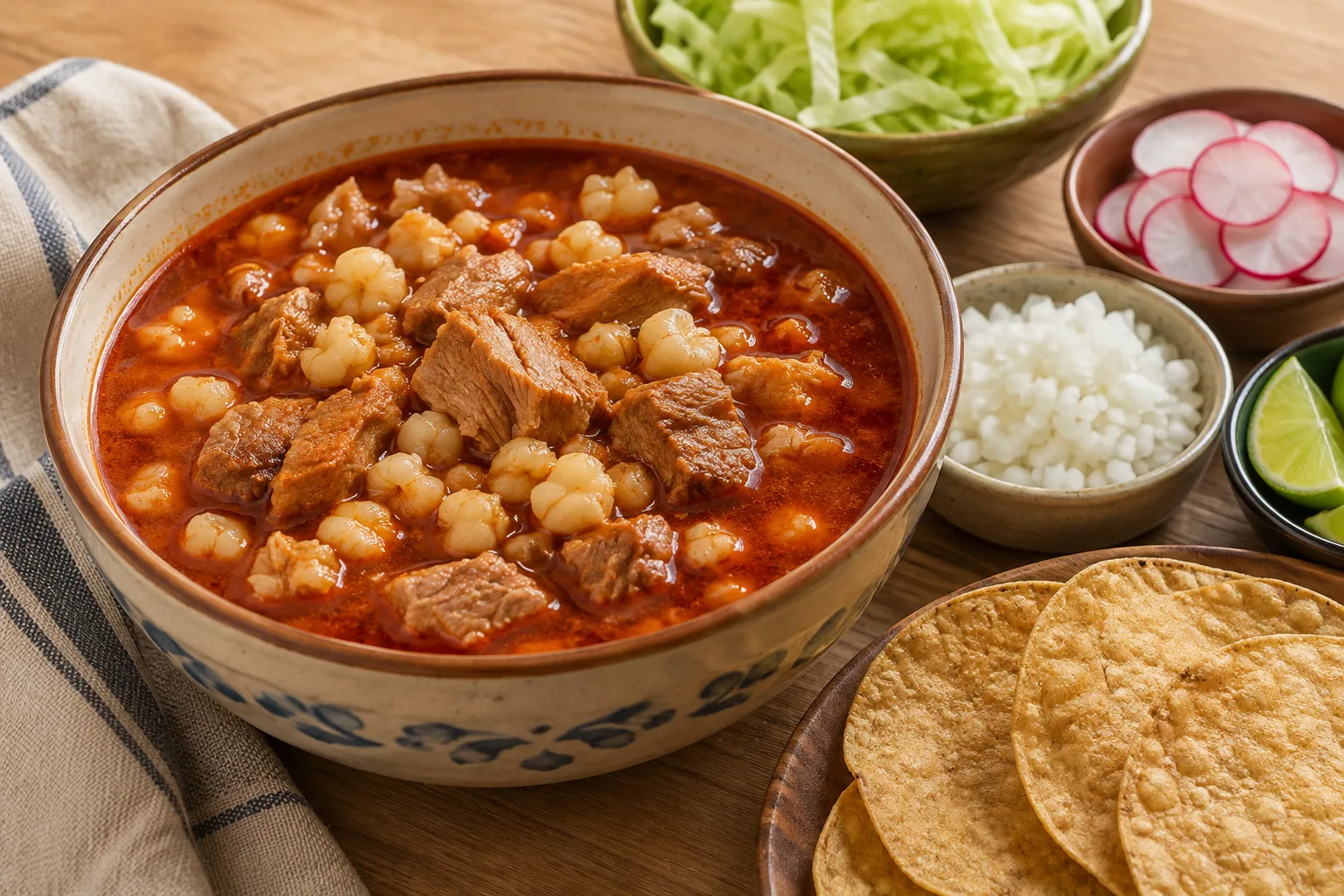
Precooked hominy is maize prepared for use in pozole-style dishes, reducing some of the preparation needed for dry kernels. Pozole maize is known for its large kernels; types used for pozole include cacahuazintle and Ancho. Precooked products are sold in different forms, so packaging, texture and cooking directions should not be assumed to be identical. Hominy is most often used as the maize component of a soup or broth, with additions such as meat, chiles, herbs and garnishes. The word “precooked” tells you that the maize has already undergone some preparation, but it does not by itself establish how much further cooking it needs. Check the package and assess the kernels’ texture before serving.
When to use it
Use it when making pozole or a maize soup and you want to start with kernels that have already undergone some cooking. It works with broth and common pozole ingredients such as pork or chicken, and can be served with garnishes including onion, radish, lettuce, oregano and lime. It is a convenient way to reduce some advance preparation, but packaging and directions vary. If you want a particular texture, check the kernels as they cook rather than assuming the product is ready to serve straight from its package.
How to use it
Read the package directions first because products can differ in form and preparation. If directed, rinse the kernels in a colander and drain them; a published recipe for this product rinses until the water runs less cloudy. Add the hominy to a pot with pozole broth and the other ingredients, or cook it in water before incorporating it into the dish. Simmer gently and check the texture as it cooks: the kernels should become tender to your liking, but there is no single cooking time to assume for every product. Serve with the chosen additions, such as meat, chiles, onion, lettuce, radishes, oregano and lime.
Flavour and texture
Pozole maize is notable for its large kernels; during cooking, kernels may open and take on a flower-like appearance. The result depends on the maize type and how it has been prepared. Precooked hominy may need further cooking to reach your preferred tenderness, so assess its texture during preparation rather than assuming all brands or formats will turn out alike.
How to choose it
Look for a package identified as precooked hominy or precooked pozole maize, and check its format and directions before buying. More than one type of packaging is available; do not assume a bag, can or frozen product cooks or stores in the same way. Check the ingredient list and allergen information for the specific product, especially when cooking for someone with an allergy.
Storage
Storage depends on the product format and the manufacturer's directions. Check the package to see whether it belongs in a cupboard, refrigerator or freezer and what it says to do after opening. Do not assume one storage period applies to every brand or format; if directions are unavailable, ask the manufacturer or retailer.
Substitutions
Dry pozole maize can be used in place of precooked hominy in a pozole preparation, but it needs its own process and is not a direct swap for cooking time: follow its soaking and cooking directions. Other maize types, such as Ancho, are also used for pozole, though kernel size and cooked texture may differ. Adjust preparation to the variety and product you have.
Common mistakes
Do not assume that “precooked” means ready to serve or that every package needs the same treatment. Skipping the package directions, failing to check texture as it cooks, or using the same process for dry and precooked maize can produce a different result than expected.
Safety and allergens
Check the ingredient list and allergen information on the specific package; composition and labelling can vary between products. Follow the package directions for storage and preparation.
Culinary uses
- Main grain for pozole-style soups
- Filling ingredient in a seasoned broth
Recommended techniques
- Rinse and drain before cooking when the product directions call for it
- Simmer in broth or water until the grain reaches the desired tenderness
Pairs well with
- Pork or chicken in pozole
- Lettuce, onion, radish, oregano, lime and tostadas as pozole accompaniments
Frequently asked questions
Should precooked hominy be rinsed?
Follow the package directions. Some recipes for this product rinse and drain it before adding it to the broth.
Is precooked hominy ready to eat?
Do not assume that from the word “precooked” alone. Follow the package directions and check that the kernels reach the texture you want.
Can I use dry pozole maize instead?
Dry pozole maize can be used in a pozole preparation, but it needs its own soaking and cooking process. Follow the directions for that product.
Ingredient allergens
Allergen listThere are no verified associations for these ingredients yet.
Sources and review
Automatically researched, cross-checked and validated content. Sources consulted:
- Alérgenos alimentarios | EFSA www.efsa.europa.eu/es/safe2eat/food-allergens
- Para la ciudadanía www.aesan.gob.es/para-la-ciudadania
- Food Allergies | FDA www.fda.gov/food/nutrition-food-labeling-and-critical-foods/food-allergies
- Food allergens | Food Safety and Quality | FAO www.fao.org/food-safety/scientific-advice/food-allergens/en
- RISK ASSESSMENT OF FOOD ALLERGENS - IRIS iris.who.int/server/api/core/bitstreams/6c71a3db-88b8-4fcd-a807-f5220eb4fc34/content
- Food allergen labelling and information requirements technical guidance - GOV.UK www.gov.uk/government/publications/food-allergen-labelling-and-information-requirements-tech…
- Food Production and Processing Considerations of Allergenic Food Ingredients: A Review - PMC pmc.ncbi.nlm.nih.gov/articles/PMC3236470/
- Etiquetado precautorio de alérgenos NO intencionados < Tecoal ® tecoal.net/seguridad-alimentaria/etiquetado-precautorio-alergenos-no-intencionados/
- POZOLE: ¿Sabías que la sopa más popular de México es de origen prehispánico? | Dirección General del Servicio de Información Agroalimentaria y Pesquera | Gobierno | gob.mx www.gob.mx/agricultura%7Cdgsiap/es/articulos/pozole-sabias-que-la-sopa-mas-popular-de-mexico…
- Rendimiento de variedades de maíz pozolero raza ‘elotes occidentales’ evaluadas en Valles Altos de México | Revista Mexicana de Ciencias Agrícolas doi.org/10.29312/remexca.v14i5.3225
- Pozole mexicano: historia, variantes y receta tradicional lacondesabarcelona.com/pozole-mexicano/
- ¿Pozole con maíz precocido? Te contamos sus riesgos lossaboresdemexico.com/pozole-con-maiz-precocido-te-contamos-sus-riesgos-para-la-salud/
- Pozole - Wikipedia, la enciclopedia libre es.wikipedia.org/wiki/Pozole
- Cómo hacer que el maíz pozolero no se bata al cocinarlo: los trucos para que floree y quede como de restaurante www.directoalpaladar.com.mx/cocina-popular-mexicana/como-hacer-que-maiz-pozolero-no-se-bata-…
- Pozole rojo con maíz precocido – Alejandra de Nava alejandradenava.com/2021/03/29/pozole-rojo-con-maiz-precocido/
- Historia del pozole: un platillo prehispánico hecho para guerreros | CocinaDelirante www.cocinadelirante.com/curiosidades/historia-del-pozole-un-platillo-prehispanico-hecho-para…
- Jueves Pozolero: Cuánto tiempo se debe remojar (y cocinar) el maíz para pozole | Grupo Animal grupoanimal.mx/gastronomia/recetas/jueves-pozolero-cuanto-tiempo-se-debe-remojar-y-cocinar-e…