- Category
- Vegetables
- State
- Fresh
- Usual unit
- g
What it is
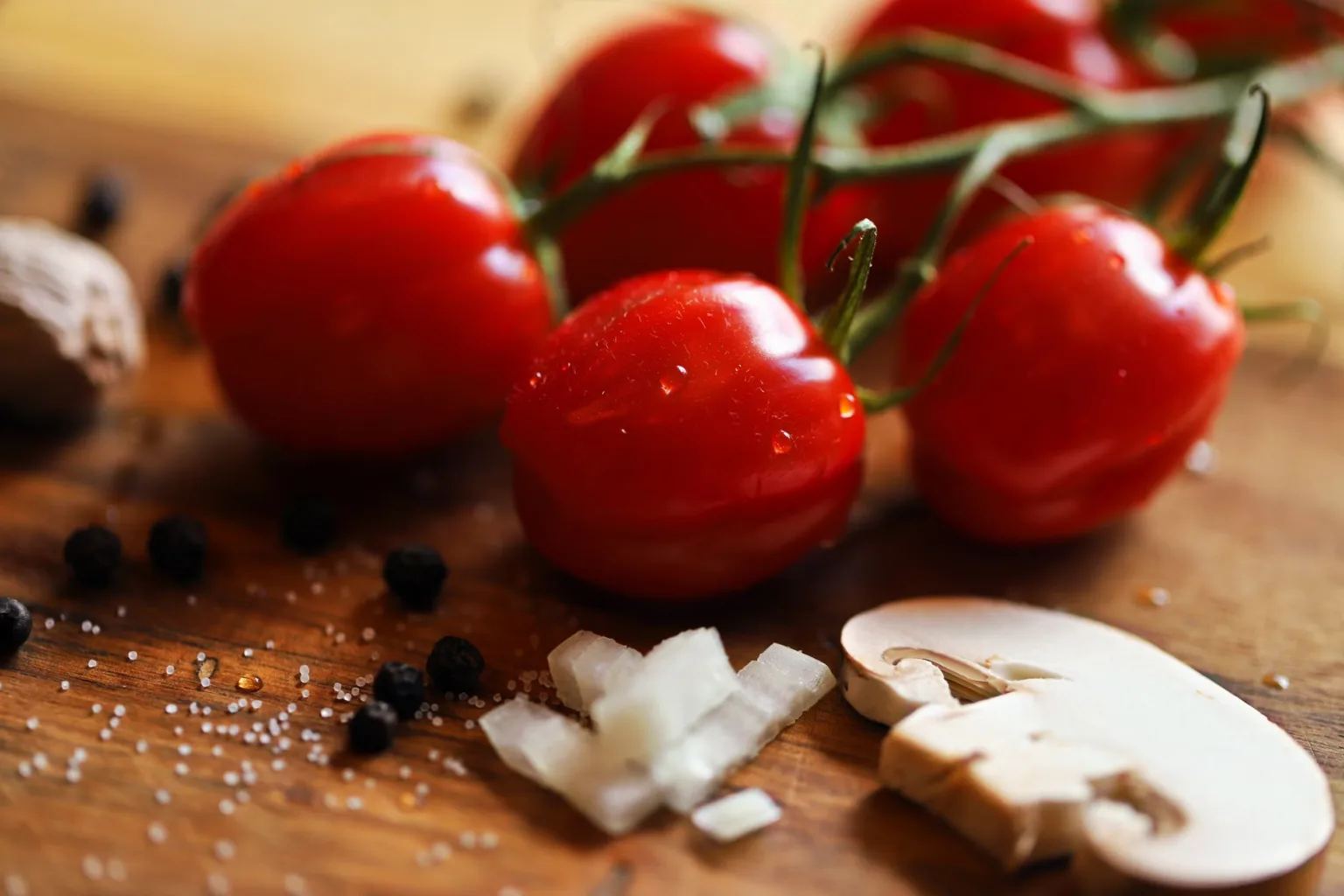
A tomato is a versatile culinary fruit that is commonly treated as a vegetable. It can be eaten raw or cooked and comes in varieties that differ in size, shape, colour, firmness, and the proportion of flesh to water. These differences affect how tomatoes work in a dish: a fleshy, lower-moisture variety is practical for sauces and sofrito, while a juicy variety may be especially appealing in a salad. Small tomatoes such as cherry tomatoes can be served raw or cooked whole. This profile covers fresh tomatoes; canned, preserved, or prepared tomato products may have different ingredients and directions for use.
When to use it
Use tomatoes raw when you want a juicy texture and fresh flavour, such as in salads, sandwiches, or on bread. For gazpacho and salmorejo, choose a variety with flesh that blends well; pear tomatoes are also used for these preparations. For a more concentrated sauce or sofrito, choose fleshy, lower-moisture tomatoes such as pear or Roma and cook them until they reach the consistency you want. Cherry tomatoes work in salads and can also be roasted or cooked whole in a pan. Season and availability depend on region, variety, and growing conditions.
How to use it
Wash and dry the tomato before cutting it. For a salad, slice or chop it and season as you like; a little olive oil and salt make simple accompaniments. For sandwiches, use firm slices that are more likely to hold their shape. To make a sauce or sofrito, chop the tomato and cook it until some moisture has evaporated and it reaches the texture you want; a fleshy pear or Roma variety can be convenient for this use. Cherry tomatoes can be added whole to a pan or oven. To remove the skin, score it lightly, briefly dip it in boiling water, transfer it to cold water, and carefully peel it.
Flavour and texture
Flavour and texture vary considerably by variety and ripeness: tomatoes can be sweeter, more acidic, juicy, firm, or fleshy. Tomatoes with more flesh and less water are generally useful in sauces and stews, while juicier ones suit raw dishes. Cherry tomatoes are often small and sweet, and cooking can intensify their sweetness. Do not judge every variety by one experience: colour, shape, and water content also vary.
How to choose it
Choose a tomato for the intended dish: a firm, fleshy one for cooking, a juicy one for salads, or cherry tomatoes when small pieces are useful. Look for fruit with an even appearance and no notably soft areas or significant blemishes. Aroma, firmness, and weight can help when comparing fruit, but varieties differ in shape, colour, and texture, so they will not all look or feel alike. Ask about the variety and its most suitable culinary uses if you are unsure.
Storage
Keep tomatoes at room temperature and out of direct sunlight. Green tomatoes that are still ripening can lose quality if exposed to cold. A ripe tomato may be refrigerated if it will not be used soon, although chilling can reduce its aroma and affect its texture. Take it out ahead of use so some of its aromas can return. For packaged or prepared products, follow the storage directions on the label.
Substitutions
In a sauce, a fleshy variety such as pear or Roma can stand in for a juicier tomato, but cooking may need adjusting to reach the desired consistency. In salads or sandwiches, another ripe variety can work; cherry tomatoes are also an option, though they change the size and texture of the dish. These are not exact equivalents and do not imply a fixed substitution ratio.
Common mistakes
Do not choose a variety without considering the preparation: a very juicy tomato can make a sauce thinner, while a fleshy one may give a different result in a salad. Avoid chilling every ripe tomato if preserving aroma is important to you. Nor should colour or shape be treated as a guarantee of flavour; characteristics vary between varieties and individual fruit.
Safety and allergens
For packaged or prepared tomato products, follow the storage and use directions on the label. Required information can vary with the product and its presentation.
Culinary uses
- Fresh ingredient for salads, sandwiches and bread toppings
- Juicy base for gazpacho, salmorejo, sauces and sofritos
- Ingredient for roasting, pan-cooking and garnishes
Recommended techniques
- Slice or cut for raw dishes
- Roast or cook whole in a pan
- Cook down into sauces or sofritos
- Blanch briefly and cool to loosen the skin
Pairs well with
- Olive oil and salt
- Pasta
- Bread
- Fish
- Chickpeas and hummus
Frequently asked questions
Which tomatoes are best for sauce?
Look for a fleshy, lower-moisture variety such as pear or Roma. Cook it to the consistency you want, since moisture can vary.
How should I store fresh tomatoes?
Keep them at room temperature, away from direct sunlight. If you refrigerate a ripe tomato because you will not use it soon, take it out ahead of time before serving.
Can cherry tomatoes be cooked?
Yes. They can be eaten raw or cooked whole in an oven or pan, and their small size is convenient for salads and side dishes.
Ingredient allergens
Allergen listThere are no verified associations for these ingredients yet.
Estimated nutrition
- Fat
- 0 g
- Saturates
- 0 g
- Carbohydrate
- 35.7 g
- Sugars
- 14.3 g
- Fibre
- 14.3 g
- Protein
- 14.3 g
- Salt
- 0.45 g
Sources and review
Automatically researched, cross-checked and validated content. Sources consulted:
- En el etiquetado alimentario hay algunas menciones que son obligatorias eletiquetadocuentamucho.aesan.gob.es/obligatoria.html
- ¿Por qué la muerte es origen de miedos y tabúes? doi.org/10.64628/aao.fccyk3qj3
- Client Challenge doi.org/10.2307/jj.27939689.16
- Gastronomía de México - Wikipedia, la enciclopedia libre es.wikipedia.org/wiki/Gastronom%C3%ADa_de_M%C3%A9xico
- Tomates: los imprescindibles de la gastronomía | Consumer www.consumer.es/alimentacion/tomates-imprescindibles-gastronomia-verano
- Tomate de verano, guía de tipos y recetas - Mercado de Chamartín mercadodechamartin.es/blog/guia-tomate-verano-variedades-recetas/
- Para la ciudadanía www.aesan.gob.es/para-la-ciudadania
- 8 variedades de tomate y su uso ideal en la cocina www.hosteleriasalamanca.es/comer/comer-1/8-variedades-de-tomate-y-su-uso-ideal-en-la-cocina
- Gastronomía de Yucatán - Wikipedia, la enciclopedia libre es.wikipedia.org/wiki/Gastronom%C3%ADa_de_Yucat%C3%A1n
- Análisis comparativo de tablas y bases de datos de ... aesan.gob.es/dam/jcr:dd37addd-f63e-476a-80db-2166c676e810/BBDD_COMPOSICION.pdf
- Caracterización de 15 variedades locales de tomate de l’Horta de Lleida openalex.org/W2306008699
- Nopal blanco (Opuntia megacantha) y cocina tradicional del Bajío: identidad, uso y continuidad openalex.org/W7164737883