Documentary synthesis prepared with AI assistance. It does not replace specialist review or certify kitchen testing. · Updated 1 November 2026
A country shaped by varied foodways
Benin lies in West Africa, between Togo, Nigeria, Burkina Faso, and Niger. Its food traditions are not a single uniform repertoire: ingredients and meals vary between communities and from south to north. Maize is a major staple in the south, where it is made into cooked or fermented pastes. Yam is especially important in central and northern areas, where it can be boiled, served with sauce, or pounded into a soft paste. Millet and rice also appear in documented dishes and food traditions.
A common meal structure pairs a substantial grain or tuber preparation with a sauce. That pattern allows for differences in vegetables, seasonings, and accompanying fish, meat, or cheese without making the bases interchangeable. Amiwo is a seasoned cooked maize paste; akassa is a fermented maize preparation; pounded yam begins with cooked tubers worked into a smooth mass. Each has its own ingredients and preparation. This atlas therefore treats Beninese cooking as a set of related but distinct foodways, grounded in particular places and communities rather than a single national menu.
Political history and culinary exchange
The country’s modern political history provides context for names and cultural encounters, but it cannot by itself explain the history of every dish. The territory was known as Dahomey, became part of French colonial rule, gained independence in 1960, and adopted the name Benin in 1975. Food traditions are better understood through the ingredients, communities, and practices documented across the region than as the direct product of one political period.
Some preparations also point to movement and contact among communities. Massa, a fermented griddle cake made with rice flour, millet flour, or a mixture, is associated with Hausa communities and is particularly noted in northern Benin. In Ouidah, amiwo is connected with Afro-Brazilian Agouda foodways and with Vodun convent traditions. These are specific documented connections, not evidence that either tradition defines the whole country. Maize and yam preparations also sit within wider West African food landscapes, where related foods and names may be shared across borders. Such relationships are best described as circulation and coexistence, without assigning an exclusive origin where the evidence does not establish one.
Staples, sauces, and locally made foods
The pantry differs across the country. Southern foodways give maize a central place: flour can be cooked into amiwo, or maize can be fermented for akassa. In central and northern areas, yam is prominent, while millet is important in some preparations, including massa. Rice, beans, and cowpeas also feature in documented meals. These staples may be served with sauces based on tomato, okra, or leafy greens, with ingredients varying between households and places.
Other foods add distinct textures and sources of flavor. Peanuts appear in sauces and in kuli-kuli, a fried peanut snack made from peanut paste after some of its oil has been removed. Fish, including smoked fish, is used in sauces and other dishes; chicken is also documented in southern meals. In northern Benin, wagasi is a soft cow’s-milk cheese made by Fulani communities. It may be fried or cooked in sauce and served alongside yam or a cereal preparation. These examples describe a varied pantry rather than a fixed ingredient list: local availability and customary combinations shape what goes into a meal.
Sauces, acidity, heat, and contrasting textures
Sauces often provide a meal’s most pronounced seasoning, accompanying a comparatively plain base of maize, yam, or another cereal. Documented ingredients include tomato, onion, chili, peanut, okra, and leafy vegetables; fish or other proteins may also be incorporated. The fresh tomato-and-chili mixture called mɔ̌yò and the okra sauce known as févi are examples of named preparations, not fixed recipes that must be identical from one household to another. Chili is prominent in descriptions of Beninese food, but its level of heat depends on the preparation.
Texture is another important source of contrast. Fermented akassa is distinct from the cooked, seasoned maize paste amiwo. Pounded yam is smooth and cohesive, while wagasi is soft and mild. Fried ripe plantain, called aloko, offers a different, crisp-edged texture, and kuli-kuli is a dry, crunchy peanut snack. Taken together, these foods show how tangy fermentation, fresh or cooked sauces, frying, and smooth pastes can coexist in the same broad food landscape. No single flavor profile or degree of heat represents every community or meal.
Harvest celebrations and everyday transmission
Yam has culinary and cultural importance in communities where it is a staple crop. Benin’s Yam Festival is held on August 15 and marks the harvest period; Savalou, associated with the Gbaguidi royal family and yam cultivation, draws participants and visitors. The festival is observed by members of communities including Mahi, Nagot or Yoruba, Bariba, and Dendi. For Mahi people in Savalou, documented practices include honoring ancestors and consulting the oracle before eating the new yam. Religious expressions, dance, and traditional music are part of this particular celebration. These details belong to the festival and communities described, not to every Beninese household.
Food knowledge also passes through ordinary preparation and shared work. Pounding boiled yam with a wooden mortar and large pestle takes sustained effort; this work has traditionally been performed by women. Cowpea-based dishes offer another view of changing foodways: doughnuts, stews, and mixed dishes remain widely consumed in surveyed urban and rural areas in southern Benin. Research also records changes in cooking methods and habits between generations. Together, these examples show traditions continuing through harvest observances, household skills, and everyday adaptation rather than through one national ritual alone.
Fermenting, stirring, pounding, and frying
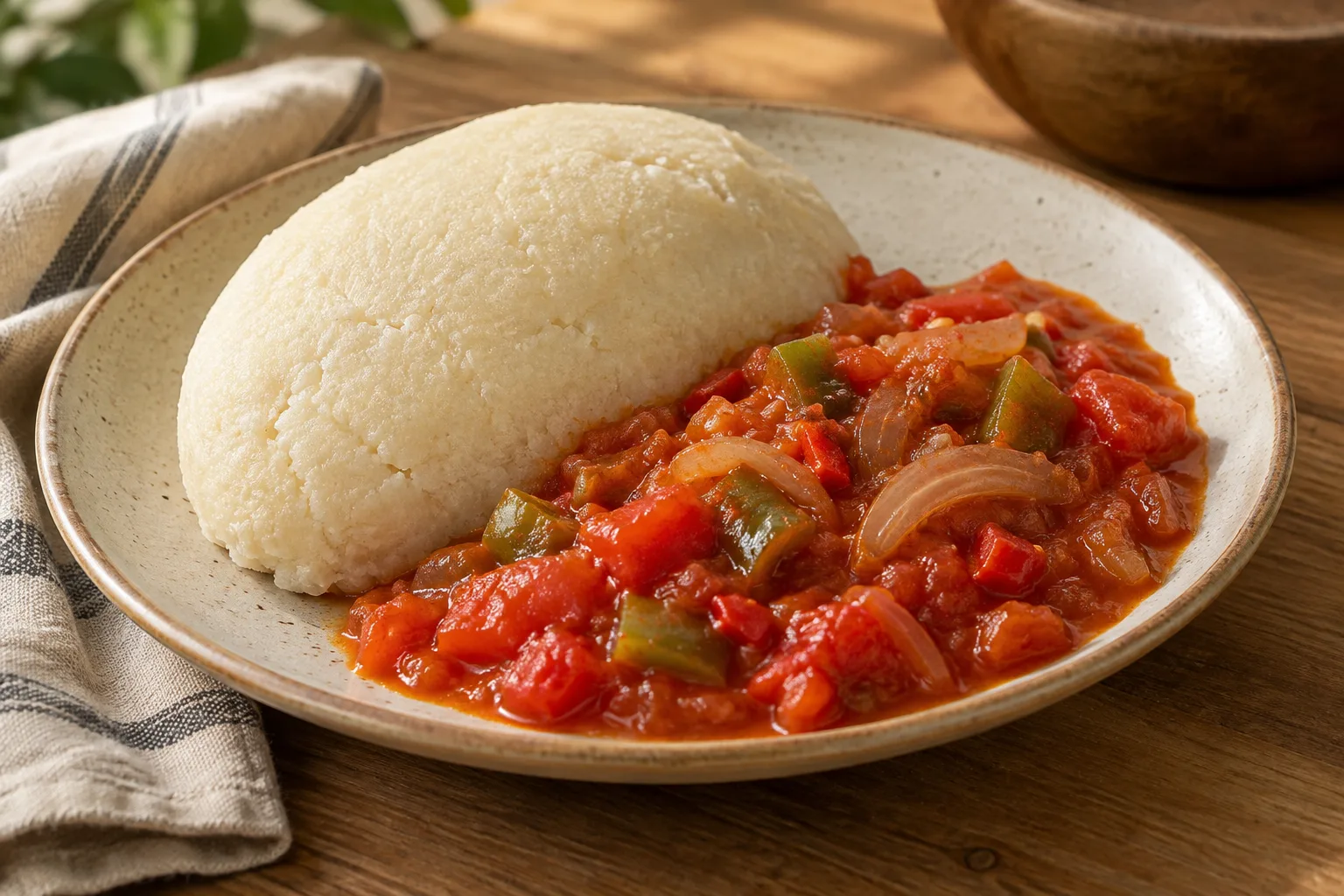
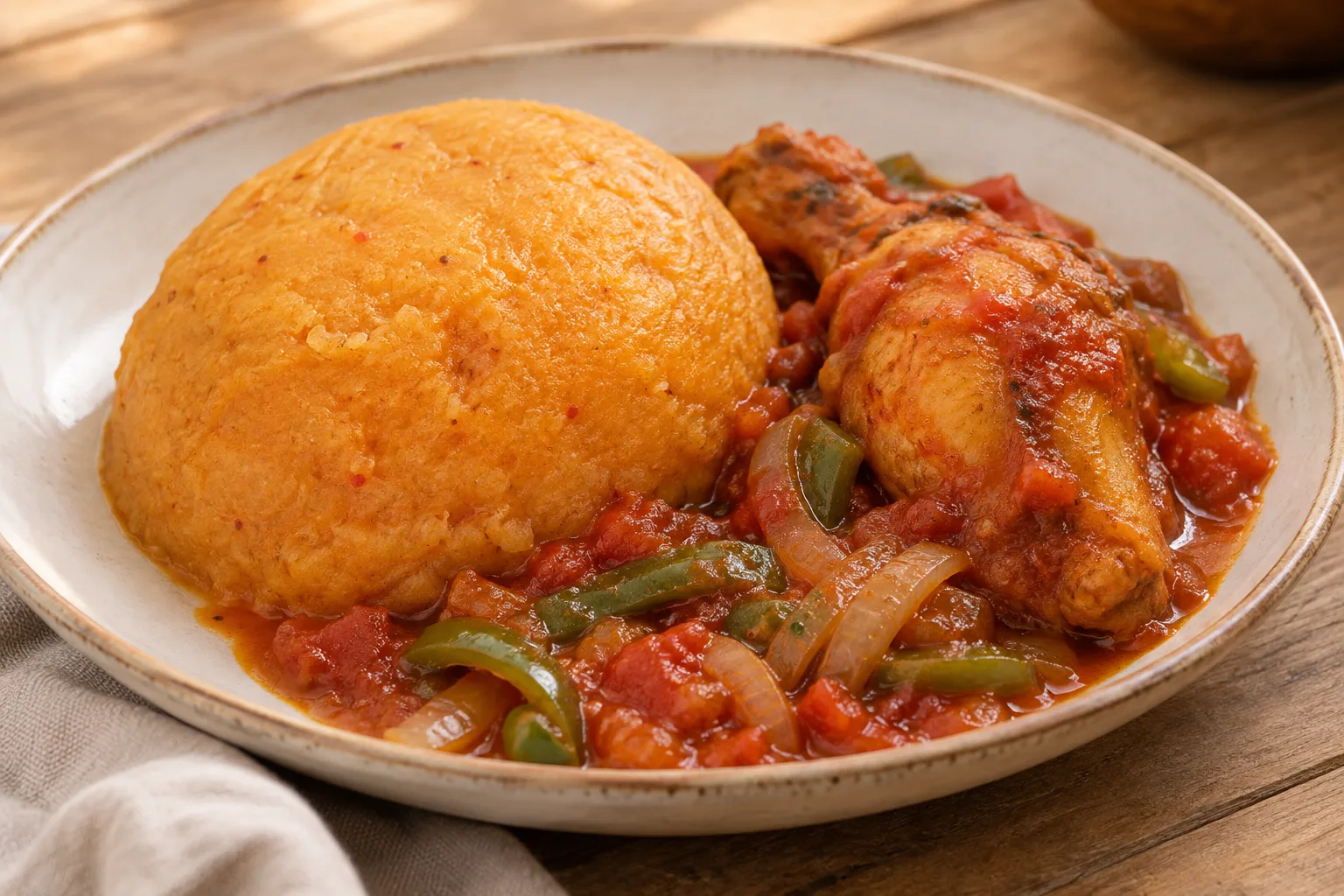
Different staples call for different kinds of work. Fermentation distinguishes akassa from amiwo: the former is made from fermented maize, while the latter is cooked from maize flour with tomato and seasonings. For amiwo, a portion of flour may first be mixed with water and added to a boiling tomato mixture; the remaining flour is stirred in vigorously with a wooden spatula until the paste thickens. The stirring helps combine the flour evenly. The precise ingredients and proportions vary across descriptions and preparations.
Pounded yam begins with cooking the tuber, followed by pounding it until it forms a soft paste. A wooden mortar and large pestle are traditional tools; pounding machines and precooked, dried yam products are also documented developments that reduce preparation time or help store the crop. Other techniques produce contrasting foods: aloko is fried ripe plantain, while kuli-kuli is formed from peanut paste after oil is extracted and then fried. Smoked fish and smoked shrimp are further examples of preservation and flavoring. These methods transform staples and accompaniments in distinct ways, from fermented sourness to a cohesive paste or a crisp fried bite.
Bases, sauces, and occasions for eating
A documented meal pattern pairs a maize, yam, or other cereal base with sauce and, where included, vegetables, fish, meat, or cheese. The base is eaten with the accompanying sauce, but its particular preparation matters: fermented akassa, cooked amiwo, and pounded yam are not simply substitute versions of one dish. Amiwo is served with accompaniments such as chicken or fish; pounded yam is eaten with sauce. In northern foodways, fried or sauced wagasi can accompany yam or a cereal paste.
Food is also bought and eaten as snacks. Yovo doko are fried flour fritters, described in both sweet and savory forms, and kuli-kuli is a crunchy peanut snack. Fried ripe plantain may be served as a side or eaten between meals. Drinks mentioned in Beninese food accounts include choukoutou, a millet beer consumed especially in the north, and sodabi, a spirit distilled from palm wine and associated with celebrations and ceremonies. These examples point to varied everyday and festive occasions, not a universal sequence or prescribed table ritual.
A glossary of Beninese foods
Names can vary between communities and accounts. The entries below identify specific foods and preparations, while distinguishing items that share ingredients but are not the same dish.
- Amiwo: A seasoned maize-flour paste cooked with tomato; it is served with accompaniments such as chicken or fish.
- Akassa: A fermented maize preparation commonly served with sauce. It is distinct from cooked amiwo.
- Pounded yam: Cooked yam worked into a soft paste. It is called agu in parts of the south and centre and chokuru in the north.
- Wagasi: Soft cow’s-milk cheese made by Fulani communities in northern Benin; it can be fried or cooked in sauce.
- Massa: A fermented griddle cake made with rice, millet, or a mixture of flours, associated with Hausa communities and especially noted in the north.
- Kuli-kuli: A fried peanut snack made from peanut paste after some oil has been removed.
- Sodabi: A spirit made by distilling palm wine, associated in food accounts with ceremonies and celebrations.
One country, many cuisines
Southern Benin
Maize is a major staple in the south and is made into preparations including cooked amiwo and fermented akassa, often served with sauce. Fish and chicken are documented accompaniments, and cowpea-based doughnuts, stews, and mixed dishes are consumed in both rural and urban areas. In Ouidah, amiwo is linked with Afro-Brazilian Agouda foodways and Vodun convent traditions, a specific local connection rather than a description of the entire south.
Central and Northern Benin
Yam is an important staple in central and northern areas and is prepared in several ways, including as pounded yam. In Savalou, the August 15 Yam Festival marks the harvest and is observed by Mahi, Nagot or Yoruba, Bariba, Dendi, and other communities. Northern foodways also include millet, massa associated with Hausa communities, and wagasi, a soft cow’s-milk cheese made by Fulani communities.
Cook