Documentary synthesis prepared with AI assistance. It does not replace specialist review or certify kitchen testing. · Updated 12 November 2026
Coasts, seasons, and local foodways
Greenland’s extensive Arctic landscape includes rocky coasts, fjords, tundra, and a vast ice-covered interior. Food traditions have developed in relation to what communities can obtain from sea and land, and to the seasons that shape hunting, fishing, travel, and storage. This means that a single island-wide menu would be misleading: ingredients and access differ between places and across the year.
Marine foods are prominent in accounts of Inuit foodways. Seal, whale, fish, shrimp, and crab appear alongside land animals such as reindeer and musk ox, as well as birds. Local berries add a contrasting plant food, while the southern landscape of Kujataa also has a documented sheep-farming tradition. These foods should not be treated as equally available everywhere.
A useful starting point is suaasat, a meat soup whose ingredients can change with local availability. It is familiar as a shared dish, but its variations show why Greenlandic food is better understood as a set of related practices than as a fixed national recipe. Imported foods and contemporary restaurant cooking further broaden the picture. Traditional knowledge and current eating habits coexist; neither alone describes the whole table. [The recipe catalogue includes Greenlandic suaasat.]
Food histories and documented exchanges
Greenlandic food history includes Inuit practices rooted in hunting, fishing, processing, and detailed knowledge of animals and seasonal conditions. Kujataa, in the south, offers a particularly documented regional history: its cultural landscape reflects more than a thousand years of Norse and Inuit farming, hunting, and fishing. That history is important in its own right, but it is not a template for every Greenlandic community.
Contact and trade also changed what could be cooked. Accounts of Greenlandic food describe Danish and other external influences, including the arrival of ingredients such as flour, sugar, yeast, and butter. These products made baking possible in forms that became part of local food culture. Rice and barley are used in some versions of suaasat, alongside local meats; the appearance of imported starches and grains illustrates exchange rather than a simple divide between “traditional” and “modern.”
Foodways continue to change as communities combine locally obtained foods with purchased goods and contemporary cooking. In Kujataa, sheep farming sits alongside Inuit hunting and fishing practices and a continuing relationship with the environment. Such regional histories resist a single-origin story: Greenlandic cooking has been shaped by Indigenous knowledge, local resources, settlement histories, trade, and adaptation, with different emphases in different places.
Seafood, game, berries, and preserved foods
The foods most often associated with Greenlandic kitchens come from marine harvesting and hunting. Seal and fish are central in many descriptions; whale, shrimp, crab, reindeer, musk ox, and birds also appear, with availability varying by location and season. Fish named in accounts include halibut and Arctic char. These lists describe a broad range of foods, not a promise that every ingredient is routinely found in every settlement or household.
The pantry also includes plant foods. Crowberries and blueberries are gathered and eaten fresh or used in sweet preparations, compotes, and accompaniments. Their fruitiness can sit alongside strongly flavored meat or seafood. In Kujataa, sheep farming forms part of the southern region’s documented landscape and livelihoods; it should be understood as a regional feature rather than a universal source of meat.
Preserved foods extend the use of seasonal catches. Fish and meat may be dried or smoked, and fat has been used in preservation as well as for other practical purposes. Mattak—whale skin with its underlying layer of fat—is a distinct food, often served raw or lightly salted. Today, imported groceries and locally sourced foods share kitchens and shops, while the range of fresh goods can shift with transport and season.
Broths, firm textures, and bright berries
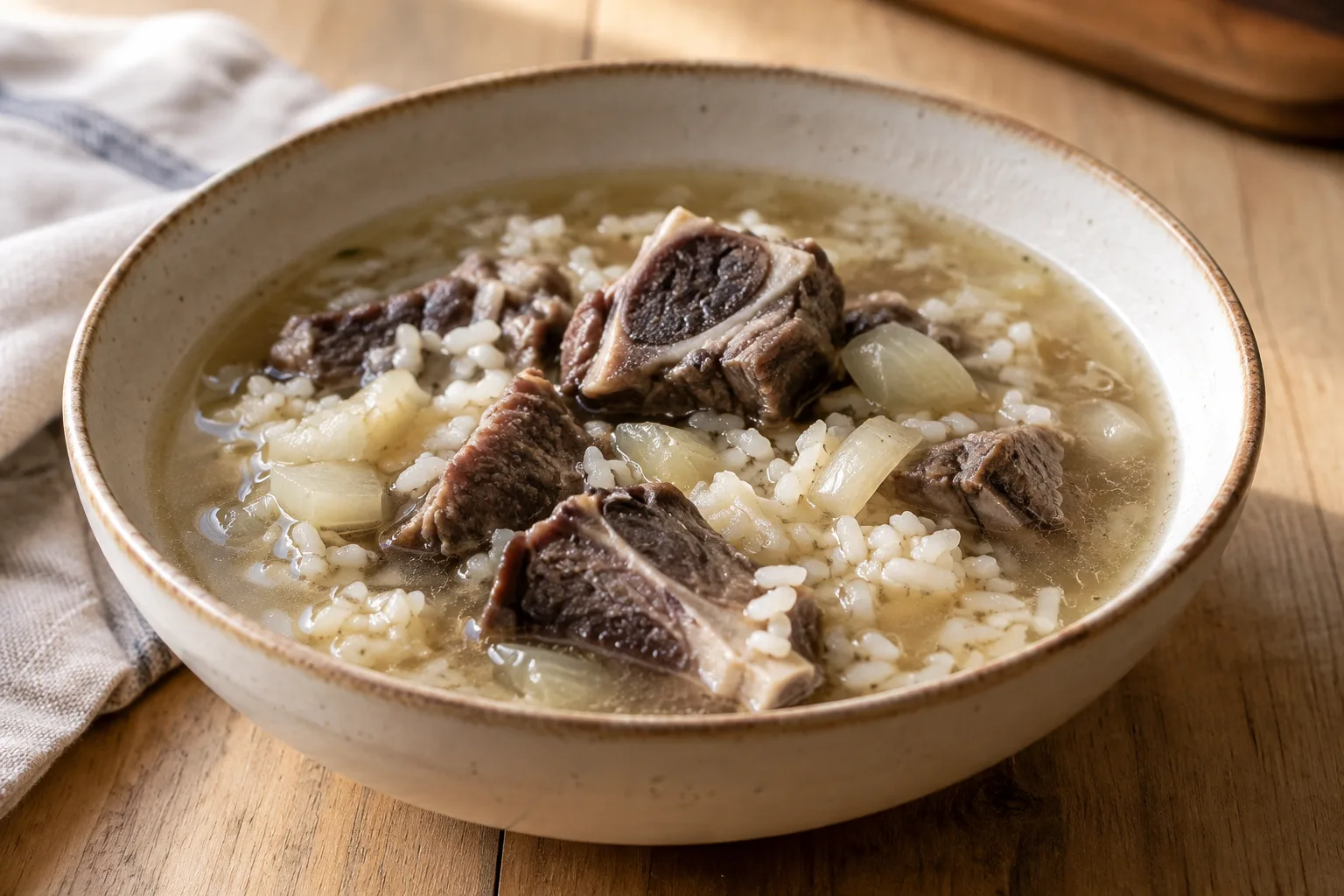
Many Greenlandic preparations let the principal ingredient remain prominent. Suaasat is a clear to somewhat thick soup, commonly made with meat, water, and simple seasoning. Onion is frequent; barley or rice can give the broth more body, and some versions include potatoes. The meat may vary, so the soup’s character changes from one place or household to another. Its name is associated with boiling or simmering, a clue to the importance of the cooking method rather than a single fixed ingredient list.
Preservation creates other textures and intensities. Dried fish becomes firmer and more concentrated in flavor; smoking brings a different savory quality. In mattak, the contrast between whale skin and its fatty layer is part of the food’s defining texture. It is a valued food with specific cultural contexts, not merely an unusual ingredient for visitors to sample.
Berries offer a tart or fruity counterpoint to richer foods. Crowberries, for example, may accompany meat or appear in preserved and sweet preparations. At the same table, a bowl of soup, dried fish, fresh berries, or sweet bread can represent quite different approaches to flavor. Together they show a cuisine shaped by both the characteristics of local ingredients and the transformations used to store or serve them.
Food knowledge, occasions, and transmission
Food preparation is connected with knowledge passed between generations: recognizing animals and seasonal conditions, hunting and fishing, and processing what is brought home. In Kujataa, hunting, fishing, and preparing local foods are described as expressions of Inuit identity as well as practical activities. The use of animal resources extends beyond meat; this broader knowledge links food preparation with materials used for clothing, tools, and other purposes.
A well-documented social occasion is the kaffemik, a gathering for events such as birthdays, weddings, and community milestones. Coffee or tea is served with cakes and other baked foods. Guests may arrive and leave over the course of the gathering, making hospitality central to its organization. Kalaallit kaagiat, a sweet Greenlandic bread or cake, is associated with these tables; descriptions differ, so no single ingredient list or decoration should be taken as universal.
Kiviak is a more regionally specific tradition associated with Inughuit communities in the northwest and with winter occasions. It is a fermented bird preparation requiring specialized local knowledge. It should not be presented as a general home-preservation method: a documented incident involving unsuitable birds resulted in fatal botulism. Respect for this tradition includes recognizing both its cultural context and the serious risks of attempting to reproduce it without the knowledge that informs local practice.
Simmering, drying, smoking, and careful preservation
Slow simmering is central to many descriptions of suaasat. Meat cooks in water until tender, producing a broth that can remain relatively clear or become thicker with cereal. Onion is a common addition; barley or rice may be used, and some versions include potatoes. Soaking barley beforehand allows starch to enter the liquid and contribute body. The exact combination reflects availability and local habit rather than a single standard method.
Drying and smoking help preserve fish and meat beyond the time when they are freshly caught or hunted. These techniques are associated with planning for seasons when weather or ice can make fishing and hunting difficult. Fat has also been used to preserve foods. The processing of an animal is part of a wider practical knowledge of its materials and uses, not only a sequence of kitchen operations.
Fermentation in kiviak is a distinct, specialized practice rather than a technique that can safely be reduced to a general recipe. Its safe preparation depends on precise knowledge, and the serious consequences of an unsuitable preparation are documented. This account therefore describes the tradition without providing directions. Contemporary kitchens also use purchased ingredients and modern equipment, but available evidence does not support assigning one set of utensils or a single domestic method to all Greenlandic households.
Everyday bowls and occasions for gathering
Greenlandic meals can bring together locally obtained foods, preserved fish or meat, and groceries brought in through trade. Fresh foods and imported choices may be more or less accessible according to place, season, and transport. A household meal should not be assumed to look the same in every community, and contemporary eating includes both longstanding practices and newer influences.
Suaasat can be an everyday soup or part of a larger shared meal. Because the meat and additions vary, the same name does not require identical bowls. Its ability to accommodate different available ingredients makes it an especially clear example of how a preparation can be recognizable while remaining adaptable.
A kaffemik arranges food around hospitality rather than a single seated meal. Coffee or tea and cakes are offered as guests come and go during a birthday, wedding, or other milestone. Sweet bread such as kalaallit kaagiat belongs to this social setting in documented accounts. Meals associated with hunting and fishing can also bring together food, stories, and the sharing of practical knowledge, though the specific occasion and menu vary by family and community.
In towns and settlements, local foods coexist with purchased products and contemporary restaurant offerings. The catalogue recipe available here is Greenlandic suaasat. Other foods discussed in this entry provide cultural context rather than additional catalogue recipes.
A glossary of Greenlandic foods and gatherings
These terms refer to particular foods or social practices documented in Greenland. Their meanings are best understood in context: ingredients, preparation, and occasions can vary between communities and households.
- Suaasat: A Greenlandic meat soup simmered in water. Seal, reindeer, whale, or other available meats may be used; onion and barley or rice are common additions in descriptions, with variations including potatoes.
- Mattak: Whale skin with the layer of fat beneath it. It is commonly described as served raw or lightly salted.
- Kiviak: A fermented bird preparation associated especially with Inughuit communities in northwest Greenland and winter occasions. It requires specialized knowledge and is not suitable for casual experimentation.
- Kaffemik: A social gathering for milestones such as birthdays and weddings, where coffee or tea and baked foods are shared as guests visit.
- Kalaallit kaagiat: A sweet Greenlandic bread or cake associated with kaffemik. Accounts describe variations in ingredients and presentation.
- Ammassat: Capelin, a small fish that may be dried for preservation.
The names identify foods and ways of gathering, not a uniform menu for the whole island. In particular, suaasat describes a flexible preparation, while kiviak belongs to a specific regional and knowledge context.
One country, many cuisines
Inughuit communities of the northwest
In northwest Greenland, kiviak is documented as a specialized food tradition associated with Inughuit communities, including Siorapaluk. It is a fermented bird preparation connected with winter occasions and community knowledge. Its significance is regional; it should not be used to characterize every Greenlandic kitchen or Inuit community. Accounts also document a fatal botulism incident after a preparation used unsuitable birds, underscoring that this is not a safe general-purpose fermentation method. The tradition is best understood through its local context and the knowledge required to prepare it, rather than through a simplified recipe.
Kujataa, southern Greenland
Kujataa is a cultural landscape in southern Greenland that documents more than a thousand years of Norse and Inuit farming, hunting, and fishing. Sheep farming is an important part of its present landscape and local livelihoods, alongside Inuit practices of hunting marine mammals, fishing, and processing local foods. These activities are connected with environmental knowledge and the transmission of culture between generations. Kujataa provides a grounded example of the region’s particular agricultural history and changing relationship with land and sea. It does not represent the food supply or history of Greenland as a whole.
Cook