Chilean Humitas
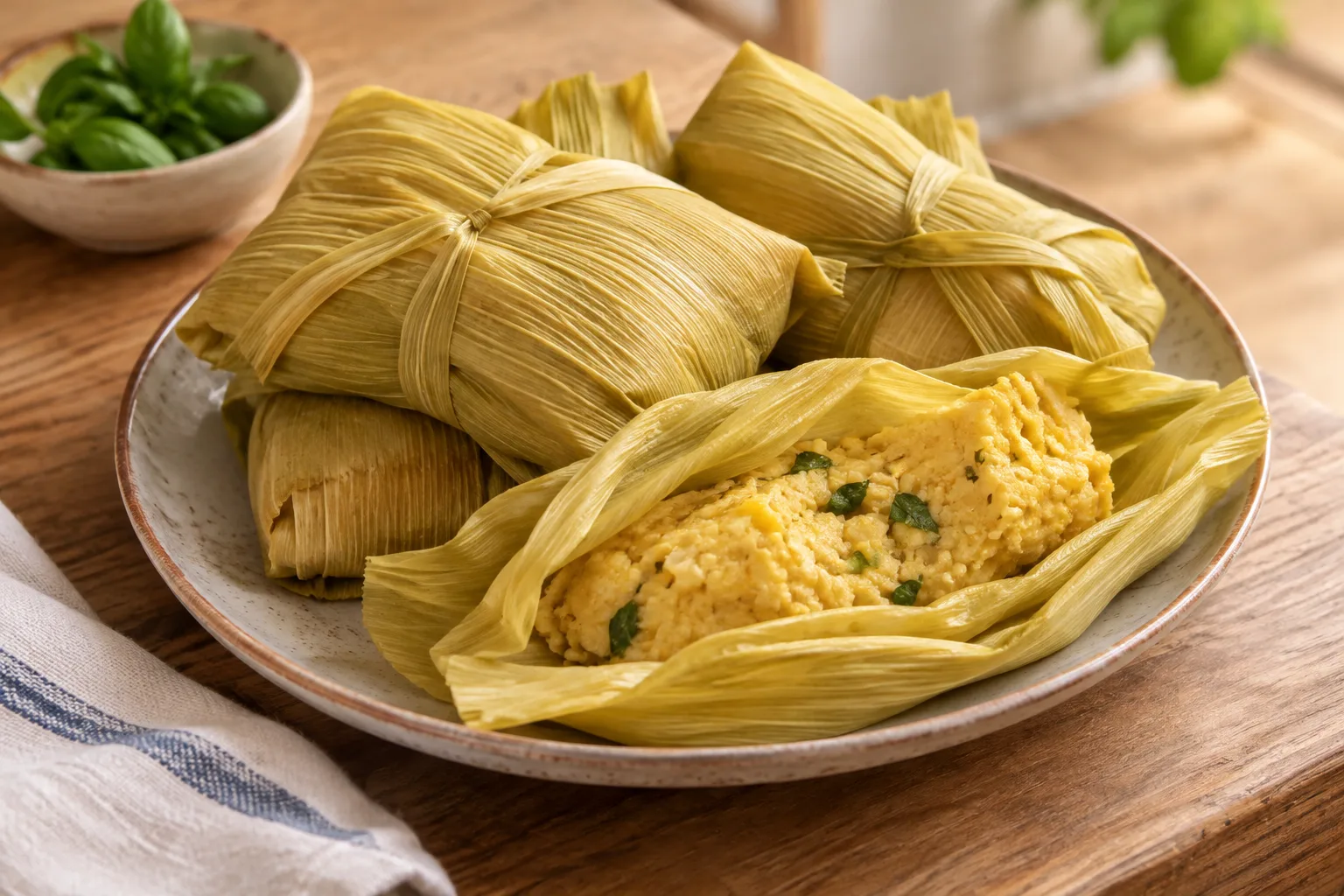
Ground corn parcels with onion and basil, wrapped in corn husks and boiled. Makes about 16 humitas, roughly 4 per person.
These humitas are made with fresh corn, lard, milk, and basil. Hands-on preparation time and the 4 servings are estimates; the stated cooking time combines the specified minutes for browning the onion and boiling the humitas.
Ingredient allergens
Allergen listThere are no verified associations for these ingredients yet.
Alternatives by dietary restriction
Lactose-free milk
For lactose intolerance
It can replace liquid milk in cooking and baking to reduce lactose. It retains milk proteins, so it does not avoid the milk allergen. Choose a variety suited to the recipe and check the label. Also check other allergens and the risk of cross-contact.
Lactose-free milk retains milk proteins. This option does not address milk allergy.
Allergens to consider in this alternative:
- Milk and milk products
Check the label, other allergens and cross-contact. Replacing one ingredient does not remove allergens elsewhere in the recipe; adjustments depend on the culinary use.
Method
- 01
Prepare the corn and husks
Cut the base off the ears and set aside the large husks for wrapping. Cut off the kernels with a knife, keeping all the juices; grind them in a food processor or grinder, or finely chop them with the knife.
Ready to continue when: The kernels are ground or finely chopped, and their juices have been kept.
20 min - 02
Brown the onion and season
Heat the lard in a large pot, preferably one with a heavy base. Add the onion and brown it, stirring occasionally, for 8–10 minutes. Stir in the paprika, pepper, and salt.
Ready to continue when: The onion is browned and the seasonings are mixed in.
10 min - 03
Cook the corn mixture
Add the ground corn with its juices and the milk to the pot. Stir and cook until it boils and thickens. Mix in the basil. If the mixture needs more body, add the cornmeal or chuchoca; it should be firm.
Ready to continue when: The mixture has boiled, thickened, and is firm.
- 04
Shape the humitas
Place 3–4 generous spoonfuls of the mixture on the open husks. Fold in the sides first, then fold the ends inward. Tie each parcel with kitchen twine.
Ready to continue when: Each parcel is closed, with the filling held inside the husks.
15 min - 05
Boil and serve
Bring plenty of salted water to a boil in a large pot. Submerge the humitas and cook for 30–40 minutes. Serve hot.
Ready to continue when: The humitas have boiled for 30–40 minutes and are served hot.
40 min
Ingredients
Sources and review
Content researched, cross-checked and automatically validated. Sources consulted:
- Por qué el Sáhara Occidental es una pieza clave para la seguridad alimentaria mundial doi.org/10.64628/aao.swhdr6qsf
- Mantención de alimentos a temperaturas altas www.achipia.gob.cl/wp-content/uploads/2025/11/OBIC_Alimentos_T_Alta_4.pdf
- Departamento de Áncash - Wikipedia, la enciclopedia libre es.wikipedia.org/wiki/Departamento_de_%C3%81ncash
- Propuesta de creación de postres para el adulto mayor utilizando chía, quinua y espirulina | OpenAlex openalex.org/W2990751589
- REGLAMENTO SANITARIO DE LOS ALIMENTOS www.minsal.cl/wp-content/uploads/2015/10/DECRETO_977_96_actualizado_-mayo-2024.pdf
- Humitas chilenas - La Cocina Chilena de Pilar Hernández cocinachilena.cl/humitas-receta-chilena/
- LA HUMITA MILENARIA www.patrimoniodechile.cl/688/articles-72997_archivo_01.pdf
- Artículo 760. Aquellos establecimientos que elaboren o fraccionen alimentos para el consumo de público tales como: Restaurantes ... nuevo.leychile.cl/servicios/Consulta/Exportar?exportar_con_notas_al_pie=False&exportar_con_n…
- Estudio de la vida útil de una masa de maíz amarillo para la elaboración de empanadas en la Empresa Maquiempanadas | OpenAlex openalex.org/W7133055538
- OR.Manual-HACCP-OK-web.pdf www.achipia.gob.cl/wp-content/uploads/2025/05/OR.Manual-HACCP-OK-web.pdf
- c) cuando el alimento contiene menos de 5% de ingredientes irradiados; nuevo.leychile.cl/servicios/Consulta/Exportar?exportar_con_notas_al_pie=True&exportar_con_no…
State: Published after documentary validation; no “Tested” label is shown.