- Category
- Herbs and spices
- State
- Dry
- Usual unit
- berry
What it is
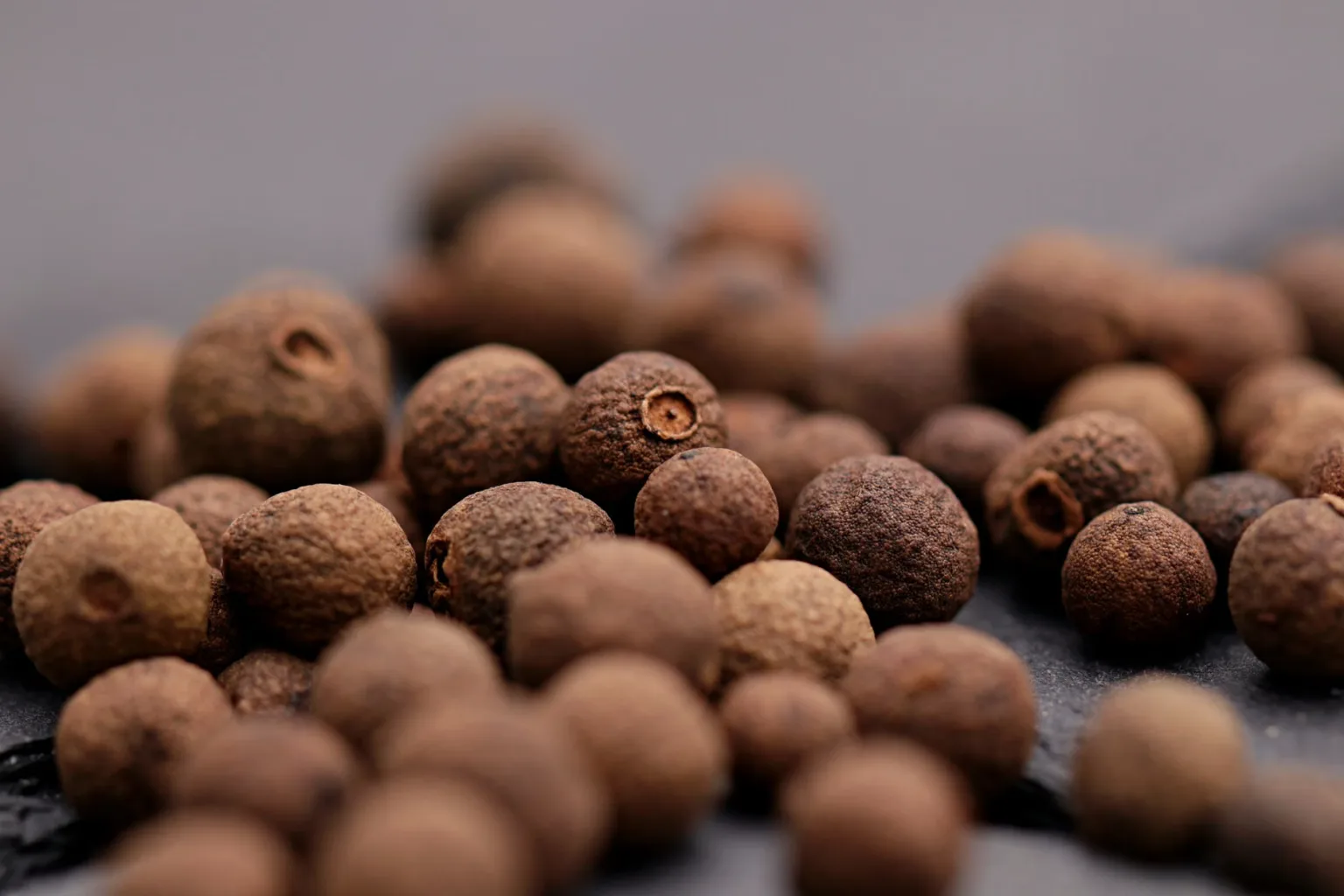
Allspice berries are the dried fruit of Pimenta dioica. Despite the name, allspice is not black pepper; it is a distinct spice with its own aromatic character. The dried berries can be used whole or ground, ideally shortly before cooking when a more pronounced aroma is wanted. Their warm, complex scent is often compared with a blend of clove, cinnamon, nutmeg and black pepper. Allspice appears in both savoury and sweet cooking, including soups, stews, meat dishes, fruit preserves, desserts and spiced drinks. Whole berries are useful for infusing a liquid and removing them before serving.
When to use it
Choose allspice when you want a rounded, warming spice note rather than only heat or sweetness. It can season soups, stews and meat dishes, and it also suits fruit preserves, desserts and spiced drinks. Whole berries are convenient when you want to flavour a cooking liquid and take the spice out before serving. Ground allspice blends more evenly into sauces, doughs and spice mixtures. Because its aroma is distinctive, begin with a small amount and adjust to taste, especially when the recipe also contains clove, cinnamon or other assertive spices.
How to use it
Add whole berries to a stew, soup, fruit preserve or hot drink to infuse it during cooking, then remove them before serving if you do not want whole spices in the finished dish. For a more even distribution, grind the berries just before adding them to a sauce, spice blend or sweet preparation. You can also lightly crush the berries, steep them in a liquid and strain the liquid at the end. To bring out their aroma, warm whole berries in a dry pan, moving them often, and take them off the heat as soon as they smell fragrant. Let them cool before grinding.
Flavour and texture
Allspice has a strong, warm and layered aroma commonly associated with clove, cinnamon, nutmeg and black pepper. It is not a direct substitute for black pepper and should not be treated simply as a source of heat. Whole berries can be removed after infusing; ground allspice disperses through a dish and is more noticeable in its texture if used generously.
How to choose it
Look for a package labelled allspice berries or allspice and check that it identifies the spice as Pimenta dioica. Whole berries can be ground as needed and are also useful for infusions; ground allspice is convenient for spice mixes and baking. Choose a clean, dry product in an intact, closed package. If a local name is unfamiliar or ambiguous, check the ingredient label so you know you are buying the intended spice.
Storage
Keep dried berries in a clean, tightly closed container in a cool, dry place, away from moisture and heat. Keeping them whole until needed helps retain their aroma; grind only the amount required for the recipe. Close a container of ground allspice after each use. Do not use the product if it is damp, visibly deteriorated or in damaged packaging.
Substitutions
A small blend of cinnamon, clove, nutmeg and black pepper can approximate allspice’s layered aroma. Adjust the blend to suit the dish, but start sparingly because clove and nutmeg can quickly dominate. If you have only two spices available, cinnamon with a little clove gives a sweeter, less peppery result. No substitute exactly reproduces allspice’s combination of aromas.
Common mistakes
Do not confuse allspice with black pepper: they are different spices and do not taste the same. Avoid adding a large amount at the start, since its aroma can overwhelm other ingredients. If you toast the berries, watch them closely and remove them once fragrant so they do not burn. When using whole berries in a stew or infusion, remember to remove them before serving if you do not want them in the finished dish.
Safety and allergens
Use a product sold as a food spice and follow the package directions. Keep it dry and do not use it if it shows visible deterioration, is damp or comes in damaged packaging.
Culinary uses
- Warm, aromatic seasoning for savoury dishes
- Sweet-spice flavouring for desserts and drinks
- Whole spice for infusing liquids and pickling mixtures
Recommended techniques
- Use whole or freshly ground
- Toast whole berries briefly in a dry pan, moving them often and removing them as soon as fragrant
- Crush lightly and steep in a simmering liquid, then strain if a smooth texture is wanted
Pairs well with
- Clove, cinnamon, black pepper and nutmeg
- Meat, soups and stews
- Fruit preserves, rice pudding and spiced drinks
Frequently asked questions
Are allspice berries the same as black pepper?
No. Allspice is the dried fruit of Pimenta dioica, while black pepper is a different spice. Their aromas and culinary uses are not identical.
Should I use allspice whole or ground?
Either works. Whole berries are useful for infusing a liquid and removing later; ground allspice distributes more evenly in sauces, blends and sweet dishes.
What dishes work well with allspice?
Try it in soups, stews, meat dishes, fruit preserves, desserts and spiced drinks. Start with a small amount and adjust to taste.
Ingredient allergens
Allergen listThere are no verified associations for these ingredients yet.
Sources and review
Automatically researched, cross-checked and validated content. Sources consulted:
- ¿Por qué la muerte es origen de miedos y tabúes? doi.org/10.64628/aao.fccyk3qj3
- Técnicas para potenciar el sabor de las especias en platos especiaselexplorador.com/tecnicas-para-potenciar-el-sabor-de-las-especias/
- De la cocina a la narrativa en Tierras de pan llevar. Un acercamiento léxico a la gastronomía tradicional hondureña | OpenAlex openalex.org/W4404546064
- Tipos de pimienta: variedades, sabores y usos en cocina munozypujante.com/tipos-de-pimienta/
- Maridajes para pimienta en Norteamérica ✓ basmatic.com/maridaje/pimienta/norteamerica
- Dr. Francisco Hernández Ate Tacos: The Foods and Drinks ... via.library.depaul.edu/cgi/viewcontent.cgi?article=1398&context=dialogo
- Basement structural controls on the Jurassic sedimentary sequences in the Tampico-Misantla Basin, northeastern Mexico from a 3-D seismic reflection study: Basement controls on Jurassic stratigraphy, Tampico-Misantla Basin | Geologica Acta revistes.ub.edu/index.php/GEOACTA/article/view/47472
- ¿Es la rareza geográfica frecuente entre las cactáceas del ... citeseerx.ist.psu.edu/viewdoc/download?doi=10.1.1.920.3438&rep=rep1&type=pdf
- Content Posted in 2025 | DigitalCommons@TMC digitalcommons.library.tmc.edu/2025.html
- John Worth Faculty Homepage - Spanish Florida - Culture - Law pages.uwf.edu/jworth/jw_spanfla_materialculture_definitions.html
- References - CBTH K-12 Outreach cbth.uh.edu/outreach/references2.php
- Allspice - Pimenta dioica ( Spanish; Castilian ) eol.org/pages/2508608/articles?locale_code=es
- Pimenta dioica - Wikipedia, la enciclopedia libre es.wikipedia.org/wiki/Pimienta_de_Tabasco