- Category
- Fruit
- State
- Fresh
- Usual unit
- g
What it is
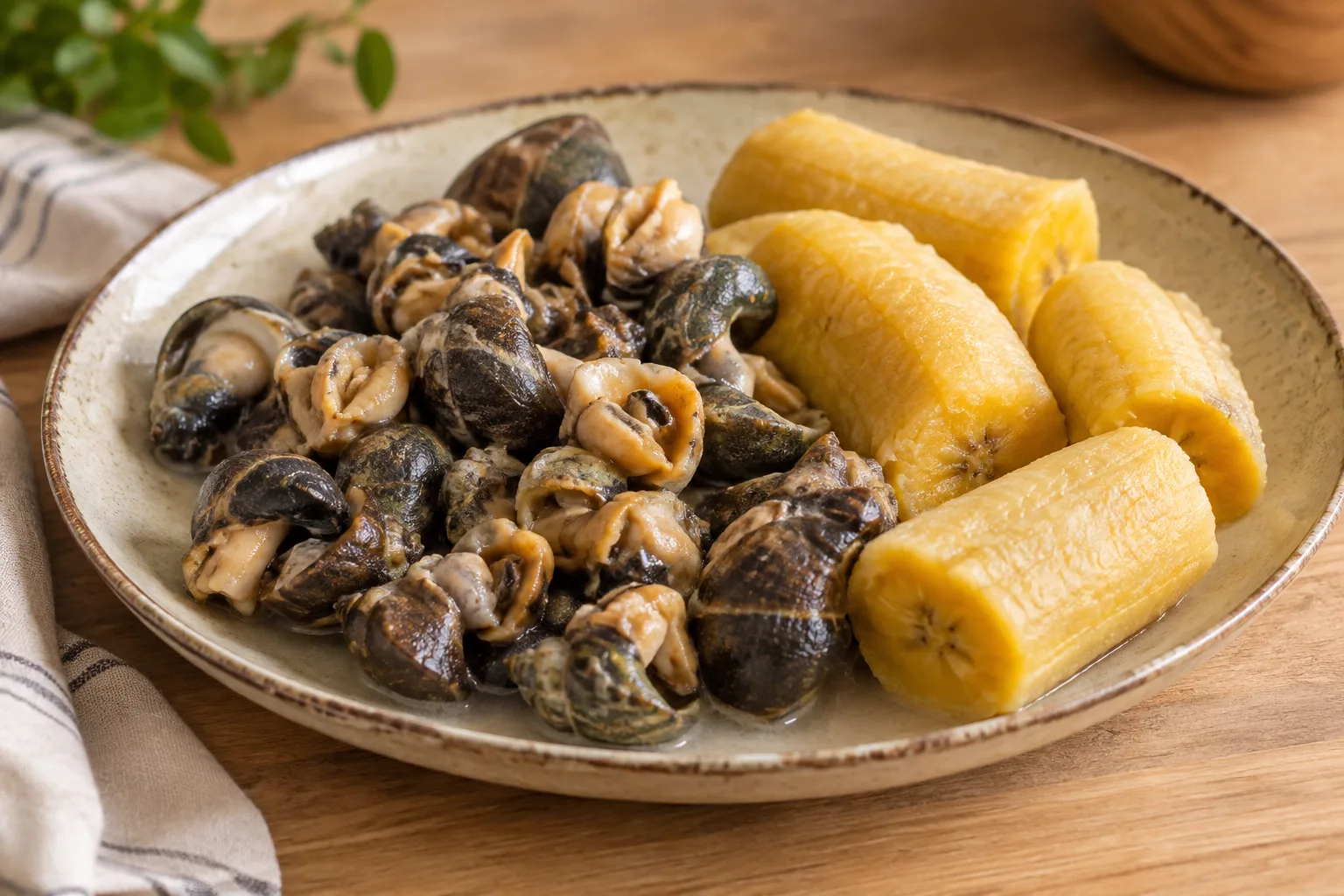
Atanga is the name used in Gabon for safou fruit, from Dacryodes edulis. It is also called African plum, although it is not the same fruit as a European plum. Its flesh surrounds a large central stone. In the boiled preparation, the flesh softens and becomes tender and buttery; the fruit can also be roasted or cooked over embers, methods that give it a more toasted character. It is described as a savory food rather than a sweet dessert plum. Fruit size and ripeness can affect its texture and how long it takes to soften.
When to use it
Use atanga when you want to serve a cooked fruit as a side or part of a savory meal. Boiling suits a softer, more tender flesh; roasting or cooking it over embers provides a different preparation with more toasted notes. It can be served on its own or alongside maize, cassava, or plantain, which are accompaniments rather than ingredients in the fruit. Since size and ripeness vary, judge doneness by texture instead of relying on a fixed cooking time.
How to use it
For the boiled preparation, cook the atanga until its flesh softens; size and ripeness can affect how long this takes, so check the texture rather than relying on a universal time. Once tender, open the fruit and eat the flesh around the large central stone, which remains in the fruit. You can also roast it or cook it over embers for a more toasted flavor. Serve it warm or at room temperature, on its own or with maize, cassava, or plantain. Present these accompaniments separately and make clear whether salt, oil, or a sauce has been added.
Flavour and texture
Cooked atanga has a savory character and tender, buttery flesh surrounding a large stone. The firm flesh may be astringent when raw, while boiling helps soften it. Roasting or cooking over embers changes the profile and adds more toasted notes. Fruit size and ripeness can alter the texture, so individual pieces may not turn out exactly alike.
How to choose it
Choose fruit suitable for the preparation you have in mind and check each piece for bruising, splits, or visible spoilage. Size and ripeness can affect the texture and the time atanga needs to soften, so do not expect every fruit to cook identically. The available information does not establish a buying season or reliable external signs of ripeness; ask the seller how to select the fruit if unsure.
Storage
No verified guidance is available on storage temperature, duration, or method for fresh atanga. Follow the seller’s or package’s storage directions and avoid keeping visibly spoiled fruit with sound pieces. Once cooked, handle it using ordinary food-safety care and consult local guidance for storing prepared foods; do not infer a specific shelf life for this fruit from the information available.
Substitutions
No substitute ingredient for atanga is established here. If you need a different preparation, you can roast it or cook it over embers instead of boiling it; it remains the same fruit, not an equivalent flavor or texture substitute. Maize, cassava, and plantain are mentioned as accompaniments to atanga, not replacements for the fruit.
Common mistakes
Do not mistake atanga for a sweet European plum: it is safou fruit and is described as savory. Do not assume its raw texture will be the same as its cooked texture; the firm flesh may be astringent, and heating softens it. Finally, do not describe maize, cassava, or plantain as ingredients in atanga: they are sides served separately.
Safety and allergens
The preparation described heats the fruit before eating because its firm flesh may be astringent when raw. Do not assume raw atanga is interchangeable with cooked fruit; use ordinary food-handling care and follow the seller’s directions.
Culinary uses
- Cooked savory fruit served as a side
- Warm or room-temperature accompaniment
Recommended techniques
- Boiling until softened
- Roasting or cooking over embers
Pairs well with
- Maize
- Cassava
- Plantain
Frequently asked questions
What is atanga?
It is the name used in Gabon for safou fruit from Dacryodes edulis. It is also called African plum, but it is not a European plum.
How is atanga usually prepared?
It can be boiled until the flesh softens, or roasted and cooked over embers. Boiling gives tender flesh, while roasting adds a more toasted character.
What is served with atanga?
It may be served with maize, cassava, or plantain. These are separate accompaniments, not ingredients in the fruit.
Ingredient allergens
Allergen listThere are no verified associations for these ingredients yet.
Sources and review
Automatically researched, cross-checked and validated content. Sources consulted:
- Client Challenge doi.org/10.2307/jj.27939689.16
- Qué es el maridaje: tipos y consejos - Brandy Fundador brandyfundador.com/actualidad/blog/que-es-el-maridaje/
- - YouTube www.youtube.com/watch?v=hkg4SVdIT0Q
- Chaat Masala: el sabor de la India en cada bocado | Excelencias Gourmet www.excelenciasgourmet.com/es/chaat-masala-el-sabor-de-la-india
- 10 ingredientes exóticos que no deben faltar en tu cocina www.lavanguardia.com/comer/materia-prima/20210427/7318306/x-ingredientes-exoticos-deben-falt…
- Atún Rojo Salvaje Tendencias y Maridajes Modernos | Blog Gadira productosdealmadraba.com/blog/lo-mas-leido/atun-rojo-salvaje-tendencias-gastronomicas-y-mari…
- - YouTube www.youtube.com/watch?v=z58qdJRiIfc
- Achiote u onoto. Origen, qué es y cómo utilizarlo en tu cocina www.abc.es/recetasderechupete/achiote-u-onoto-origen-que-es-y-como-utilizarlo-en-tu-cocina/3…
- ADUKU SUBCOUNTY dl.tufts.edu/downloads/5x21tt47c?filename=nc581033r.pdf
- Strategies for Reducing Voluntary Employee Turnover in ... scholarworks.waldenu.edu/cgi/viewcontent.cgi?article=8991&context=dissertations
- Castañas en la cocina www.enciclopediadegastronomia.es/articulos/historias-de-los-alimentos/frutas-y-hortalizas/ca…
- Ingredientes de la cocina asiática. Cómo para darle a tus platos un toque más exótico www.abc.es/recetasderechupete/ingredientes-de-la-cocina-asiatica-como-para-darle-a-tus-plato…
- Qué es la malanga y cómo puede utilizarse en la cocina - Revista Mia miarevista.okdiario.com/recetas/comida-saludable/18353.html
- Persea americana - Wikipedia, la enciclopedia libre es.wikipedia.org/wiki/Persea_americana
- la oca andina como ingrediente en la pastelería ... innovasciencejournal.omeditorial.com/index.php/home/article/download/89/202/441
- El azafrán, entre los ingredientes más apreciados en gastronomía | Consumer www.consumer.es/alimentacion/el-azafran-entre-los-ingredientes-mas-apreciados-en-gastronomia…
- LAVI PENG www.isenberg.umass.edu/sites/default/files/2025-09/CV_Lavi%20Peng-202508.pdf?1756849729=
- Dr. Barbara Atanga | Johnson C. Smith University www.jcsu.edu/faculty/dr-barbara-atanga
- Climate Change, Flood Disaster Risk and Food Security ... ui.adsabs.harvard.edu/abs/2021FrSFS...506721A/abstract
- Final Sept8 Lottery.xlsx www.stritch.luc.edu/lumen/meded/medicine/medclerk/lotteries/sep8_17_2.pdf
- Gifty Lad Ayela - Department of Agricultural Economics www.ageconomics.k-state.edu/about/people/directory/new_grad_directory/cvs/Gifty_CV.pdf
- Thursday November 17th education.asu.edu/sites/g/files/litvpz656/files/2022-09/2022%20TECBD%20Schedule%20-%20Overvi…
- Meet undergraduate student Eric Atanga - UConn Today today.uconn.edu/2020/10/meet-undergraduate-student-eric-atanga/
- Reducing rice post-harvest losses in sub-Sahara Africa (SSA) – ADM Institute for the Prevention of Postharvest Loss postharvestinstitute.illinois.edu/rice-post-harvest-ndindeng/
- Oscar Atanga tisch.nyu.edu/special-programs/study-abroad/study-abroad-faculty/berlin-faculty/berlin-facul…
- Atanga bouilli: origen, ingredientes y alérgenos www.menuella.com/es/food-wiki/atanga-bouilli