- Category
- Grains, flour and pasta
- State
- Powdered
- Usual unit
- g
What it is
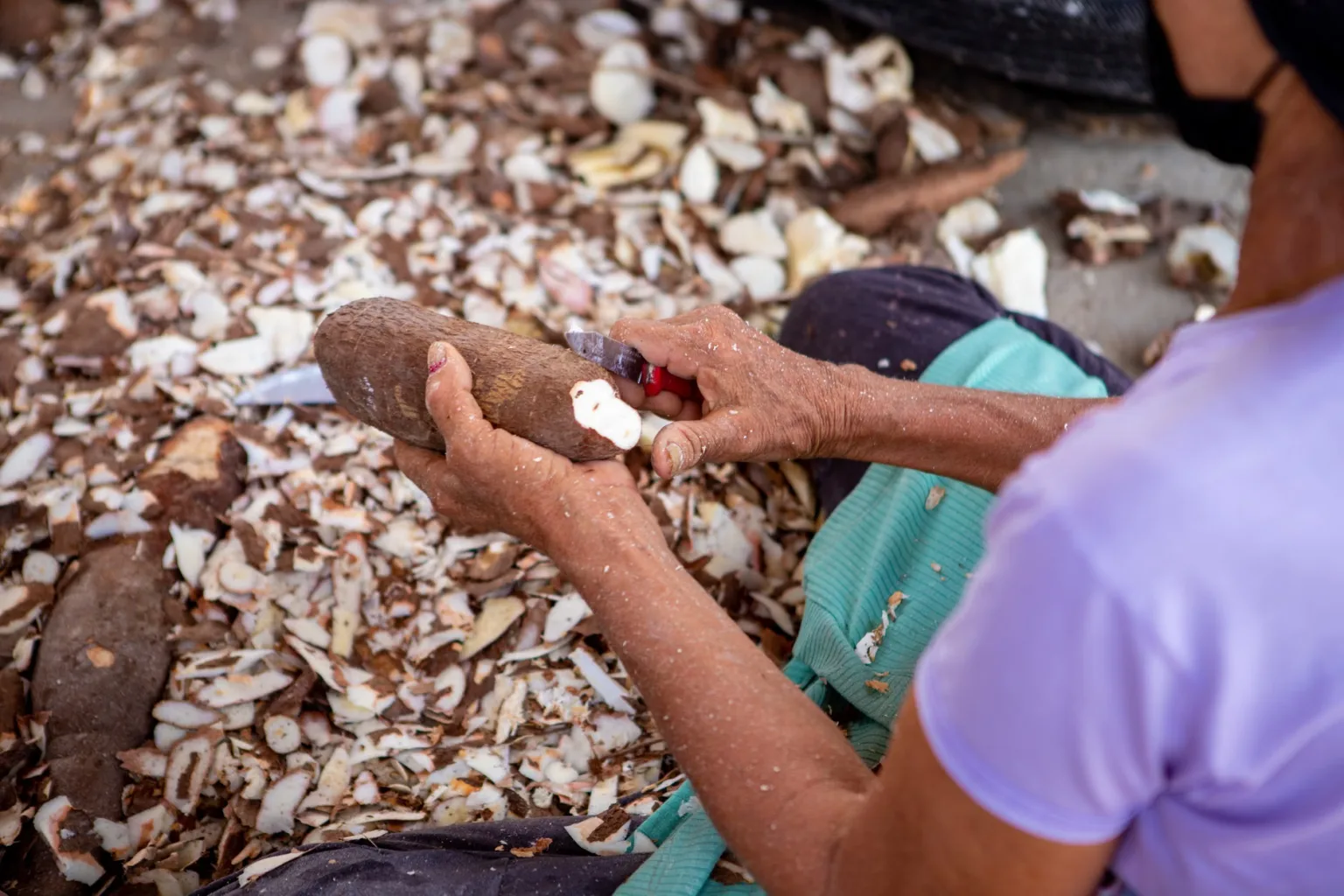
Cassava starch, also known as manioc starch or tapioca starch, is a powdered ingredient extracted from the root of the cassava plant. In production, starch granules are separated from the root pulp and liquid, then dried. It is sold as native starch and also as sour or fermented starch, which is fermented before drying. The two types are not identical in flavor or culinary behavior: native starch is generally milder, while fermented starch has a more acidic character and is used in baking where a lighter crumb is wanted. It is a starch ingredient, not whole-root flour, so its main role is to thicken and alter texture rather than automatically replace all the flour in a recipe.
When to use it
Use it when a sauce, soup or dessert needs thickening, or when a dough needs the texture provided by starch. It can be part of mixes for cakes, muffins and other baked goods. For bread and preparations such as pão de queijo, the type affects the result: sour or fermented starch can help produce a lighter, airier texture, while native starch tends to make a denser bite. If you are replacing wheat flour in bread, do not assume starch behaves the same way on its own; formulation and proportions affect the outcome.
How to use it
Follow the recipe's quantities and method, since the result depends on the preparation and on whether the product is native or fermented. To thicken sauces, soups or desserts, add it as directed by the recipe and cook it as part of the preparation rather than adding it blindly at the end. In doughs and baked goods, mix it with the other ingredients according to the formulation: cassava starch can contribute elasticity and texture, but it does not behave like wheat flour, which contains gluten-forming proteins. In bread, partial replacement of wheat flour depends on the starch type and recipe; changing the proportion can affect viscosity, texture and the finished loaf. For pão de queijo, sour starch is often used for a more airy interior, while native starch can give a denser bite. Do not swap the two without accounting for the change in texture and flavor.
Flavour and texture
Native cassava starch is usually mild in flavor and adds a smooth, elastic or denser texture depending on the recipe. Sour or fermented starch has a more pronounced, acidic profile. In baked goods, the fermented type can contribute to a lighter, airier structure, while native starch tends to produce a more compact result. The finished texture also depends on the other ingredients and the formulation.
How to choose it
Check the package to see whether you are buying native or sour/fermented starch: the type matters because their flavor and texture are not identical. Choose a product labeled cassava or manioc starch if that is what the recipe calls for, rather than assuming whole-root flour is equivalent. For a specific preparation, use the stated type or consider how a substitution will change the texture.
Storage
Follow the storage instructions printed on the package; there is no single duration or storage condition that can be established for every product and package. After opening, use the manufacturer's directions for that particular product and check the package before use. Do not apply instructions intended for fresh cassava root to the starch: they are different products sold in different states.
Substitutions
Native and sour or fermented cassava starch can be substituted only if you are willing to accept changes in acidity and texture; fermented starch can give a lighter result, while native starch can be denser. Modified cassava starch has been studied as a replacement for modified corn starch in specific bread formulations, but that does not make ordinary versions interchangeable in every recipe.
Common mistakes
Do not confuse cassava starch with flour made from the whole root, or assume native and fermented starch will produce the same result. Do not replace all wheat flour with starch without adapting the formulation: its baking behavior differs and can change the texture and structure of bread.
Safety and allergens
Use a packaged food-grade product and follow its preparation and storage directions. No product-specific safety warning is established here that would justify more detailed instructions.
Culinary uses
- Thickener for sauces, soups and desserts
- Texture-setting ingredient in baked goods and doughs
- Gluten-free starch used in baking blends
Recommended techniques
- Disperse and cook into a sauce or soup to thicken
- Mix into dough or batter as directed by the recipe
- Choose native or fermented starch according to the intended texture
Pairs well with
- Sauces and soups
- Desserts, cakes and muffins
- Pão de queijo and other baked preparations
Frequently asked questions
Are cassava starch and cassava flour the same?
Not necessarily. Starch is the fraction extracted from the root; flour may contain more of the root and should not automatically be treated as equivalent.
What is the difference between native and sour cassava starch?
Sour or fermented starch is fermented before drying and has a more acidic, pronounced flavor. It can produce lighter doughs, while native starch tends to give a denser texture.
Can I use it to thicken a sauce or soup?
Yes. It is used as a thickener in sauces and soups. Follow your recipe's method and quantities to achieve the intended consistency.
Ingredient allergens
Allergen listThere are no verified associations for these ingredients yet.
Sources and review
Automatically researched, cross-checked and validated content. Sources consulted:
- ¿Por qué la muerte es origen de miedos y tabúes? doi.org/10.64628/aao.fccyk3qj3
- Efecto de tratamiento térmico y uso de aditivos en las ... bdigital.zamorano.edu/server/api/core/bitstreams/2660891d-ffb3-4001-aab2-f3951eda7d79/conten…
- Manihot esculenta - Wikipedia, la enciclopedia libre es.wikipedia.org/wiki/Manihot_esculenta
- A Discursive Analysis of Culturally Appropriate Food digitalcollections.ohsu.edu/record/7710/files/Grosskopf.Brianne.2018.pdf
- La cocina técnico conceptual: origen, significado, características y propuesta gastronómica a partir de 25 productos cultivados, en la provincia del Azuay-Ecuador | OpenAlex openalex.org/W66629700
- almidón fermentado de mandioca, denominado almidón agrio en Colombia y amido azedo o polvilho azedo (almidón ácido) en Brasil, e... cicytac.cba.gov.ar/wp-content/uploads/2018/03/AnalisisFisico-QuimicosSensoriales.pdf
- Aplicación de almidón de mandioca modificado en pan de molde : una alternativa para la sustitución de almidón de maíz modificado y la sustitución de grasa ri.unlu.edu.ar/items/d8ec8943-4b73-4751-96d7-ebea6685c034
- Characterization of novel cassava genes involved in cyanide ... scholar.uprm.edu/server/api/core/bitstreams/0899cd02-1670-4e36-bf7d-0b8c44eb3ed7/content
- Almidón de yuca - EcuRed www.ecured.cu/index.php?oldid=3753361&title=Almid%C3%B3n_de_yuca
- Almidón de mandioca: un recurso versátil, saludable y sin gluten - FACE celiacos.org/almidon-de-mandioca-un-recurso-versatil-saludable-y-sin-gluten/
- La fécula de mandioca podrá reemplazar en parte a la harina de trigo en el pan www.dicyt.com/noticias/la-fecula-de-mandioca-podra-reemplazar-en-parte-a-la-harina-de-trigo-…
- - YouTube www.youtube.com/watch?v=JjpTrLG_pqU