- Category
- Vegetables
- State
- Fresh
- Usual unit
- g
What it is
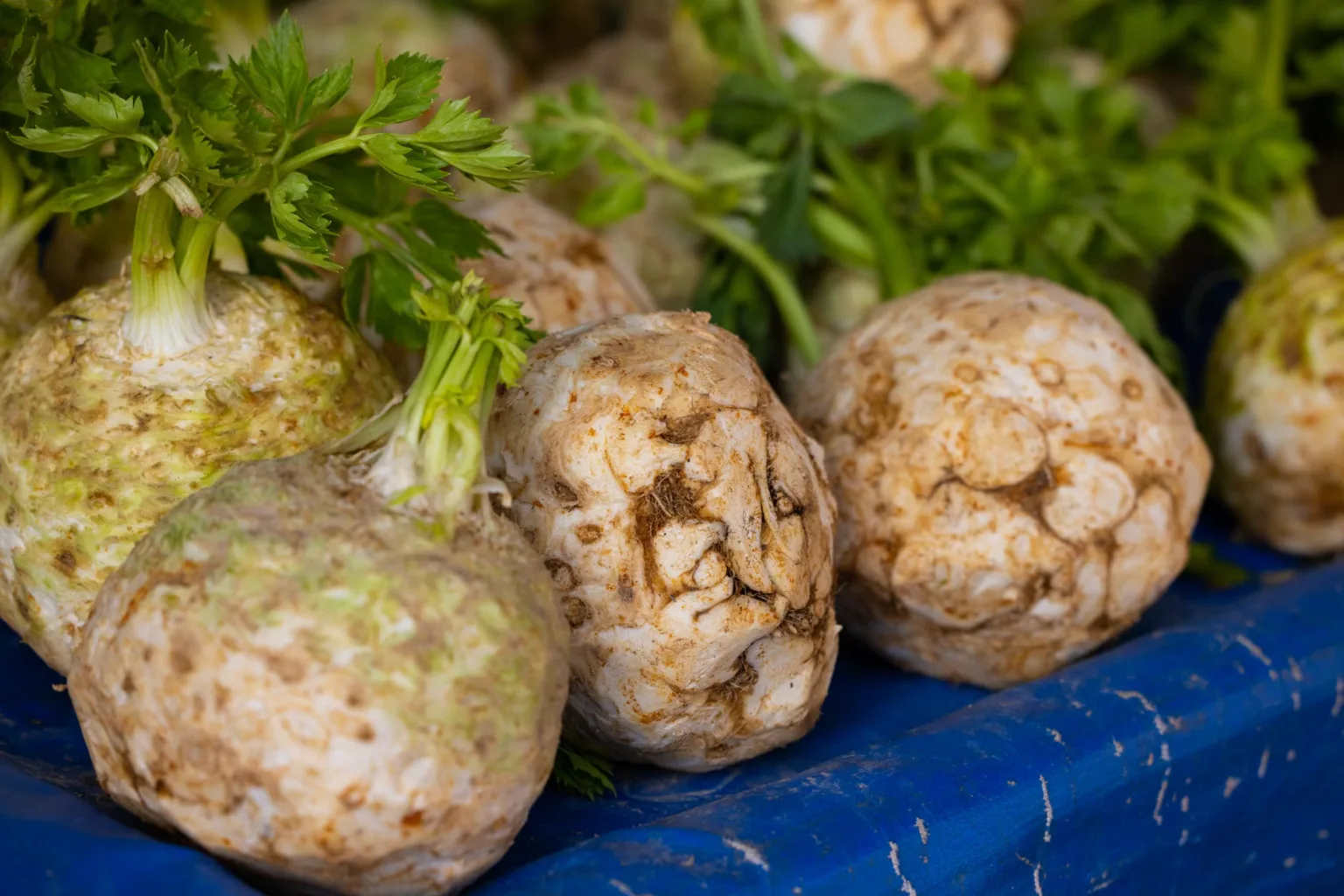
Celeriac, also known as celery root, is the enlarged edible base of a celery variety. It is not the same as the long, crisp stalks of common celery. Its outside is typically rough and knobbly, and it may still have some soil attached, while the inside is pale and firm when raw. An irregular shape alone does not mean that it is spoiled. Once washed and peeled, the flesh can be sliced, grated, or cooked. Celeriac is used raw in salads as well as cooked in soups, purées, and side dishes. It is a vegetable related to common celery.
When to use it
Use celeriac when you want a recognizable celery flavor and crisp texture in a salad, or a milder flavor and softer texture after cooking. Grated raw, it works in salads, including combinations with apple. Cooked, it suits soups, purées, and side dishes, either on its own or mixed with potato; it can also be used in gratins. Choose the preparation to match the texture you want: raw for crunch, cooked for a softer result. Do not reject it simply because it looks irregular if it is firm and shows no signs of spoilage.
How to use it
Wash the root well and remove soil from the surface. Trim the ends so it can sit securely on a cutting board, then peel away the outer skin with a knife. Cut the flesh into cubes, slices, or strips, or grate it for a salad. For a raw dish, combine it with apple or other salad ingredients. For soup or purée, cook it with the other ingredients and blend to your preferred texture. It can also be sautéed, roasted, or cooked in a gratin. For a mash, use celeriac on its own or combine it with potato, then season and serve as you like. Discard pieces that show clear signs of decay or mold.
Flavour and texture
Raw celeriac has a pronounced celery aroma and a crisp texture. Its flesh is pale and firm. Cooking softens both its texture and its flavor, making it suitable for purées, soups, and side dishes. The rough outer skin does not reflect the texture of the flesh and should be removed before use. Grated, it adds crunch to a salad; cooked and mashed, it can be smooth or left with a few pieces, depending on how you prepare it.
How to choose it
Choose roots that feel firm and heavy for their size, with dry skin and no significant bruising, wet patches, dark bruises, or visible mold. The surface may be knobbly, retain a little soil, or have an uneven shape; those features alone do not mean the vegetable is poor quality. When cut, sound flesh should look pale or creamy white. Avoid pieces with clear signs of decay or deterioration.
Storage
Keep the unpeeled root in the refrigerator in an open bag; a piece of paper towel can help absorb excess moisture. A practical guide is to use it within about a couple of weeks, though the condition of each root can vary. Check it before use and discard it if mold or clear signs of decay appear. The evidence available here does not establish a specific storage period for peeled or cut celeriac; handle it cleanly and refrigerate it if you are not using it straight away.
Substitutions
Potato can be a useful alternative in some dishes, especially purées and gratins, but it will not reproduce celeriac’s celery flavor or exactly the same texture. You can also combine celeriac and potato to replace some of the usual potato or to vary a mash. The ratio depends on the flavor and texture you prefer; there is no fixed one-to-one conversion for every recipe.
Common mistakes
Do not confuse celery root with the stalks of common celery: they are different forms with different uses. Another mistake is cooking celeriac without washing and peeling it, since soil can cling to its rough surface. Do not reject a root just because its shape is uneven, but do not overlook significant bruising, wet areas, mold, or signs of decay. Remember that raw celeriac is crunchier and more aromatic than cooked celeriac.
Safety and allergens
Celeriac is celery. People with a celery allergy should avoid eating it and check ingredient and allergen information on prepared products that contain it. Wash the surface and remove the skin before cooking. Discard the root if it has mold or clear signs of decay.
Culinary uses
- Hortaliza de raíz para guarniciones y platos principales
- Ingrediente para sopas, cremas y purés
- Base crujiente para ensaladas crudas
Recommended techniques
- Lavar, recortar los extremos y pelar antes de cocinar
- Rallar crudo para ensaladas
- Cocer y triturar para puré o crema
- Saltear, asar o preparar en gratén
Pairs well with
- Patata
- Manzana
- Yogur o mantequilla
- Tomillo
- Pistacho
Frequently asked questions
Is celery root the same as celery stalk?
Not exactly. Celeriac, or celery root, is a variety grown for its enlarged base; common celery is usually eaten for its stalks and leaves.
Can celeriac be eaten raw?
Yes. Wash and peel it, then grate or slice it thinly for salads. Raw celeriac is crisp and has a pronounced celery aroma.
How should I store celeriac?
Keep it unpeeled in the refrigerator in an open bag. A practical guide is to use it within about a couple of weeks, and discard it if it develops mold or signs of decay.
Ingredient allergens
Allergen listThere are no verified associations for these ingredients yet.
Sources and review
Automatically researched, cross-checked and validated content. Sources consulted:
- ¿Por qué la muerte es origen de miedos y tabúes? doi.org/10.64628/aao.fccyk3qj3
- The Essential Glossary of Cooking Terms for the Culinary Arts - Escoffier www.escoffier.edu/blog/culinary-arts/the-essential-glossary-of-cooking-terms-for-the-culinar…
- Gastronomía sefardí - Wikipedia, la enciclopedia libre es.wikipedia.org/wiki/Gastronom%C3%ADa_sefard%C3%AD
- Gastronomía de Costa Rica - Wikipedia, la enciclopedia libre es.wikipedia.org/wiki/Gastronom%C3%ADa_de_Costa_Rica
- Apio: qué es, beneficios y usos culinarios bonviveur.com/es/noticias/apio
- Agencia Española de Seguridad Alimentaria y Nutrición www.aesan.gob.es/
- Advertencia para personas con alergia al apio: presencia de apio no incluido en etiquetado en caldos y sopas deshidratados procedentes de España. (Ref. ES2025/139) aesan.gob.es/alertas/2025_12
- efectos del cambio climático en la alergia alimentaria www.google.com/goto?url=CAESkgEB6zswFaXfiUe2Kx-wCOjC3Oa7bn6t2Ssf_VFbxKwWk0oqp9YkJHBZHuoMxx-r…
- Advertencia para personas con alergia al apio y/o a la mostaza: presencia de apio y mostaza no declarados en sandwich de bacon y huevo congelado procedente de España. (Ref. ES2025/191). www.aesan.gob.es/alertas/2025_17
- Raíz de apio | Cook for Your Life www.google.com/goto?url=CAESggEB6zswFRNHi4blbzNF6263ciBHZh7hyK_MpZJ45o15XweY49MvfvQsG0PpzzCn…
- Cómo Preparar la Raíz de Apio | Cook for Your Life www.cookforyourlife.org/es/videos/como-preparar-la-raiz-de-apio/
- La raíz de apio se come: cómo sacar partido a este feo tesoro nutricional www.abc.es/bienestar/alimentacion/recetas-saludables/abci-raiz-apio-come-como-sacar-partido-…
- Raíz de apio | Cook for Your Life www.cookforyourlife.org/es/nuestro-blog-de-cocina/raiz-de-apio/
- Food allergen labelling and information requirements technical guidance - GOV.UK www.gov.uk/government/publications/food-allergen-labelling-and-information-requirements-tech…