- Category
- Herbs and spices
- State
- Dry
- Usual unit
- teaspoon
What it is
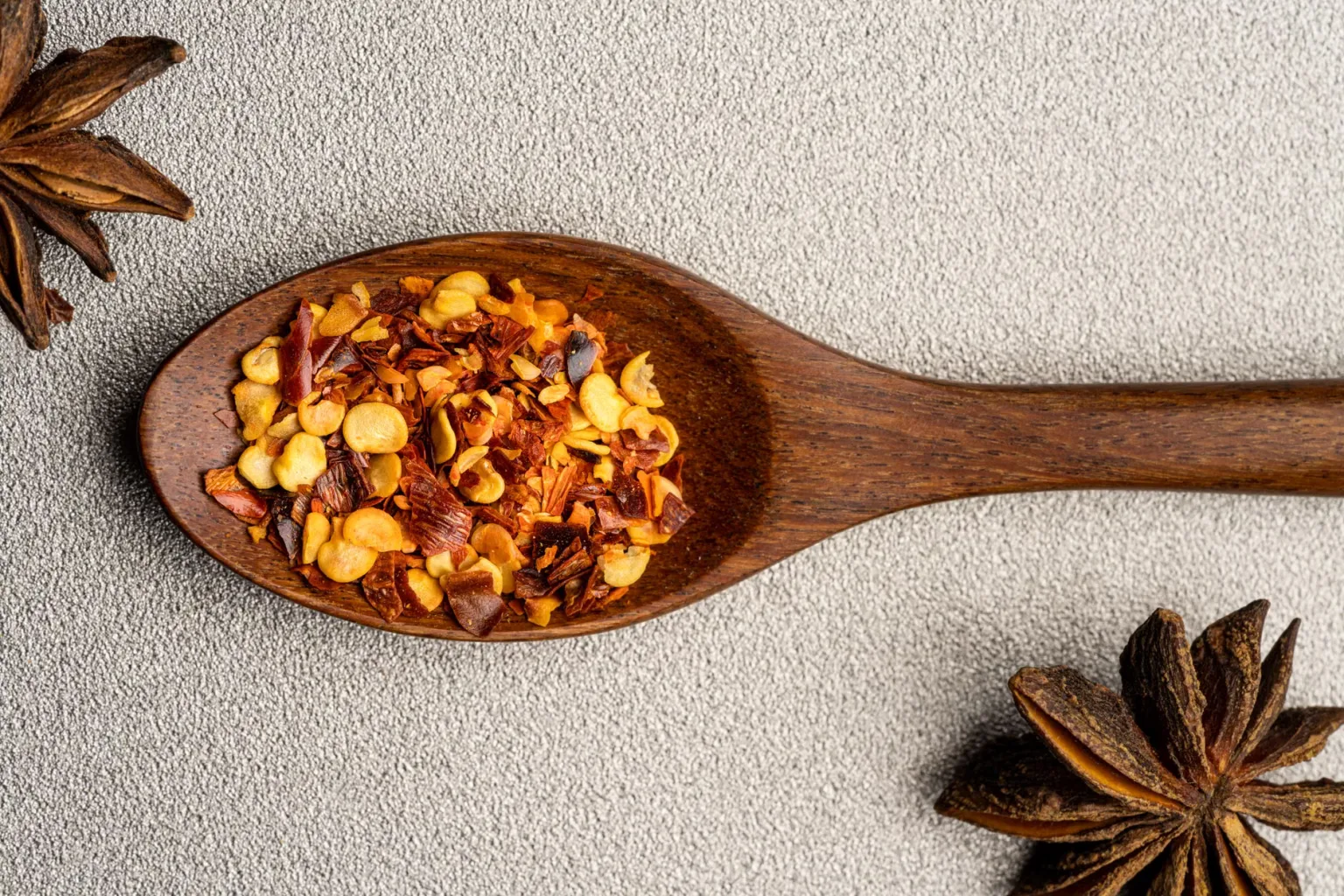
Chilli flakes are pieces of dried chilli that have been crushed into coarse fragments rather than a fine powder. They can be made from different Capsicum varieties and may contain seeds or be sold without them. This means their appearance and heat are not identical from one product to another. Unlike fresh chilli, flakes are a dry seasoning that can be sprinkled over food or stirred into a dish. They are used to add heat to pasta, pizza, stews, soups, curries, sauces, and other preparations. Some products are mild, while others are quite hot. Taste the product and adjust the amount rather than assuming every jar or packet has the same strength.
When to use it
Use chilli flakes when you want to add a controllable, visible touch of heat, either while a dish cooks or just before serving. They work in sauces, pasta, pizza, stews, soups, and curries, and can also provide contrast in some sweet combinations. Because chilli varieties and seed content differ between products, adding the flakes in small amounts makes it easier to manage the result. Taste the dish before adding more, especially when trying a new brand or variety.
How to use it
Stir a small pinch into a sauce, soup, curry, or stew and mix to distribute it. Taste the dish before adding more, since heat depends on the chilli variety and may differ between products. For a finishing touch, sprinkle flakes over pasta, pizza, or a salad just before serving. They can also be combined with garlic or ginger in savoury dishes. When handling a substantial quantity, avoid touching your eyes and wash your hands thoroughly afterwards; capsaicin in chillies can irritate. Do not treat flakes and powder as interchangeable: their particle sizes affect how the seasoning spreads through a dish.
Flavour and texture
Their flavour is typically warm and chilli-like, with heat and aroma that vary according to the variety used. The flakes are dry and coarse, with irregular pieces and seeds that may be present or absent. Sprinkled over food, they can make some bites hotter than others; stirring them through a dish helps distribute the seasoning more evenly.
How to choose it
Check that the product is labelled as dried chilli flakes and look for the variety if it is provided. Some flakes include seeds and others do not; appearance alone does not reliably tell you how hot they will be. If you do not know the product's strength, choose a small pack or begin with a cautious amount. Select a sealed package and check its product and storage instructions.
Storage
Keep the flakes in a tightly closed container in a dry place, and follow the package instructions. Keep moisture out and use a clean, dry spoon when serving them. This helps keep the flakes dry and ready to sprinkle or stir into food. If the label gives different storage directions, follow those; there is no single storage period that applies to every product.
Substitutions
Chilli powder or finely crushed dried chilli can replace flakes, but particle size and heat may change the result. Powder distributes more finely and may make its presence less visible in a dish. Add any substitute gradually, taste, and adjust; avoid assuming a fixed conversion unless you know how hot the product is.
Common mistakes
A common mistake is adding a large quantity before tasting the product. Chilli varieties and blends do not have a uniform heat level, and flakes with seeds may differ from those without. It is also easy to distribute them unevenly if they are sprinkled on at the end without mixing. Start small, stir, and taste before adding more.
Safety and allergens
Capsaicin in chillies can irritate the skin and, especially, the eyes. Avoid touching your face while handling the flakes and wash your hands thoroughly afterwards. Keep the product dry and follow the package storage instructions.
Culinary uses
- Seasoning for adjustable heat
- Visible spicy garnish
Recommended techniques
- Stir into sauces, soups, or stews during cooking
- Sprinkle over a finished dish in small amounts
Pairs well with
- Garlic
- Ginger
- Tomato and pasta
Frequently asked questions
Do chilli flakes always have the same heat?
No. Heat varies with the chilli variety and the product, so start with a little and taste.
Can chilli flakes contain seeds?
Yes. They are sold with or without seeds, so their appearance can vary.
When should I add chilli flakes?
Stir them in during cooking or sprinkle them on when serving. Add them gradually to control the heat.
Ingredient allergens
Allergen listThere are no verified associations for these ingredients yet.
Sources and review
Automatically researched, cross-checked and validated content. Sources consulted:
- ¿Por qué la muerte es origen de miedos y tabúes? doi.org/10.64628/aao.fccyk3qj3
- Guindilla: Botánica, cultura y sabor en una Especia | Alveus www.alveus.eu/es/blog/guindilla-origen-y-tipos/
- Qué es (y qué no es) la estadística, usos y abusos de una disciplina clave en la vida de los países y las personas | Estudios económicos doi.org/10.52292/j.estudecon.2015.740
- Guindilla: qué es, beneficios, usos en la cocina y variedades de este pimiento picante www.directoalpaladar.com/ingredientes-y-alimentos/guindilla-que-beneficios-usos-cocina-varie…
- Hojuelas de chile (¿crudas?, ¿orgánicas?) | Fundación G+E www.diet-health.info/es/recetas/ingredientes/in/uy9408-copos-de-chile
- ETNOBOTÁNICA DE LA AMAZONIA PERUANA digitalrepository.unm.edu/cgi/viewcontent.cgi?article=1306&context=abya_yala
- Amazon.es Los más vendidos: Los productos más populares en Copos de chili www.amazon.es/gp/bestsellers/grocery/6349328031
- Un faccioso más y algunos frailes menos people.duke.edu/~garci/cibertextos/PEREZ-GALDOS-B/Faccioso-mas-frailes-menos/Faccioso-mas-fr…
- Guindilla: qué es, beneficios y usos en la cocina de este pimiento picante www.google.com/goto?url=CAESZgHrOzAVd0OXZieJWwuGTPk3Rdd148oJaELBaE1U9CekqjHzPLHbh-N6CxlQ45YL…
- - YouTube www.google.com/goto?url=CAESZgHrOzAVyLLIbZwAL1ufdsmoTET0CpKS4b6G-ee_3fWlvHLqJUa5ZaNCHvzmllHd…