- Category
- Sauces and condiments
- State
- Dry
- Usual unit
- pinch
What it is
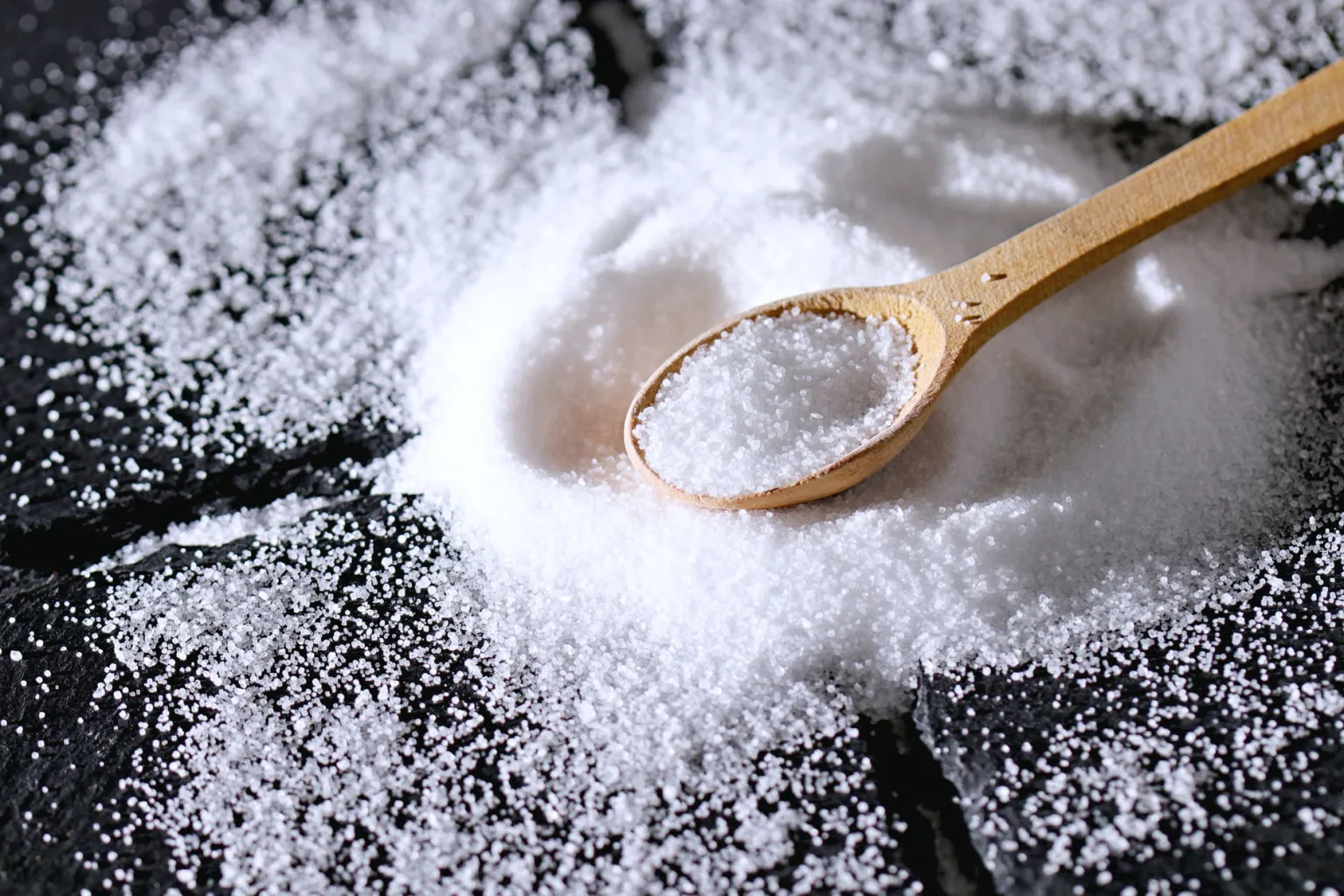
Coarse salt is edible salt sold as large or lightly ground crystals. The name mainly describes grain size, not one specific source: salt can be obtained, for example, from marine saltworks or mines and sold at different levels of refinement. Its basic culinary role is seasoning and enhancing food’s flavors. Compared with fine salt, its crystals take longer to dissolve and feel more distinct when used as a finishing touch. Coarse salts do not all have the same shape, composition, or solubility, so check the package for details about the particular product.
When to use it
Choose coarse salt when the crystal size suits the preparation, rather than assuming it is always interchangeable with unspecified salt in a recipe. It can cover meat or fish before baking and season food during cooking. It can also be added at the end when a visible, crunchy finish is wanted. For soups, sauces, or doughs that need quick, even dissolving, fine salt is often more convenient. Since a pinch by volume changes with crystal size, add the salt gradually and taste the dish as you go.
How to use it
Add coarse salt gradually while cooking, and stir to help distribute and dissolve the crystals. Taste before adding more, especially when other ingredients already contain salt. To bake a whole piece of meat or fish in a salt crust, cover it with a layer of coarse salt; recipes for this method may call for moistening the salt’s surface. For a crunchy finish, scatter a few crystals over the food just before serving rather than mixing them in earlier. When replacing fine salt with coarse salt, do not assume that the same volume measure will produce the same result: adjust gradually to taste.
Flavour and texture
Its taste is salty, like that of other salts; the most noticeable culinary difference is usually texture. Large crystals are more distinct to bite into and can take longer to dissolve than fine crystals. Size, shape, and solubility vary by product, so two coarse salts may behave differently. Salt seasons savory food and can also be used in some sweet preparations, where a small amount may contrast with other flavors.
How to choose it
Check the label to make sure you are buying coarse salt rather than a fine salt sold under a different name. Consider the crystal size and shape for your intended use: regular grains for seasoning, or appealing crystals for finishing a dish. Color, source, and refinement vary by product and do not by themselves guarantee a particular culinary use. If you need to know whether ingredients such as iodine or anti-caking agents have been added, check the ingredient list and package information.
Storage
Keep coarse salt in its tightly closed package or in a clean, dry container, following the label’s directions. Avoid using a damp spoon or allowing food residue into the container, as this can contaminate the salt or encourage clumping. If the product has specific storage instructions, follow those. Check any date and storage guidance printed on the package rather than assuming a special shelf life.
Substitutions
Fine salt can replace coarse salt when seasoning, and coarse salt can replace fine salt if it is given time to dissolve. However, crystals occupy different volumes and the texture will change, so a spoonful or pinch of one is not always equivalent to the same measure of the other. Add gradually and taste. Fine salt will not create the same appearance or crunch in a salt crust or a crisp finishing sprinkle.
Common mistakes
Do not measure fine and coarse salt as though a spoonful of each must be equivalent: crystal size affects how much fits in a measure. Avoid adding a large handful at once, since the crystals may take time to dissolve and an over-salted dish can be difficult to correct. Do not assume all coarse salt comes from the sea or that every product dissolves in the same way; check the label and taste as you cook.
Safety and allergens
Use clean, dry salt, keep the package closed, and follow the product instructions. Season gradually and account for salt already present in other ingredients; if you have been advised to limit salt, follow that personal guidance.
Culinary uses
- seasoning
- finishing garnish
- flavor enhancer
Recommended techniques
- seasoning during cooking
- sprinkling just before serving
- forming a salt crust for baking
Pairs well with
- meat
- whole fish
- vegetables
- chocolate and desserts
Frequently asked questions
Is coarse salt the same as sea salt?
Not necessarily. “Coarse” mainly describes crystal size, while “sea salt” describes a type of source. Check the product label to see how the salt is identified.
Can I use coarse salt instead of fine salt?
Yes, for seasoning, but allow it time to dissolve and adjust gradually. Volume measures can produce different results because the crystals are different sizes.
What is coarse salt especially useful for?
It is useful for covering meat or fish before baking and for adding distinct crystals as a finishing touch. It can also season food during cooking.
Ingredient allergens
Allergen listThere are no verified associations for these ingredients yet.
Estimated nutrition
- Fat
- 0 g
- Saturates
- 0 g
- Carbohydrate
- 0 g
- Sugars
- 0 g
- Protein
- 0 g
- Salt
- 100 g
Sources and review
Automatically researched, cross-checked and validated content. Sources consulted:
- Client Challenge doi.org/10.2307/jj.27939689.16
- 15 tipos de sal para dar variedad a nuestros platos: cómo elegirlas y usarlas en la cocina www.directoalpaladar.com/ingredientes-y-alimentos/15-tipos-sal-para-dar-variedad-a-nuestros-…
- Sabor a sal: 10 variedades que debes conocer y usar cooking.elmundo.es/noticias/2024/08/16/sabor-sal-10-variedades-debes-conocer.html
- Vamos a Conservar Alimentos: Ingredientes Utilizados en las Conservas Preparadas en Casa extension.psu.edu/vamos-a-conservar-alimentos-ingredientes-utilizados-en-las-conservas-prepa…
- Elaboración de Conservas a Presión (Pressure Canning) | VCE Publications | Virginia Tech pubs.ext.vt.edu/348S/348-585S/348-585S.html
- Salsa de Chile II (Spanish) - National Center for Home Food Preservation nchfp.uga.edu/how/can/canning-salsa/chile-salsa-ii-spanish/
- Tipos de sal: ¿sabes cuál hay que escoger en cada momento? www.carnesmarch.com/es/novedades/74-tipos-sal-cocinar.html
- Tipos de sal y su uso en la cocina profesional - EN LA COCINA Magazine enlacocina.telemesa.es/cocina/tipos-de-sal-y-su-uso-en-la-cocina-profesional/
- Online and Official Price Indexes: Measuring Argentina's ... www.hbs.edu/ris/Supplemental%20Files/Cavallo-Argentina-JME-Appendix_54491.pdf
- Comité Científico www.aesan.gob.es/dam/jcr%3A37c06c87-ec8b-4abb-b7ea-16b9f9c582b8/comite_cientifico_1.pdf
- Ensalada de Nopales www.cordonbleu.edu/news/ensalada-de-nopal/mx