- Category
- Fish and seafood
- State
- Fresh
- Usual unit
- g
What it is
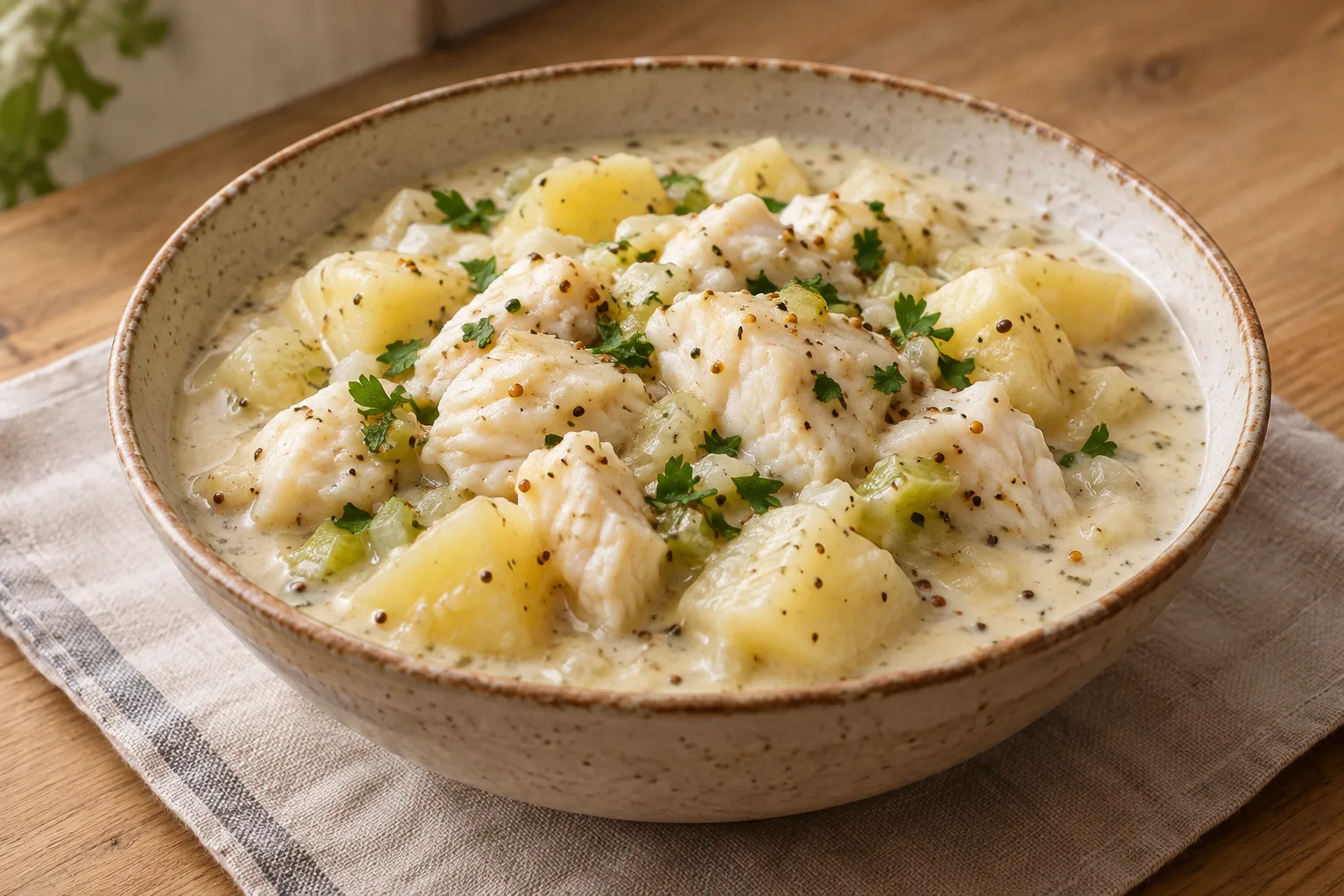
Cod is a common name used for fish in the genus Gadus, although the word also appears in the names of other fish and its use can vary by region and market. Atlantic cod and Pacific cod are familiar species within that genus. In the kitchen, fresh cod is valued for its mild taste, white flesh, and firm texture that separates into flakes when cooked. Fresh cod should not automatically be treated as the same product as salt cod: salted fish is preserved and requires different preparation. Check the product name and condition on the label so you know whether you have fresh, salted, smoked, or another form of cod.
When to use it
Fresh cod suits meals that call for a mild fish able to sit comfortably alongside a sauce or side dish without overwhelming it. Serve a portion as a baked, steamed, or gently poached main, or cut it up for frying, soup, or a flaked salad. Use a simple preparation when you want its delicate flavor to stand out; choose tomato, garlic, potatoes, or peppers for a heartier plate. If a recipe specifically calls for salt cod, do not assume fresh cod can replace it without adjustments: the salt level and preparation are different.
How to use it
Keep the fish in the condition specified on its package and follow the product directions. Fresh fillets or loins can be baked or roasted, steamed or cooked en papillote, gently poached, or fried, including in a light coating. Add lemon, butter, or herbs for a restrained accompaniment, or serve it with tomato and garlic, potatoes, peppers, or aioli. Avoid cooking it longer than needed, since the flesh can dry out. For soups, salads, croquettes, or fritters, cook the fish first and separate it into flakes. Taste before adding salt, especially when the dish also contains salty ingredients.
Flavour and texture
Cod has a mild flavor and white flesh that is firm and flakes into distinct pieces when cooked. Its restrained taste works with a range of seasonings and sauces without requiring strong flavors. The finished texture depends on the cut and cooking method; excessive heat or cooking can make the fish dry, while careful cooking helps it remain tender. Fresh cod does not have the same salty taste or characteristics as cod preserved in salt.
How to choose it
Read the label to confirm that the product is fresh cod rather than salted, smoked, frozen, or thawed fish. Since the common name can cover different species or commercial uses, check the species or product designation if it matters to your recipe. Choose a piece that is intact and kept under the cold conditions specified by the seller. Select loins, fillets, chunks, or flakes to suit the dish; available cuts vary.
Storage
Store fresh cod according to the package directions and applicable food-safety guidance. Keep raw fish separate from ready-to-eat food and do not leave it outside the stated cold-storage conditions. If you will not use it promptly, follow the label to determine whether it should be refrigerated or frozen and how to handle it. Do not use desalting instructions for salt cod on a fresh product.
Substitutions
Haddock or flounder can work in some dishes that suit mild white fish with delicate flesh. They are not identical to cod, and the firmness, flake size, and cooking result may differ, so adapt the cut and watch the cooking. In recipes that depend on salt cod, fresh alternatives will not provide the same saltiness or preserving role.
Common mistakes
Do not confuse fresh cod with salt cod: they have different salt levels and require different preparation. Avoid cooking the fish longer than necessary, as it can become dry. Taste before adding extra salt if the dish includes salty ingredients or a seasoned sauce. Check that the species and cut suit the recipe.
Safety and allergens
Handle and store fish according to its package directions and official food-safety guidance. Keep it under the stated cold-storage conditions and prevent raw fish from contacting ready-to-eat foods. Cook appropriately before serving.
Culinary uses
- Main protein in a meal
- Flaked ingredient for fritters, croquettes, soups, and salads
Recommended techniques
- Bake or roast
- Steam or cook en papillote
- Fry or pan-fry
- Poach
Pairs well with
- Lemon, butter, and fresh herbs
- Tomato, garlic, and olive oil
- Potatoes, peppers, and aioli
Frequently asked questions
Is fresh cod the same as salt cod?
No. Salt cod is a preserved product with a different salt level and preparation. This profile covers fresh cod.
How can I cook fresh cod?
Bake, roast, steam, cook it en papillote, poach it gently, or fry it. Choose a method that suits the cut and avoid overcooking so the flesh does not dry out.
What flavors pair well with cod?
Lemon, butter, and herbs make gentle accompaniments. Tomato, garlic, olive oil, potatoes, peppers, and aioli also work well with cod.
Ingredient allergens
Allergen listThere are no verified associations for these ingredients yet.
Estimated nutrition
- Fat
- 2.94 g
- Saturates
- 0.59 g
- Carbohydrate
- 5.29 g
- Sugars
- 0 g
- Fibre
- 0.6 g
- Protein
- 12.4 g
- Salt
- 1.04 g
Sources and review
Automatically researched, cross-checked and validated content. Sources consulted:
- Client Challenge doi.org/10.2307/jj.27939689.16
- The Essential Glossary of Cooking Terms for the Culinary Arts - Escoffier www.escoffier.edu/blog/culinary-arts/the-essential-glossary-of-cooking-terms-for-the-culinar…
- Culinary Mestizaje: An Afro-Latino Collective Sensory ... via.library.depaul.edu/cgi/viewcontent.cgi?article=1404&context=dialogo
- IEW Recipes | OISS | Rice University oiss.rice.edu/recipes
- Secretos de la alta cocina revelados: Cómo cocinar nuestro bacalao de autor como un chef estrella - Bacalao BARQUERO bacalaobarquero.com/secretos-de-la-alta-cocina-revelados-como-cocinar-nuestro-bacalao-de-aut…
- Para la ciudadanía www.aesan.gob.es/para-la-ciudadania
- Evolución del léxico culinario desde 1932 a 1972 | OpenAlex openalex.org/W2291578502
- Essentials of Basque Cooking recreational.ice.edu/Courses/Detail/13874
- Holiday Memories from the CIA Faculty | CIA Culinary School www.ciachef.edu/blog/holiday-memories/
- A Culinary Voyage: Spanish Cuisine | Le Cordon Bleu London www.cordonbleu.edu/london/culinary-voyage-spanish-cuisine-cookery-course/en
- Bacalao - Wikipedia, la enciclopedia libre es.wikipedia.org/wiki/Bacalao
- Bacalao y fogonero para hostelería | Pescanova Fish Solutions : Pescanova Fish Solutions fishsolutions.pescanova.es/catalogo/pescado-para-hosteleria/bacalao-y-fogonero-para-hosteler…
- Domina la cocina del bacalao: técnicas y tips que debes saber | Albacor albacor.es/domina-la-cocina-del-bacalao-tecnicas-y-tips-que-debes-saber/
- Food allergen labelling and information requirements technical guidance - GOV.UK www.gov.uk/government/publications/food-allergen-labelling-and-information-requirements-tech…