- Category
- Grains, flour and pasta
- State
- Dry
- Usual unit
- cup
What it is
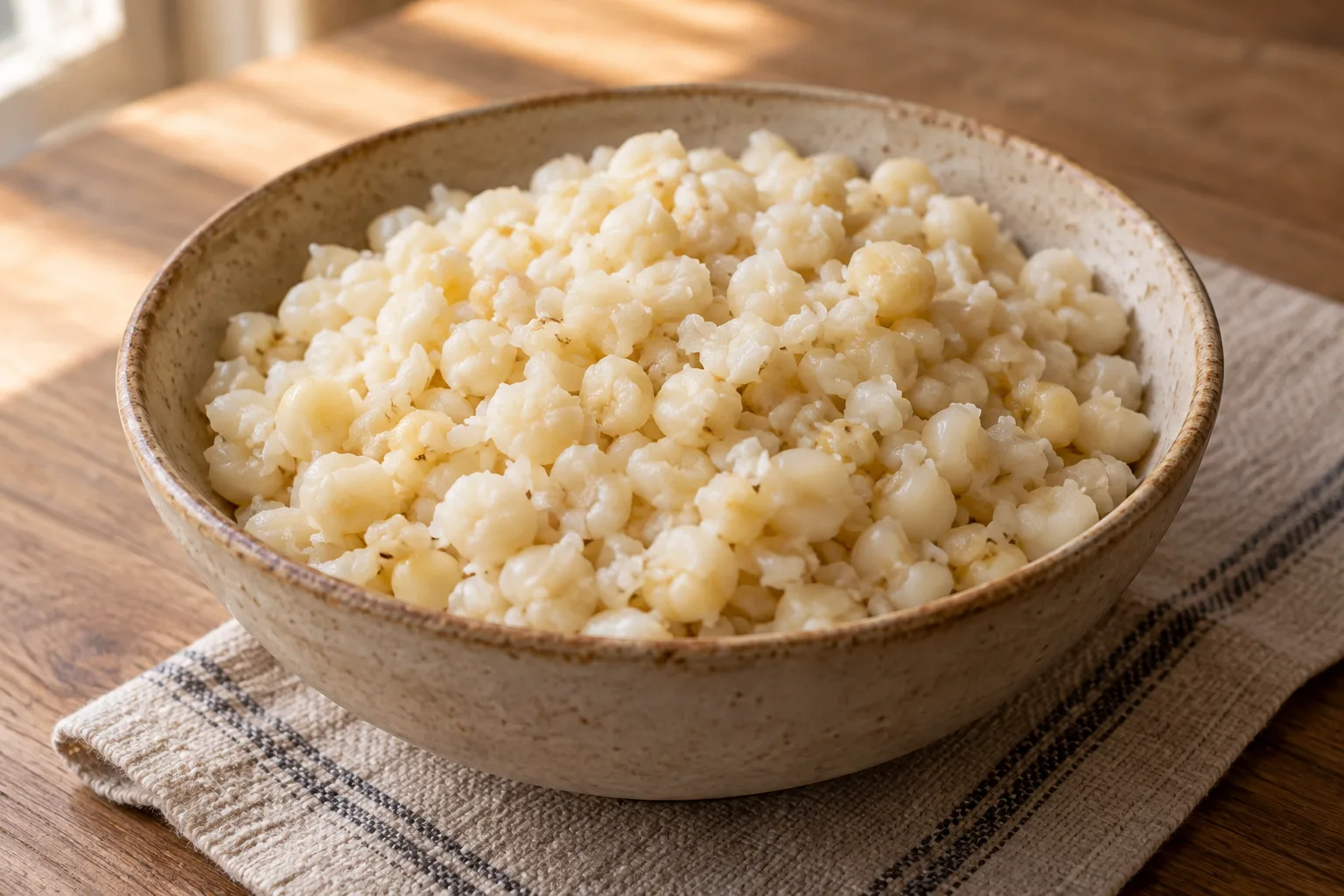
Cracked maize samp is identified as maize in the form of broken grain, rather than fresh corn on the cob or fine maize flour. Maize is a cereal whose grain is used as food in different preparations. “Cracked” describes the product's broken form, but does not by itself specify the size of the pieces, whether any part of the grain has been removed, or whether it has undergone another treatment. Check the name and directions on the particular package instead of assuming that all products called samp have the same form or are prepared in the same way. This profile treats it as a maize pantry ingredient; it does not specify a brand, variety, or manufacturing process.
When to use it
Use it when you want maize in a liquid-based preparation such as soup or broth, provided the directions for this product suit the recipe. It may also be included in a substantial dish where the grain adds body. The available information does not establish a cooking time or liquid ratio for this particular product, so check the package before planning the meal. If you substitute another maize product, bear in mind that a different particle size can change both the texture and the preparation.
How to use it
Start by reading the package directions: no cooking time or liquid ratio is established here for this particular product. If the label says it needs cooking, follow those directions and use a liquid-based preparation such as soup or broth only if the product is suitable for it. You can pair it with ingredients often used alongside maize, including tomato, cheese, lime, or red beans. Check the texture as it cooks, and do not automatically use the timing for whole kernels, flour, or polenta. Do not assume that it needs soaking or is ready to eat; confirm those details on the label.
Flavour and texture
The product is identified as cracked maize, but the available information does not describe the flavor, sweetness, or finished texture of this particular samp. Piece size and processing may vary between products, so a uniform texture cannot be promised and it should not be equated directly with whole maize, flour, or polenta. Check the label and observe the texture during the preparation it specifies. Tomato, lime, cheese, and red beans are possible accompaniments to maize and can bring contrast or a softer element to a dish.
How to choose it
Look for a package clearly identified as cracked maize samp, and check its preparation and storage directions before buying. Confirm that it is broken grain rather than flour, fine meal, or another form of maize, since these produce a different texture. The available information does not support recommending a specific variety, piece size, or brand. If you need it for a particular recipe, choose a product whose label gives directions clear enough to plan how to use it.
Storage
Exact storage conditions and shelf life may vary by product, and the available information does not establish them for every samp. Follow the date and instructions printed on the package. Once opened, protect the product and close the package according to the manufacturer's directions. Do not infer its storage life from the ingredient name alone. If the package is damaged or the product shows changes that concern you, do not use it and check the manufacturer's information.
Substitutions
Another cracked maize product may be the closest substitute, although piece size and processing can change the preparation needed. Coarse maize meal or polenta can also work if the recipe allows a different texture; neither is an exact equivalent for cracked samp. Check the substitute's directions and adapt the preparation to that product. No equivalent quantities are established for these substitutions.
Common mistakes
Do not automatically treat it as fresh maize, fine flour, or whole kernels: the product is identified as cracked maize, and directions can vary. Avoid assigning it a cooking time or liquid ratio without checking the package. If you choose polenta or flour as a substitute, expect a different texture and follow that product's own directions rather than assuming it will behave like samp.
Safety and allergens
Follow the package directions for handling, preparation, and storage. The available information does not establish whether this particular product needs soaking or cooking, or whether it is ready to eat; check the label rather than assuming.
Culinary uses
- Broken maize grain for substantial dishes
- Maize component in soups and other broth-based preparations
Recommended techniques
- Cook according to the product package directions
- Add to a soup or broth only when the package directions suit that preparation
Pairs well with
- Tomato
- Cheddar cheese
- Lime
- Red beans
Frequently asked questions
What is cracked maize samp?
It is identified as a maize product in the form of broken grain. The available information does not specify the piece size or exact processing, so check the package label.
Can I add it to soup?
Maize is used in broth-based preparations. You can add this product to soup if its preparation directions suit that use; follow the package instructions.
Can I substitute polenta for it?
Polenta may work if the recipe allows a different texture, but it is not equivalent to cracked grain. Follow the polenta package directions.
Ingredient allergens
Allergen listThere are no verified associations for these ingredients yet.
Sources and review
Automatically researched, cross-checked and validated content. Sources consulted:
- ¿Por qué la muerte es origen de miedos y tabúes? doi.org/10.64628/aao.fccyk3qj3
- ¿Qué es el maridaje de sabores? - Hostelería Benidorm www.hosteleriabenidorm.com/2024/11/15/maridaje-de-sabores-que-es/
- La guía práctica para un buen maridaje - Industrias Espadafor S.A. espadafor.es/guia-para-un-buen-maridaje/
- Maíz: qué es, tipos y beneficios bonviveur.com/es/noticias/maiz
- ¿Conoces los diferentes tipos de maíz que existen y cómo usarlos en la cocina? - Todos a comer www.todosacomer.net/diccionario/conoces-diferentes-tipos-maiz-que-existen
- Zea mays - Wikipedia, la enciclopedia libre es.wikipedia.org/wiki/Zea_mays
- El maíz, un alimento muy versátil | Huercasa www.huercasa.com/maiz-historia-usos-y-propiedades-de-un-producto-unico/el-maiz-un-alimento-m…
- EL MAÍZ EN LOS TRÓPICOS: Mejoramiento y producción www.fao.org/4/x7650s/x7650s08.htm
- Project Based Learning – Prince | EDT 622 sites.miamioh.edu/edt222-2017/2017/07/project-based-learning-prince/
- - YouTube www.youtube.com/watch?v=vnbBksi9Uw4
- El maíz nativo: un tesoro ancestral en la gastronomía - UNAM Global unamglobal.unam.mx/global_revista/el-maiz-nativo-un-tesoro-ancestral-en-la-gastronomia/
- Ingredientes que maridan con maíz ✓ basmatic.com/maridaje/maiz