- Category
- Fruit
- State
- Dry
- Usual unit
- g
What it is
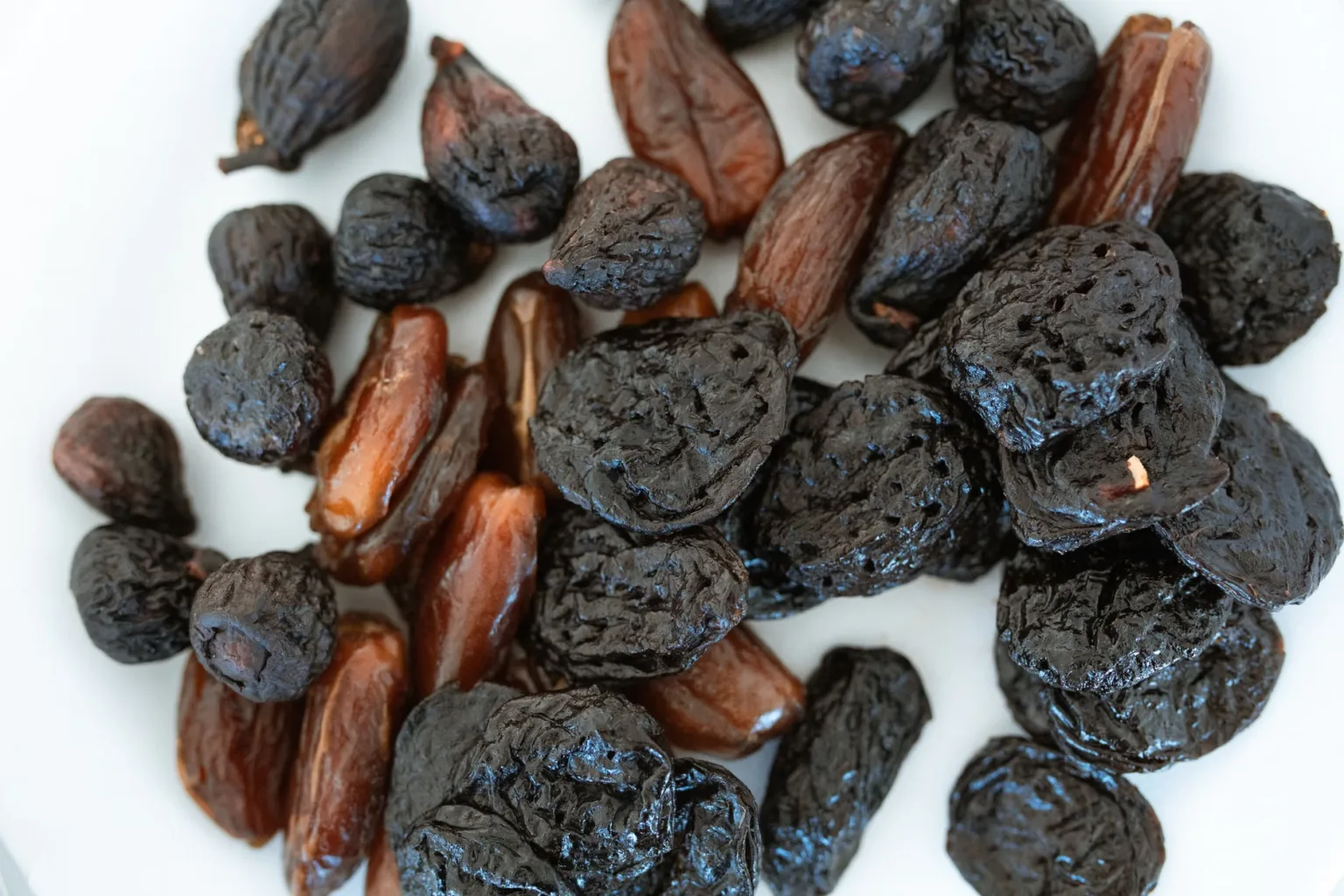
Dried prunes, also called prunes or dried plums, are plums prepared by drying. Not every plum is intended for this product; suitable varieties are selected for drying. The result is a sweet dried fruit, and its texture can vary between products. Some descriptions characterize the fruit as soft, but that should not be assumed for every package. The Spanish common name guindón can be ambiguous: in this profile it means a dried plum, not a sour cherry. Dried prunes are sold as food and are also described in forms such as juice. Check the product label to confirm what you have purchased.
When to use it
Use dried prunes when you want a sweet dried fruit to eat on its own or when a recipe can accommodate fruit of this kind. They can also be added to blended drinks and fruit preparations such as fruit salads or smoothies. Their sweetness and texture may affect the result, so add them gradually and adjust to taste. If a recipe calls for a particular fruit, do not assume dried prunes will give the same flavor or consistency.
How to use it
Dried prunes can be eaten as they come in the package, provided the product is in good condition and its label gives no different directions. For a drink, add them to the mixture and blend to the consistency you want; increase the amount gradually because they add sweetness. You can also add them to a fruit salad or another preparation that allows dried fruit. Check the ingredient list for additions and follow the package directions. No verified soaking instructions or specific cooking times are available here, so do not assume a particular preparation method is required.
Flavour and texture
Dried prunes are described as sweet, and some products are described as soft. Texture can vary from one product to another, so check the package and the fruit before deciding how to use it. Their sweetness suits eating on its own or adding to drinks and fruit preparations.
How to choose it
Look for a label that identifies the product as prunes or dried plums. The Spanish name guindón can be ambiguous, so do not rely on that common name alone when shopping. Check that the package is intact, read the ingredient list, and note the storage directions provided for the product.
Storage
Follow the storage directions on the package; the available information does not establish one universal storage method or shelf life. Keep the product in its package or another suitable container as directed by the label, and do not rely on a general storage period that is not stated there. Follow any specific instructions given for the product after opening.
Substitutions
Another variety of dried plum is the closest alternative, though sweetness and texture may differ. The available information does not establish a distinct ingredient as an equivalent substitute. Use another fruit only if the recipe allows changes, and expect the flavor and texture to be different.
Common mistakes
The word guindón can be confused with a sour cherry, leading to the wrong purchase; confirm the product name on the label. Do not assume every dried plum has the same sweetness or texture, or that one storage method and duration apply to every package. Follow the product directions.
Safety and allergens
No specific official safety warning for this ingredient is established in the available information. Follow the package directions and avoid eating the product if it shows clear signs of spoilage.
Culinary uses
- Sweet dried fruit for eating as a snack
- Fruit ingredient for drinks and other dishes
Recommended techniques
- Eat as-is
- Blend into a drink or smoothie
Pairs well with
- Fruit salads
- Smoothies
Frequently asked questions
What are dried prunes?
They are plums that have been dried, also known as prunes or dried plums.
How can I use dried prunes?
Eat them on their own or add them to drinks and fruit preparations when the recipe allows.
Does the Spanish word guindón always mean a dried prune?
The word can be ambiguous. Check that the label identifies the product as prunes or dried plums.
Ingredient allergens
Allergen listThere are no verified associations for these ingredients yet.
Estimated nutrition
- Fat
- 0 g
- Saturates
- 0 g
- Carbohydrate
- 64 g
- Sugars
- 38 g
- Fibre
- 6 g
- Protein
- 2 g
- Salt
- 0 g
Sources and review
Automatically researched, cross-checked and validated content. Sources consulted:
- Client Challenge doi.org/10.2307/jj.27939689.16
- Gastronomía del Perú - Wikipedia, la enciclopedia libre es.wikipedia.org/wiki/Gastronom%C3%ADa_del_Per%C3%BA
- Page 3 | See All Pest Management and Education - Pest Management and Education - Insects, Pests, and Diseases extension.psu.edu/insects-pests-and-diseases/pest-management-and-education/see-all-pest-mana…
- Duke University Dissertation Template dukespace.lib.duke.edu/server/api/core/bitstreams/b552a83c-0281-4df2-8cea-ad9d99e90736/conte…
- DESIGN HEURISTICS dalyresearch.engin.umich.edu/wp-content/uploads/sites/237/2018/02/The-Psychology-of-Design-C…
- Guindón | HerbaZest www.herbazest.com/es/hierbas/guindon
- Guindón, el super fruto peruano que contiene vitamina B y fortalece la salud cardiovascular y ósea - Infobae www.infobae.com/peru/2024/04/18/descubre-cual-es-la-fruta-cultivada-en-el-peru-que-contiene-…
- Propiedades De Los Guindones Para La Salud 2024 campograndeperu.com/propiedades-de-los-guindones/?srsltid=AYCX9vLPB3k8SUn0t3AxjnCrjKRr6dUpr-…
- Guinda- Historia, propiedades y producción - Región de Murcia Digital www.regmurcia.com/servlet/s.Sl?r=ReP-23757-DETALLE_REPORTAJESPADRE&sit=c%2C543%2Cm%2C2715