- Category
- Vegetables
- State
- Fresh
- Usual unit
- leaf
What it is
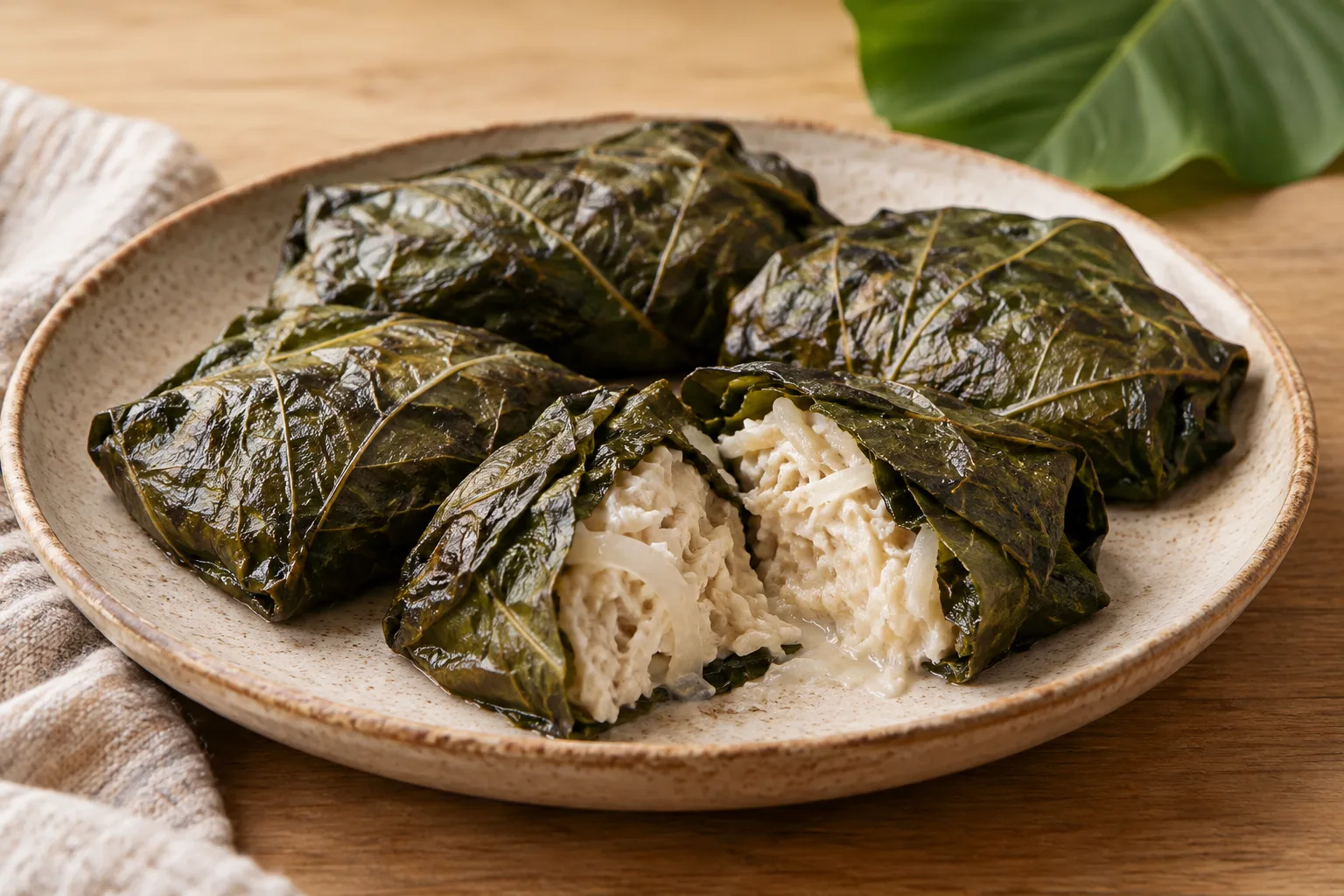
Edible taro leaves are the leaves of Colocasia esculenta, also called taro and belonging to the Araceae family. They are used as a cooked vegetable and can also wrap food. They are distinct from the taro corm or tuber: although both come from the same plant, the leaves have different culinary uses. Young leaves are described as suitable for cooking and serving as a vegetable, while larger leaves can be used as wrappers. Their preparation is compared with that of other leafy greens, such as mustard or turnip greens. Available information says the leaves should be cooked before eating; do not serve them raw.
When to use it
Choose taro leaves when you want to add a cooked leafy vegetable to a soup or stew, or when you need leaves to wrap food that will be cooked afterward. They can also be paired with coconut cream or tropical fruit, combinations described for cooked leaves. Use them in recipes that allow thorough cooking, not in raw preparations. If a recipe calls for mustard or turnip greens, taro leaves may work as a culinary alternative, though the result will differ. The available information does not establish a specific season.
How to use it
Confirm that the product is sold as edible taro leaves, and remove any visibly deteriorated parts. Do not taste the leaves raw: available information says they should be cooked before eating. Add them to a soup or stew and cook them thoroughly, or prepare them in a way similar to other cooked leafy greens, such as mustard or turnip greens. You can also serve them cooked with coconut cream or combine them with tropical fruit. Large leaves may be used to wrap food, provided the preparation cooks them adequately. No verified cooking times or temperatures for these leaves are available; follow a reliable recipe for the dish and do not serve them undercooked.
Flavour and texture
Taro leaves are used as a cooked leafy vegetable, and their preparation is compared with that of mustard or turnip greens. The available information does not establish one precise flavor profile for every variety or stage of maturity. Young leaves are described as suitable for cooking and serving as a vegetable, while larger leaves can function as wrappers. The final texture depends on the leaf and how it is cooked. Coconut cream and tropical fruit are among the culinary pairings described.
How to choose it
Look for fresh leaves clearly identified as edible taro and intended for culinary use. Common names can vary, so confirm that you are buying leaves for cooking rather than an ornamental plant. Choose leaves without obvious deterioration, and ask the seller if the product’s intended use or preparation is unclear. The available information does not establish more detailed commercial criteria for judging variety, maturity, or quality.
Storage
The available information is not sufficient to recommend a specific storage method or duration for fresh taro leaves. Follow package directions or the seller’s advice, and keep the leaves separate from ready-to-eat foods until preparation. Do not use leaves that show obvious deterioration. If you cannot confirm that they are in good condition, do not use them; no safe storage duration is established here.
Substitutions
Mustard greens or turnip greens may replace taro leaves when a recipe allows another cooked leafy vegetable, since taro-leaf preparation is compared with that of those greens. They are not identical substitutes and may change the dish’s flavor and texture. Choose greens intended for cooking and make sure the recipe allows them to be cooked thoroughly. Adjust the amount and timing to suit the dish rather than assuming all greens behave alike.
Common mistakes
The main mistake is eating taro leaves raw or leaving them undercooked: available information says they should be cooked before consumption. Do not assume that any plant called taro or sold as an ornamental is a food product; confirm that the leaves are identified as edible. Another mistake is substituting other greens without allowing for a change in flavor and texture.
Safety and allergens
Do not eat taro leaves raw; cook them thoroughly before consumption. Use leaves identified as edible and follow the product’s preparation directions or a reliable recipe. The available information does not provide specific cooking times or temperatures, so none are stated here.
Culinary uses
- Cooked leafy vegetable in stews and soups
- Leaf wrapper for food that will be cooked
Recommended techniques
- Cook thoroughly before eating; do not serve raw
- Simmer in a soup or stew until fully cooked
- Prepare like other cooked leafy greens
Pairs well with
- Coconut cream or coconut milk
- Tropical fruit
- Stews and other vegetables
Frequently asked questions
Can taro leaves be eaten raw?
No. Available information says they should be cooked before they are eaten.
How are taro leaves used?
They are cooked as a vegetable, added to soups or stews, or used to wrap food that will then be cooked.
What can I use instead of taro leaves?
Mustard greens or turnip greens may work in recipes that allow another cooked leafy vegetable, but the flavor and texture will change.
Ingredient allergens
Allergen listThere are no verified associations for these ingredients yet.
Estimated nutrition
- Fat
- 0.74 g
- Saturates
- 0.15 g
- Carbohydrate
- 6.7 g
- Sugars
- 3.01 g
- Fibre
- 3.7 g
- Protein
- 4.98 g
- Salt
- 0.01 g
Sources and review
Automatically researched, cross-checked and validated content. Sources consulted:
- Etiquetado de sustancias que causan alergias e intolerancias alimentarias www.aesan.gob.es/seguridad-alimentaria/informacion-alimentaria/etiquetado-sustancias
- El taro www.joseanalija.com/taro/
- Taro, ñame o malanga: los tubérculos peludos | CocinaSinReceta.com www.cocinasinreceta.com/tecnicas/manual-de-instrucciones/taro-name-o-malanga-los-tuberculos-…
- Taro | HerbaZest www.herbazest.com/es/hierbas/taro
- Taro raíz china: qué es y cómo se cocina www.finedininglovers.es/explorar/noticias/que-es-el-taro-la-raiz-tropical-parecida-las-patat…
- Allergies - Food Safety - European Commission food.ec.europa.eu/food-safety/campaign-2026/allergies_en
- Food Allergies | FDA www.fda.gov/food/nutrition-food-labeling-and-critical-foods/food-allergies
- Risk assessment of food allergens: part 1: review and validation of Codex alimentarius priority allergen list through risk assessment: meeting report www.who.int/publications/i/item/9789240042391
- Food Allergy: Labelling and exposure risks - PMC pmc.ncbi.nlm.nih.gov/articles/PMC11250542/
- Allergen guidance for food businesses - GOV.UK www.gov.uk/government/publications/allergen-guidance-for-food-businesses/allergen-guidance-f…
- Client Challenge doi.org/10.2307/jj.16192337.4
- ¿Qué es el taro y cuáles son sus famosas propiedades? salroche.com/blogs/tips-saludables/que-es-el-taro-y-cuales-sus-famosas-propiedades?srsltid=A…
- Aprovechamiento integral de raíces de ahipa (Pachyrhizus ahipa) y sus productos derivados con fines alimentarios | OpenAlex openalex.org/W1522495052
- Dioscorea - Wikipedia, la enciclopedia libre es.wikipedia.org/wiki/Dioscorea
- ¿Qué es el taro y cuáles son sus famosas propiedades? salroche.com/blogs/tips-saludables/que-es-el-taro-y-cuales-sus-famosas-propiedades?srsltid=A…