- Category
- Grains, flour and pasta
- State
- Dry
- Usual unit
- cup
What it is
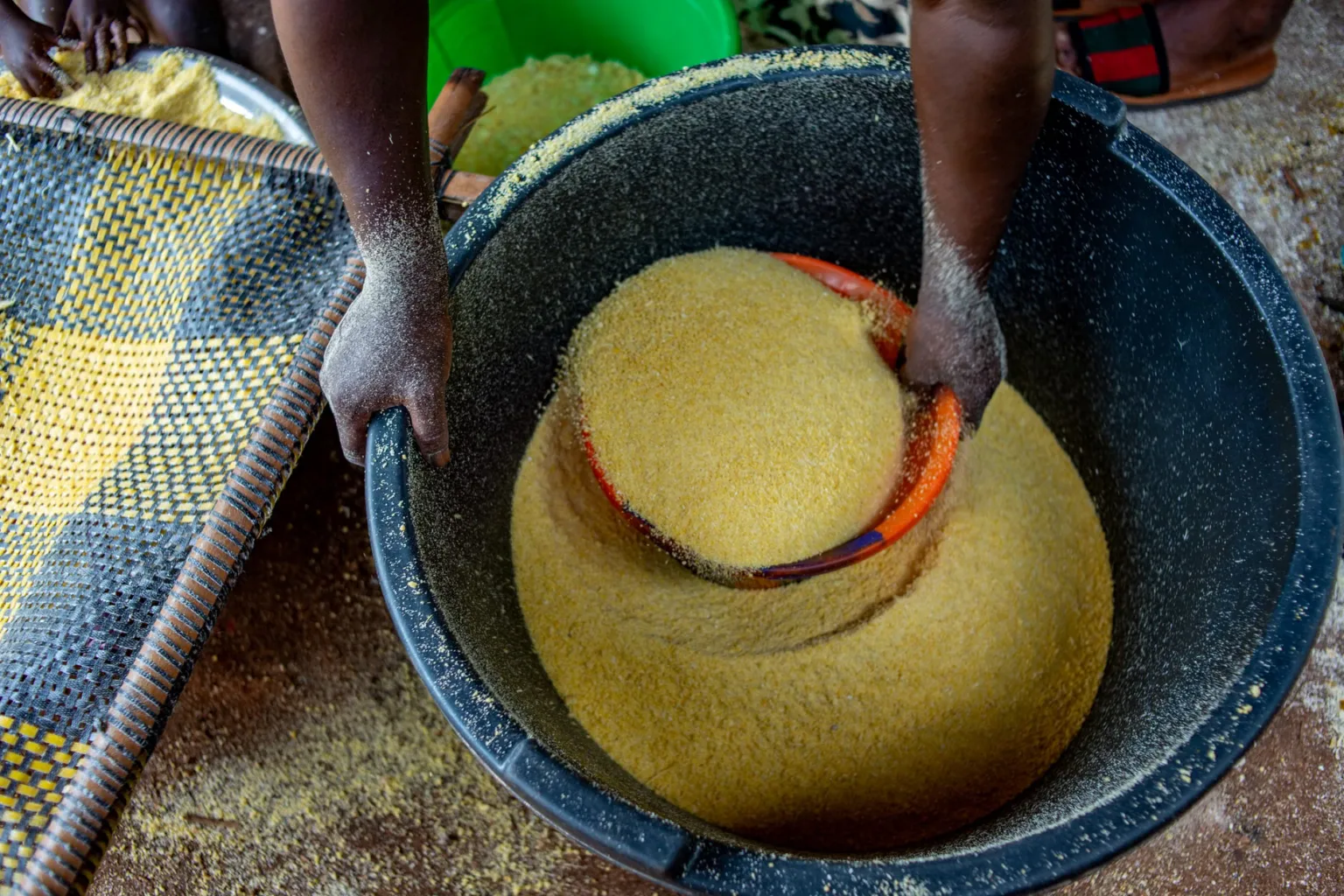
Fine white cornmeal is a milled product made from dried white corn kernels. Its fine grind distinguishes it from coarse cornmeal or grits, which have larger particles. It is also different from cornstarch: cornstarch is the starch extracted from corn, not flour milled from the whole kernel. The name “cornmeal” can cover products made using different processes, including raw, precooked or nixtamalized flour. For that reason, color and grind alone do not tell you exactly how a product will behave in a recipe; check the package and use the product as directed. Fine white cornmeal brings a recognizable cereal flavor and can be used in doughs, baked goods and coatings.
When to use it
Choose it when you want a corn flavor and a finer texture than coarse meal would give. It can be added to doughs and baked goods, combined with other flours, or used as a coating. In bread and dough recipes that need elasticity or structure that cornmeal alone does not provide, combine it with another flour suited to the recipe. Do not automatically use it in place of cornstarch: milled corn flour and corn starch are different products with different behavior. Nor should you assume that any corn flour is suitable for tortillas; precooked and nixtamalized flours are distinct products.
How to use it
Check the package before cooking to see whether the product is raw, precooked or nixtamalized, since these types are not always used in the same way. To add it to dough, mix it with the dry ingredients or gradually whisk it into liquid so it is distributed evenly. In breads, cakes and other baked goods, combine it with another flour when the recipe needs structure that cornmeal alone cannot provide. For a coating, cover the food evenly and cook it according to the recipe. Do not treat it as cornstarch when thickening sauces or creams: this flour has a more recognizable corn flavor and is not the same ingredient. Adapt the recipe to the grind and specific product named on the package.
Flavour and texture
Its flavor is recognizably corn-like and usually more noticeable than that of cornstarch, which is mostly starch and serves a different purpose. The fine grind feels less grainy than coarse meal, although the result depends on the product. White color reflects the type of corn used, while processing can also affect the flour. In doughs and coatings, it contributes a distinct cereal character; it does not behave exactly like wheat flour or corn starch.
How to choose it
Read the precise product description on the package: fine cornmeal, grits, cornstarch, precooked flour and nixtamalized flour are not interchangeable terms. Check that the product is made from white corn and is finely ground if that is what your recipe requires. Dry corn products can be made using different methods, which affects their uses. Avoid coarse grits when a fine texture is needed. For recipes such as tortillas or arepas, verify that the flour type matches the recipe.
Storage
Keep the flour dry in a clean, tightly closed container, away from moisture and strong odors. Follow the package directions, especially after opening, because storage guidance can vary by product and processing method. Use a dry spoon and reseal the package after each use. If the flour becomes damp or shows unusual changes or signs of spoilage, do not use it; check the manufacturer's storage guidance.
Substitutions
Fine yellow cornmeal can work in some doughs or coatings, but it will change the color and may alter the flavor. Finely ground whole-grain cornmeal may also suit some recipes, though it can give a more noticeable texture. Do not substitute cornstarch automatically: it is corn starch, not meal ground from the kernel. Precooked and nixtamalized flours are not universal replacements either; choose an alternative suited to the intended use.
Common mistakes
A common mistake is confusing fine cornmeal with cornstarch, polenta or tortilla flour; these are different products and cannot always be swapped in the same proportions. Another is assuming all corn flours have been processed alike. Check the package, especially when a recipe calls for precooked or nixtamalized flour. In doughs, do not assume cornmeal alone will provide the same structure as wheat flour.
Safety and allergens
Use product that is in good condition, keep it dry and follow the package directions. If you need to avoid an ingredient, check the label of the specific product before using it.
Culinary uses
- Base ingredient for batters and doughs
- Adds corn flavor and texture to baked goods
- Coating for frying
Recommended techniques
- Whisk into liquid gradually to reduce lumps
- Mix with other flours for doughs and baked goods
- Use as a coating before frying
Pairs well with
- Water or stock
- Cheese and savory fillings
- Wheat or rice flour in blended doughs
Frequently asked questions
Is fine cornmeal the same as cornstarch?
No. Cornmeal is made by milling corn; cornstarch is starch extracted from corn. They have different uses and produce different results.
Can I use it to make tortillas?
Not necessarily. A tortilla recipe may require nixtamalized corn flour. Check the type specified by the recipe and on the package.
Can I replace it with fine yellow cornmeal?
For some preparations, yes, but the color and flavor may change. The result also depends on the recipe and how the flour was processed.
Ingredient allergens
Allergen listThere are no verified associations for these ingredients yet.
Sources and review
Automatically researched, cross-checked and validated content. Sources consulted:
- The Essential Glossary of Cooking Terms for the Culinary Arts - Escoffier www.escoffier.edu/blog/culinary-arts/the-essential-glossary-of-cooking-terms-for-the-culinar…
- Evaluación de harina de amaranto como ingrediente antioxidante para la preparación de matrices alimentarias funcionales doi.org/10.35537/10915/162211
- Harinas de maíz ¿Cuántos tipos hay y para qué sirven? - Formacion en Gastronomia www.formacionengastronomia.com/cocina-latina/harinas-de-maiz-cuantos-tipos-hay-y-para-que-si…
- La harina de maíz y sus diferentes usos en la cocina | masymas supermercados www.supermasymas.com/blog/la-harina-de-maiz-y-sus-diferentes-usos-en-la-cocina/
- Building Communication between Serve City and the Hamilton ... etd.ohiolink.edu/acprod/odb_etd/ws/send_file/send?accession=muhonors1114807342&disposition=i…
- Eating Spain: National Cuisine Since 1900 - UKnowledge uknowledge.uky.edu/context/hisp_etds/article/1031/viewcontent/Eating_Spain_National_Cuisine_…
- Analyzing Food Sources and Food Insecurity of Kichwa ... scholarworks.uark.edu/cgi/viewcontent.cgi?article=1045&context=csesuht
- Beneficios de la harina de maíz en la cocina panceliac.com/beneficios-harina-maiz-cocina/
- Diferencias entre polenta, maicena y harina de maíz bonviveur.com/es/noticias/diferencias-entre-polenta-maicena-y-harina-de-maiz