- Category
- Fruit
- State
- Fresh
- Usual unit
- unit
What it is
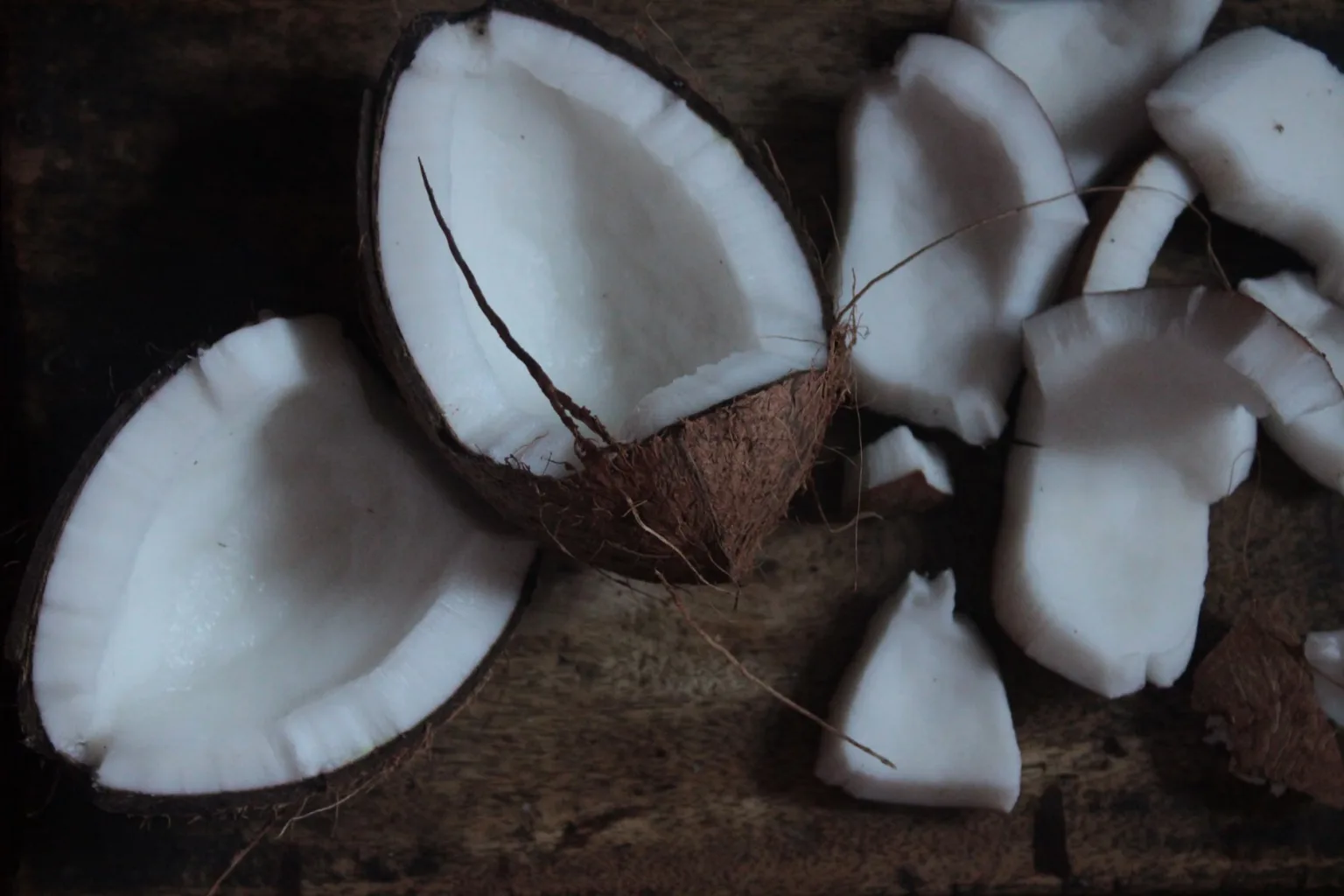
Fresh coconut is the fruit of the coconut palm. Often called a nut in everyday speech, botanically it is a drupe, with an outer covering, a fibrous layer, a hard inner shell, and an edible interior containing white flesh and water. Market coconuts may have some of their outer covering removed and may appear brown and hard-shelled. The balance of water and flesh, as well as the flesh's firmness, changes as the fruit matures: a younger coconut generally has more water and softer flesh, while a mature one has denser flesh and less water. Choose the stage that suits the intended use. The water can be drunk, and the flesh can be eaten fresh, grated, or processed into coconut milk.
When to use it
Choose fresh coconut when you want to use both the water and the flesh, or when freshly grated flesh would add flavor and texture to a dish. Grated flesh works in curries, rice dishes, sauces, and Caribbean- or Asian-inspired food, as well as in baking and desserts. The water can be served as a drink. A younger coconut is often a better fit if you want plenty of water and tender flesh; a mature one is usually more suitable when you need firmer flesh for grating. These differences depend on maturity and can vary from fruit to fruit.
How to use it
Set the coconut on a stable surface and open it carefully; the inner shell is hard. Collect the water in a clean container if you plan to drink it or use it in a dish. Remove the white flesh, then cut it, eat it fresh, or grate it. Add grated flesh to curries, rice, salads, sauces, or desserts for flavor and texture. To make coconut milk, blend the flesh with water and strain the mixture; adjust the water to suit the consistency you want. Fresh coconut can sometimes replace dried coconut in a recipe, but it adds more moisture and has a different texture. Check whether a recipe calls for flesh, water, or milk: they are distinct ingredients and are not interchangeable in equal amounts.
Flavour and texture
Fresh coconut has a distinctive, sweet flavor. Its water is light and liquid, while the flesh is white, juicy, and crisp when fresh. Maturity changes the texture: flesh from a young coconut may be more tender, while mature coconut flesh is denser and firmer. These differences also affect how much water and flesh you get from each fruit.
How to choose it
Choose a coconut for the job: a younger one for more water and tender flesh, or a more mature one if you want firm flesh to grate. The outside appearance varies with maturity and with how much of the outer covering has been removed, so color alone does not tell you exactly how to use it. If possible, ask whether it is young or mature, and choose a fruit that appears intact and free of visible damage.
Storage
Keep the coconut whole until you are ready to open it and follow the handling advice provided where you buy it; the available information does not establish one storage time or temperature that applies to every coconut. After opening, handle the water and flesh with clean utensils and protect them from contamination. The fruit's maturity and condition when purchased can affect how long it remains in good quality.
Substitutions
Unsweetened dried grated coconut can replace grated fresh flesh, but it is drier and does not reproduce the fresh coconut's juiciness. Canned coconut milk can stand in for the liquid component of coconut milk made from fresh flesh, although its consistency may differ. Do not automatically substitute coconut milk for coconut water; they have different uses and textures.
Common mistakes
Do not treat coconut water, flesh, and coconut milk as the same ingredient; they are different components and are not always interchangeable. Do not expect young and mature coconuts to have the same texture: maturity changes flesh firmness and water content. When replacing fresh flesh with dried coconut, remember that the dried product contributes less moisture.
Safety and allergens
The inner shell is hard, so open the coconut carefully on a stable surface and keep fingers clear of the tool. Use clean utensils when collecting the water and removing the flesh; do not eat a fruit that shows obvious spoilage.
Culinary uses
- Fresh edible flesh for sweet or savory dishes
- Coconut water served as a drink
Recommended techniques
- Open and extract the water and flesh
- Grate fresh flesh for toppings or cooking
- Blend flesh with water and strain to make coconut milk
Pairs well with
- Curries and rice dishes
- Tropical fruit and desserts
- Savory dishes with sweet-and-salty flavors
Frequently asked questions
Can you eat both the flesh and the water?
Yes. The white flesh and the water inside are edible and can be used separately.
What is the difference between a young and a mature coconut?
As a coconut matures, its water generally decreases and its flesh becomes denser and firmer. A young one may suit drinking and tender flesh, while a mature one is often better for grating.
How do you make coconut milk from fresh coconut?
Blend the flesh with water and strain the mixture. Adjust the amount of water for a thinner or thicker result.
Ingredient allergens
Allergen listThere are no verified associations for these ingredients yet.
Estimated nutrition
- Fat
- 33.49 g
- Saturates
- 29.7 g
- Carbohydrate
- 15.23 g
- Sugars
- 6.23 g
- Fibre
- 9 g
- Protein
- 3.33 g
- Salt
- 0.05 g
Sources and review
Automatically researched, cross-checked and validated content. Sources consulted:
- ¿Por qué la muerte es origen de miedos y tabúes? doi.org/10.64628/aao.fccyk3qj3
- Client Challenge doi.org/10.2307/jj.27939689.16
- The Essential Glossary of Cooking Terms for the Culinary Arts - Escoffier www.escoffier.edu/blog/culinary-arts/the-essential-glossary-of-cooking-terms-for-the-culinar…
- El coco rallado: Historia, Curiosidades y Usos ruca.es/el-coco-rallado-historia-curiosidades-y-usos/
- Comité Científico aesan.gob.es/dam/jcr:1c57d784-1e9a-48ba-abfc-8dc315083560/comite_cientifico_12.pdf
- El coco: de fruta tropical a producto estrella del bienestar www.plataformatierra.es/actualidad/el-coco-producto-estrella-del-bienestar
- Aprende todo sobre el coco en la enciclopedia Cocinista www.cocinista.es/web/es/enciclopedia-cocinista/ingredientes-del-mundo/coco.html
- opinión científica www.aesan.gob.es/dam/jcr:711cce41-8de5-461c-b787-05c58ba1d61c/establecimientos_minoristas.pd…
- Recipe Pamphlets in the Chef Louis Szathmáry Collection of Culinary Arts A-D - Special Collections and Archives - University of Iowa Libraries www.lib.uiowa.edu/sc/louis/
- Tanzania Food Composition Tables | The Nutrition Source nutritionsource.hsph.harvard.edu/wp-content/uploads/2023/09/Tanzania-Food-Composition-Tables…
- Elaboración de pastas artesanales con ocho tipos de harinas y su aplicación en nuevas recetas | OpenAlex openalex.org/W2197804739
- El coco es una... - Carlos Merchan Agricultura y Tecnología www.google.com/goto?url=CAES2AEB6zswFWDUVBl9jXQ9GIquWa3ifuF4c_SzCwkrN3Huka3i-4Y9DyDd9vkJsaom…
- Cocos nucifera - Wikipedia, la enciclopedia libre es.wikipedia.org/wiki/Cocos_nucifera
- - YouTube www.youtube.com/watch?v=3fn7Wt6ybUA