- Category
- Vegetables
- State
- Fresh
- Usual unit
- g
What it is
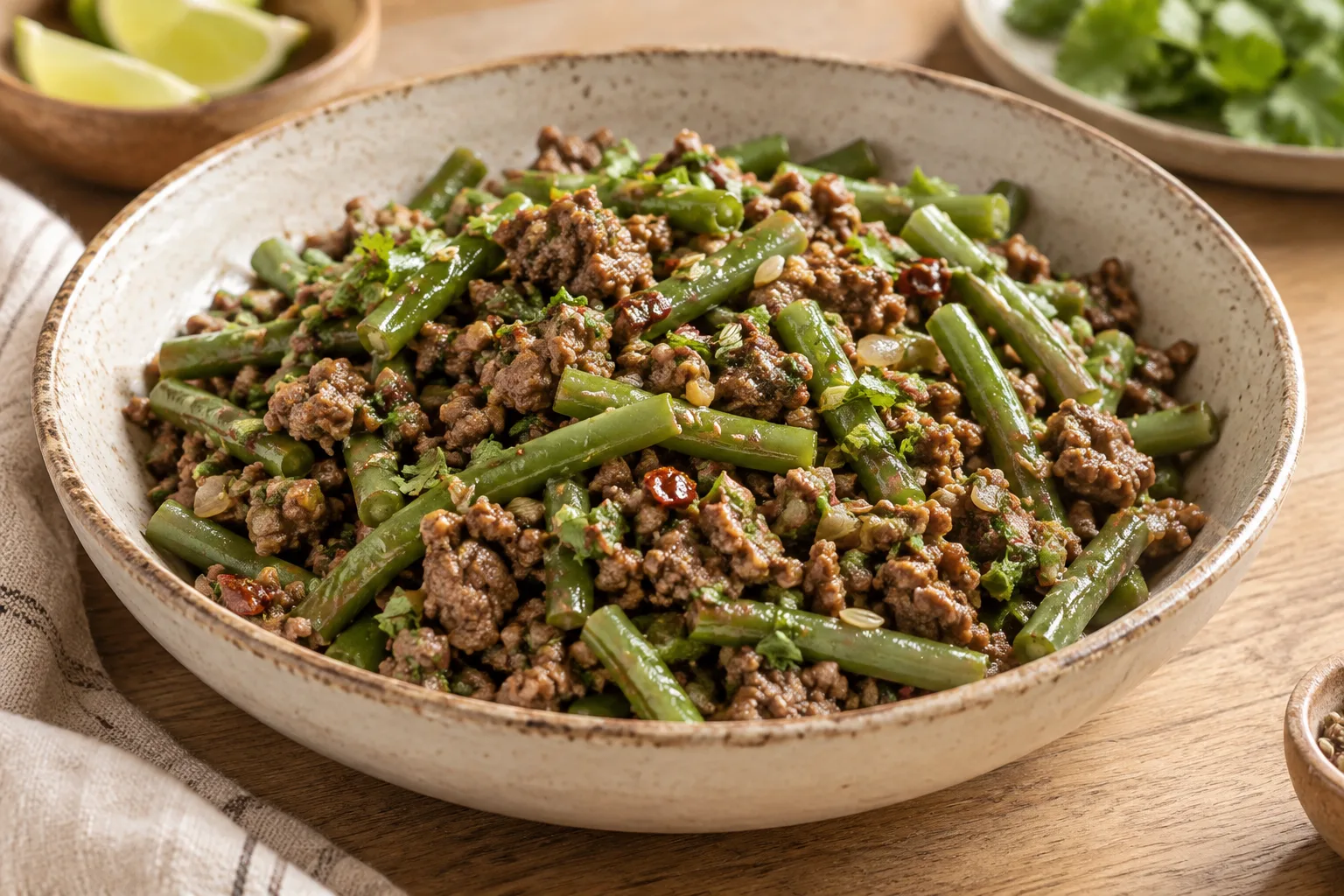
Green beans are tender pods harvested before their seeds mature. They are eaten whole and unopened, including the outer pod. The pods may be flat or rounded; green is a common color, although varieties in other colors also exist. Before preparing them, wash the beans and trim the ends. If a lengthwise string runs along one side, it can be removed without peeling the pod. Leave the beans whole or cut them into pieces to suit the dish. They are used in preparations such as omelets, soups, and pasta or rice dishes with vegetables.
When to use it
Use green beans when you want to add a tender pod vegetable to an omelet, soup, or vegetable dish. They also fit into pasta or rice preparations with chicken and other vegetables. Flat and rounded pods offer different shapes for presenting a dish; choose according to the recipe and the look you prefer. You can leave them whole or cut them into pieces, depending on how you plan to serve them. They work in a range of preparations, from soup to an omelet with tuna.
How to use it
Before preparing green beans, wash them thoroughly under running water to remove surface dirt. Trim the ends and remove any lengthwise string along one side; do not peel away the outer pod, which is eaten too. Leave the beans whole or cut them into pieces according to the recipe. You can steam, boil, or stew them. Then add them to an omelet with tuna, a soup with meatballs, or a pasta or rice dish with chicken and vegetables. There is no single cooking time specified for every green bean: check the texture as they cook and decide when they are ready for the dish you are making.
Flavour and texture
The outer pod is described as smooth, and green beans may be flat or rounded; varieties in other colors also exist. There is no reliable, uniform flavor description for every variety, so do not assume that all will have the same profile. Keep the pods whole to preserve their shape, or cut them into pieces to distribute through an omelet, soup, or pasta or rice dish. The result also depends on how you prepare them.
How to choose it
Green beans may be flat or rounded. Green is a common color, although varieties in other shades are available. When choosing them, look for a shape that suits your recipe and an outer pod that looks smooth. Appearance can vary between varieties, so do not expect every bean to have exactly the same shape or color. If you plan to serve them whole, choose a shape that suits the presentation; for soups, omelets, or rice dishes, you can also cut them into pieces.
Storage
For fresh green beans, follow the storage directions supplied with the product. If you buy them loose and no directions are available, ask the retailer how to store them. Do not treat them as a preserved product or assume that one storage duration applies to every batch: advice can depend on the product and how it was sold. Check the pods and wash them under running water before cooking.
Substitutions
If you only want to change the appearance of a dish, choose flat pods instead of rounded ones, or the other way around. These are different forms of the same vegetable, not equivalents for replacing it with another ingredient. The shape can change the presentation, but no substitutes from other vegetables or legumes are established here for reproducing the same result in a recipe.
Common mistakes
Do not remove the outer pod: green beans are eaten whole and unopened. Also, do not confuse removing a lengthwise string, if present, with peeling the vegetable. Wash the beans before preparing them, trim the ends, and decide whether to leave them whole or cut them according to the dish. Remember that pods may be flat or rounded and that color can vary between varieties.
Safety and allergens
Wash green beans under running water before cutting or cooking them. Trim the ends and remove any lengthwise string if present; do not peel the outer pod, which is eaten too. Use clean utensils when preparing them and follow any handling directions supplied with the product.
Culinary uses
- Hortaliza para platos de pasta, arroz y verduras
- Ingrediente para tortillas y sopas
Recommended techniques
- Cocción al vapor
- Hervido
- Guisado
Pairs well with
- Pollo y pasta
- Atún en tortilla
- Arroz y pollo
- Albóndigas en sopa
Frequently asked questions
Are green beans eaten whole?
Yes. They are eaten as whole, unopened tender pods, including the outer pod. Wash them and trim the ends; remove a lengthwise string if present.
Do green beans need to be peeled?
No. The outer pod is eaten too. If a bean has a lengthwise string along one side, remove the string rather than the skin.
How can green beans be cooked?
You can steam, boil, or stew them. They can also be added to omelets, soups, and pasta or rice dishes with vegetables.
Ingredient allergens
Allergen listThere are no verified associations for these ingredients yet.
Estimated nutrition
- Fat
- 0 g
- Saturates
- 0 g
- Carbohydrate
- 3.33 g
- Sugars
- 1.67 g
- Fibre
- 1.7 g
- Protein
- 0.83 g
- Salt
- 0.79 g
Sources and review
Automatically researched, cross-checked and validated content. Sources consulted:
- Origen, curiosidades y recetas con vainilla www.hola.com/cocina/noticias/20200721172323/vainilla-origen-curiosidades-recetas/
- Vainilla y vanilina. ¿Qué son, tipos y usos en la cocina? www.abc.es/recetasderechupete/vainilla-y-vanilina-que-son-tipos-y-usos-en-la-cocina/32421/
- ¿Por qué la muerte es origen de miedos y tabúes? doi.org/10.64628/aao.fccyk3qj3
- Client Challenge doi.org/10.2307/jj.27939689.16
- ¿Qué es el maridaje de sabores? - Hostelería Benidorm www.hosteleriabenidorm.com/2024/11/15/maridaje-de-sabores-que-es/
- Tipos de Maridaje: de afinidad o contraste | Bartalent Lab www.bartalentlab.com/academy/tecnicas-sala-barra/clases-maridaje-combinacion-comida-bebida
- Redescubre la vainilla, el fruto de la orquídea que cambió el mundo del dulce: qué es y cómo usarla en la cocina con cinco recetas www.directoalpaladar.com/ingredientes-y-alimentos/redescubre-vainilla-fruto-orquidea-que-cam…
- Gastronomía de Costa Rica - Wikipedia, la enciclopedia libre es.wikipedia.org/wiki/Gastronom%C3%ADa_de_Costa_Rica
- La guía práctica para un buen maridaje - Industrias Espadafor S.A. espadafor.es/guia-para-un-buen-maridaje/
- Vainas de vainilla ✨ guía para no tirar tu dinero (y usarlas bien) www.lolitalapastelera.com/vainas-de-vainilla/
- Maridajes poco habituales perfectos para winelovers - CestaShop cestashop.com/blog/maridajes-poco-habituales/
- Técnicas de maridaje de vinos - Bodegas Heredad Linares heredadlinares.com/blog/tecnicas-de-maridaje-de-vinos
- Maridaje en gastronomía: guía fácil para combinar sabores elcarbondevalentina.madrid/blog/maridaje-en-gastronomia/
- Elementos del maridaje. La textura. – Terroaristas, el Blog del VINO terroaristas.com/elementos-del-maridaje-la-textura/
- Vainilla mexicana, una reliquia culinaria con mil y un usos - Mawey Taco Bar restaurantemawey.com/vainilla-mexicana-una-reliquia-culinaria-con-mil-y-un-usos/
- Qué es el maridaje: tipos y consejos - Brandy Fundador brandyfundador.com/mx/actualidad/blog/que-es-el-maridaje/
- Guía básica para entender las armonías en el maridaje de vinos - Fraga do Corvo www.fragadocorvo.com/guia-para-entender-las-armonias-en-el-maridaje-de-los-vinos-tintos/
- Las Diferentes Variedades de Vainas de Vainilla 🌱 – La Vanille de Rose lavanillederose.com/blogs/todo-lo-que-necesitas-saber-sobre-la-vainilla/explorar-las-diferen…
- - YouTube www.youtube.com/watch?v=s8Jp4sPkh_0
- Las Diferentes Variedades de Vainas de Vainilla 🌱 – La Vanille de Rose lavanillederose.com/blogs/todo-lo-que-necesitas-saber-sobre-la-vainilla/explorar-las-diferen…
- - YouTube www.youtube.com/watch?v=XQAJOyA-uOw
- Las Diferentes Variedades de Vainas de Vainilla 🌱 – La Vanille de Rose lavanillederose.com/blogs/todo-lo-que-necesitas-saber-sobre-la-vainilla/explorar-las-diferen…
- Las Diferentes Variedades de Vainas de Vainilla 🌱 – La Vanille de Rose lavanillederose.com/blogs/todo-lo-que-necesitas-saber-sobre-la-vainilla/explorar-las-diferen…
- Las Diferentes Variedades de Vainas de Vainilla 🌱 – La Vanille de Rose lavanillederose.com/blogs/todo-lo-que-necesitas-saber-sobre-la-vainilla/explorar-las-diferen…
- Las Diferentes Variedades de Vainas de Vainilla 🌱 – La Vanille de Rose lavanillederose.com/blogs/todo-lo-que-necesitas-saber-sobre-la-vainilla/explorar-las-diferen…
- Las Diferentes Variedades de Vainas de Vainilla 🌱 – La Vanille de Rose lavanillederose.com/blogs/todo-lo-que-necesitas-saber-sobre-la-vainilla/explorar-las-diferen…
- Las Diferentes Variedades de Vainas de Vainilla 🌱 – La Vanille de Rose lavanillederose.com/blogs/todo-lo-que-necesitas-saber-sobre-la-vainilla/explorar-las-diferen…
- Las Diferentes Variedades de Vainas de Vainilla 🌱 – La Vanille de Rose lavanillederose.com/blogs/todo-lo-que-necesitas-saber-sobre-la-vainilla/explorar-las-diferen…
- Descubre Vainitas: Variedades y recetas | Recetas Nestlé www.recetasnestle.com.ec/escuela-de-sabor/tips-de-recetas/vainitas
- Las Diferentes Variedades de Vainas de Vainilla 🌱 – La Vanille de Rose lavanillederose.com/blogs/todo-lo-que-necesitas-saber-sobre-la-vainilla/explorar-las-diferen…