- Category
- Dairy and eggs
- State
- Other
- Usual unit
- Variable
What it is
Kashk is a fermented dairy product associated with whey and used in several West Asian and neighboring food traditions. It does not come in just one form: it may be sold dry, shaped into balls or discs, or ready to use as a liquid. Some traditional preparations also start with yogurt or sour milk, so ingredients and consistency can vary. Its flavor is typically pronounced, tangy, and salty, and it is used in measured amounts to season soups, sauces, and vegetable dishes. Check the package to identify the form you have and the ingredients it contains.
When to use it
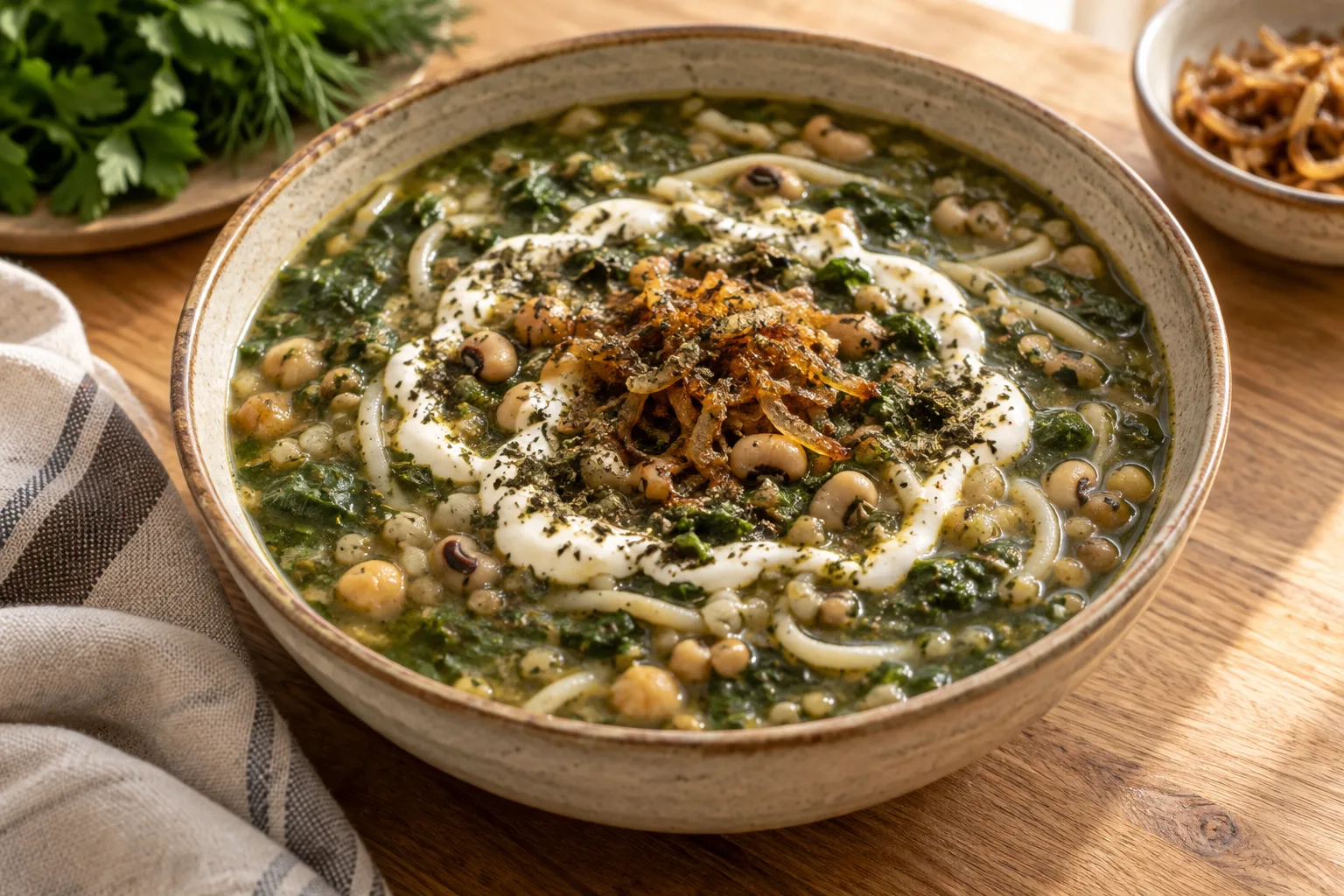
Use kashk when a recipe calls for a tangy, salty fermented-dairy note, especially in thick soups, sauces, or aubergine dishes. It is used in preparations such as ash reshteh and kashk-e bademjan. Liquid kashk can be stirred into a dish or drizzled over it at serving; dry kashk generally needs water to soften or dissolve it. Its intensity varies, so begin with a little and adjust the flavor at the end.
How to use it
First check whether your kashk is dry or liquid. For the dry form, add water gradually and stir until it reaches a consistency that can be mixed or drizzled; the amount depends on the recipe. Stir liquid kashk into soups or sauces as a seasoning, or drizzle it over the dish just before serving. It pairs well with aubergine, onion, garlic, and mint, and can finish thick soups containing noodles, beans, and herbs. Its flavor is powerful, so start with a small amount and taste before adding more.
Flavour and texture
Kashk brings a tangy, salty flavor that can be intense and lingering. Its texture depends on the form: it may be dry and firm, or liquid and pourable. Dry kashk can be mixed with water to soften it and adjust its consistency; liquid kashk can be used directly as a seasoning or finishing touch.
How to choose it
Look for kashk or a local equivalent name, and check whether the product is dry or liquid. Read the ingredient list and package directions, since preparations can vary and may be based on whey, yogurt, or sour milk. Choose a form that suits your recipe: dry kashk needs water preparation, while liquid kashk can be added directly.
Storage
Follow the package storage directions, since dry and liquid kashk are different forms and may need different handling. Keep it in its original packaging or a clean, closed container. Once opened, check the label for storage conditions and use-by guidance; do not assume that liquid kashk keeps like the dry form.
Substitutions
There is no single substitute that exactly reproduces kashk’s pronounced flavor. Fermented yogurt or sour milk may provide tangy dairy notes in some recipes, but they change the texture and result. Use them cautiously and remember that they are not exact equivalents.
Common mistakes
Do not treat dry and liquid kashk as interchangeable: dry kashk generally needs water before use, while liquid kashk can be added directly. Another common mistake is adding too much at once; its salty, tangy flavor can dominate a dish. Add it gradually and taste before adjusting the seasoning.
Safety and allergens
Kashk is a dairy product. If you have a milk allergy, check the label carefully and avoid the product if its ingredients are unclear. Follow the package storage directions.
Culinary uses
- Tangy, savory seasoning for soups and sauces
- Finishing drizzle or topping for prepared dishes
Recommended techniques
- Dilute dry kashk with water to reach a recipe-appropriate consistency
- Stir liquid kashk into a dish or drizzle it over the finished serving
Pairs well with
- Aubergine, onion, garlic, and mint
- Thick soups with noodles, beans, and herbs
Frequently asked questions
Is kashk always liquid?
No. It is sold in liquid form and also dry, including as balls or discs. Dry kashk can be diluted with water for a recipe.
What does kashk taste like?
It has a fermented-dairy flavor that is tangy and salty, and can be intense. Start with a small amount and adjust after tasting.
What dishes use kashk?
It is used as a seasoning or finishing touch in soups and sauces, including ash reshteh and the aubergine dish kashk-e bademjan.
Ingredient allergens
Allergen listThere are no verified associations for these ingredients yet.
Sources and review
Automatically researched, cross-checked and validated content. Sources consulted:
- ¿Por qué la muerte es origen de miedos y tabúes? doi.org/10.64628/aao.fccyk3qj3
- Client Challenge doi.org/10.2307/jj.27939689.16
- Kashk - Wikipedia, la enciclopedia libre es.wikipedia.org/wiki/Kishk
- Kashk: el tradicional suero de leche fermentado de Irán | Comer viajando www.jidlonacestach.cz/es/kashk/
- Kashk, un plato iraquí de yogur fermentado, la receta contra la resaca www.antena3.com/noticias/salud/kashk-plato-iraqui-yogur-fermentado-receta-resaca_20140908571…
- 5 claves para entender qué es el suero lácteo, explicadas por Cristina Chuck | Cristina Chuck-Hernandez es.linkedin.com/posts/cristinachuck_5-claves-para-entender-qu%C3%A9-es-el-suero-l%C3%A1cteo-…
- - YouTube www.youtube.com/watch?v=LRltGinb85A
- ¡Asegurándonos de que no eres un robot! riunet.upv.es/bitstreams/ee5816ba-7e2b-4781-b46b-a4bdac3e61eb/download
- Comprobando su navegador repositorio.upct.es/bitstreams/215da568-b5ef-41a7-8361-4bab60f745c2/download
- Food allergen labelling and information requirements technical guidance - GOV.UK www.gov.uk/government/publications/food-allergen-labelling-and-information-requirements-tech…