- Category
- Bread and dough
- State
- Fresh
- Usual unit
- unit
What it is
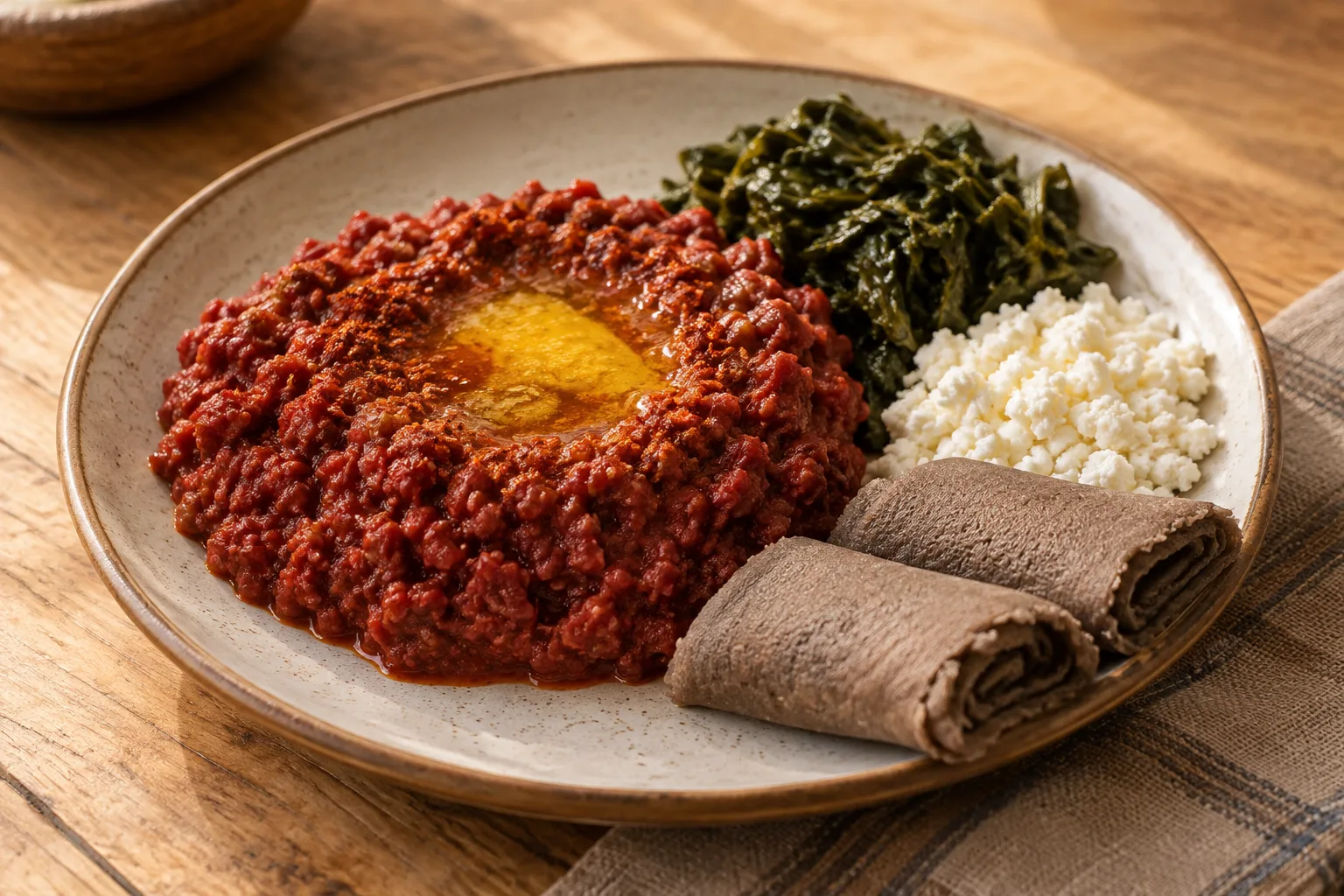
Kocho is the name of a traditionally fermented food discussed in research involving samples collected from districts in the Gamo Zone. That description is not enough to establish its ingredients, texture, retail form or characteristic preparation here. Identify the specific product from its label, and do not assume that all products called kocho have the same ingredients or directions. This profile retains the product category supplied in the ingredient record.
When to use it
Use kocho according to the form and directions of the specific product you have. The available information does not support a particular occasion, recipe or serving style, or confirm whether a given product is ready to eat. Before serving it, check the ingredients and package directions. If those details are unavailable, ask the seller or manufacturer rather than improvising a preparation method. The choice of accompaniments also depends on the specific product and its intended use.
How to use it
Start by reading the product label: check the ingredients, preparation method and any storage directions. Follow the directions for that particular product, and do not treat the name kocho as a recipe or cooking time. If the package does not say whether cooking is needed, or how to cook it, ask the manufacturer or seller before serving. After opening, follow the product's storage instructions. Check the ingredient list as well if you need to avoid a particular ingredient.
Flavour and texture
The available information does not reliably describe kocho's flavor or texture. Do not assume a particular acidity, intensity, consistency or aroma without knowing the specific product. Check the product information or ask the person selling it about its characteristics; the name alone does not show whether different products share the same texture or flavor profile.
How to choose it
Choose a product with a clear label identifying the food, its ingredients and its directions. The name alone does not reveal its composition or whether it is ready to eat. If you need to avoid a particular ingredient, check the full label and ask the manufacturer when the composition is unclear. Also make sure the directions apply to the particular form you are buying.
Storage
No kocho-specific storage directions can be established here. Follow the label for the unopened product and after opening; do not infer from the name whether it needs refrigeration or how long it keeps. If directions are missing, ask the seller or manufacturer before storing or eating it. Do not apply storage guidance for another food to kocho without confirming that it suits the specific product.
Substitutions
No specific culinary substitute for kocho is supported by the available information. A suitable replacement would depend on the recipe and the role the product plays, which cannot be established from the name alone. Check the intended use on the label and choose an alternative with compatible characteristics and ingredients. If a recipe relies on a particular form, first confirm that a replacement can serve the same purpose.
Common mistakes
Do not assume kocho has one universal composition, texture or cooking method. Do not serve it as ready to eat unless the product directions confirm that it is. Avoid applying cooking times or storage rules for a different food; check the package or ask the manufacturer. The product name alone does not establish its ingredients or uses.
Safety and allergens
Check the specific product's ingredient list and allergen information, especially if you have an allergy. The name kocho alone cannot confirm whether an allergen is present or absent. If the label is incomplete or unclear, contact the manufacturer and do not eat the product until the details are clear. Follow the preparation and storage instructions supplied for that product.
Culinary uses
- Traditionally fermented food
- Food product whose use depends on its specific preparation and presentation
Recommended techniques
- Follow the preparation directions for the specific product
- Check the label before serving to determine whether preparation is required
Pairs well with
- No kocho-specific pairing is established by the available information
- Choose accompaniments only after checking the product's intended use and ingredients
Frequently asked questions
What is kocho?
It is described as a traditionally fermented food. The name alone does not establish its ingredients or preparation method.
Is kocho ready to eat?
That cannot be determined from the name alone. Check the package directions and follow the instructions for that specific product.
Which allergens does kocho contain?
A general list cannot be confirmed for kocho. Check the specific product's ingredient and allergen information, or contact its manufacturer.
Ingredient allergens
Allergen listThere are no verified associations for these ingredients yet.
Sources and review
Automatically researched, cross-checked and validated content. Sources consulted:
- REGLAMENTO (UE) No 1169/2011 DEL PARLAMENTO ... eletiquetadocuentamucho.aesan.gob.es/media/reglamento-11692011.pdf
- Client Challenge doi.org/10.2307/jj.27939689.16
- Etiquetado de sustancias que causan alergias e intolerancias alimentarias www.aesan.gob.es/seguridad-alimentaria/informacion-alimentaria/etiquetado-sustancias
- Kitchen Companion: Your Safe Food Handbook ucanr.edu/sites/default/files/2020-09/336322.pdf
- Comité Científico aesan.gob.es/dam/jcr:a7c4e553-46f5-4def-9ede-b6d1e19b3948/comite_cientifico_42.pdf
- Externships | ICE Career Services | Institute of Culinary Education www.ice.edu/career-services-resources/career-services/externships
- CIA in the News Archives | Culinary Institute of America www.ciachef.edu/blog/cia-alumni-lead-the-way-in-food-business-innovation/
- Kimchi coreano: qué es, origen, recetas y ingredientes www.finedininglovers.es/explorar/noticias/que-es-el-kimchi-todo-sobre-la-preparacion-coreana
- Arachis hypogaea - Wikipedia, la enciclopedia libre es.wikipedia.org/wiki/Arachis_hypogaea
- Cooking: low temperature or sous-vide at the right temperature? insights.ehl.edu/cuisson-basse-temperature-sous-vide
- 3 Types of Cooking Methods and the Foods That Love Them | CIA www.ciachef.edu/blog/3-types-cooking-methods-foods-love/
- Sasha Kocho-Williams – Fruition blogs.cornell.edu/fruition/author/sasha-kocho-williams/
- A study abroad experience in South India: A journey into hospitality, culture and culinary arts | College of Education and Human Sciences | Nebraska cehs.unl.edu/news/study-abroad-experience-south-india-journey-hospitality-culture-and-culina…
- STU Culinary: Bringing It Home - St. Thomas University www.stu.edu/news/stu-culinary-bringing-it-home/
- anxiety, eating, and the foodwork practices of individuals living www.ideals.illinois.edu/items/128757/bitstreams/430111/data.pdf
- Funko Pop Shinobu Kocho 2195 Sumi Deco Demon Slayer Anime Signed Auto Autograph - crm.myotherapy.edu crm.myotherapy.edu/item/388093696220
- Koji, el hongo que revolucionó la gastronomía japonesa | Gastronomía & Cía www.gastronomiaycia.com/koji-el-hongo-que-revoluciono-la-gastronomia-japonesa/
- Explorando los Sabores de Japón: Ingredientes Básicos e Imprescindibles de la Cocina Japonesa - Gakko Sushi Formación gakkosushiformacion.es/explorando-los-sabores-de-japon-ingredientes-basicos-e-imprescindible…
- Koji, el hongo que revolucionó la gastronomía japonesa. Qué es, propiedades y cómo se usa en la cocina www.abc.es/recetasderechupete/koji-el-hongo-que-revoluciono-la-gastronomia-japonesa-que-es-p…
- Food Service Management - Amrita Vishwa Vidyapeetham www.amrita.edu/course/food-service-management/
- Rodolfo M. Nayga, Jr. Current Position: Professor and Tyson ... agribusiness.uark.edu/_resources/pdf/CV/Nayga/Nayga-vita-Jul16.pdf
- Food & Nutrition - Texas 4-H texas4-h.tamu.edu/projects/food-nutrition/
- Food | Illinois Extension | Illinois extension.illinois.edu/food
- Preserve the Harvest | USU extension.usu.edu/preserve-the-harvest/
- Food Allergies | FDA www.fda.gov/food/nutrition-food-labeling-and-critical-foods/food-allergies
- Risk assessment of food allergens: part 1: review and validation of Codex alimentarius priority allergen list through risk assessment: meeting report www.who.int/publications/i/item/9789240042391
- Food allergens | Food Safety and Quality | FAO www.fao.org/food-safety/scientific-advice/food-allergens/en
- Evaluating food safety of traditionally fermented kocho: microbial profiling ... pubmed.ncbi.nlm.nih.gov/40782126/
- - YouTube www.youtube.com/watch?v=ZwFHwFU6jF0
- ¿Qué es el koji? El hongo del sabor e ingrediente secreto de los chefs www.huleymantel.com/despensa/que-es-koji-hongo-alquimista-sabor-ingrediente-secreto-alta-coc…
- Gochugaru: El condimento coreano de moda - Blog de La Parada de las Especias comprarespecias.net/blog/gochugaru-condimento-coreano/?srsltid=AYCX9vIquOl2fJwQzYvxXIfFK30Fd…