- Category
- Vegetables
- State
- Fresh
- Usual unit
- unit
What it is
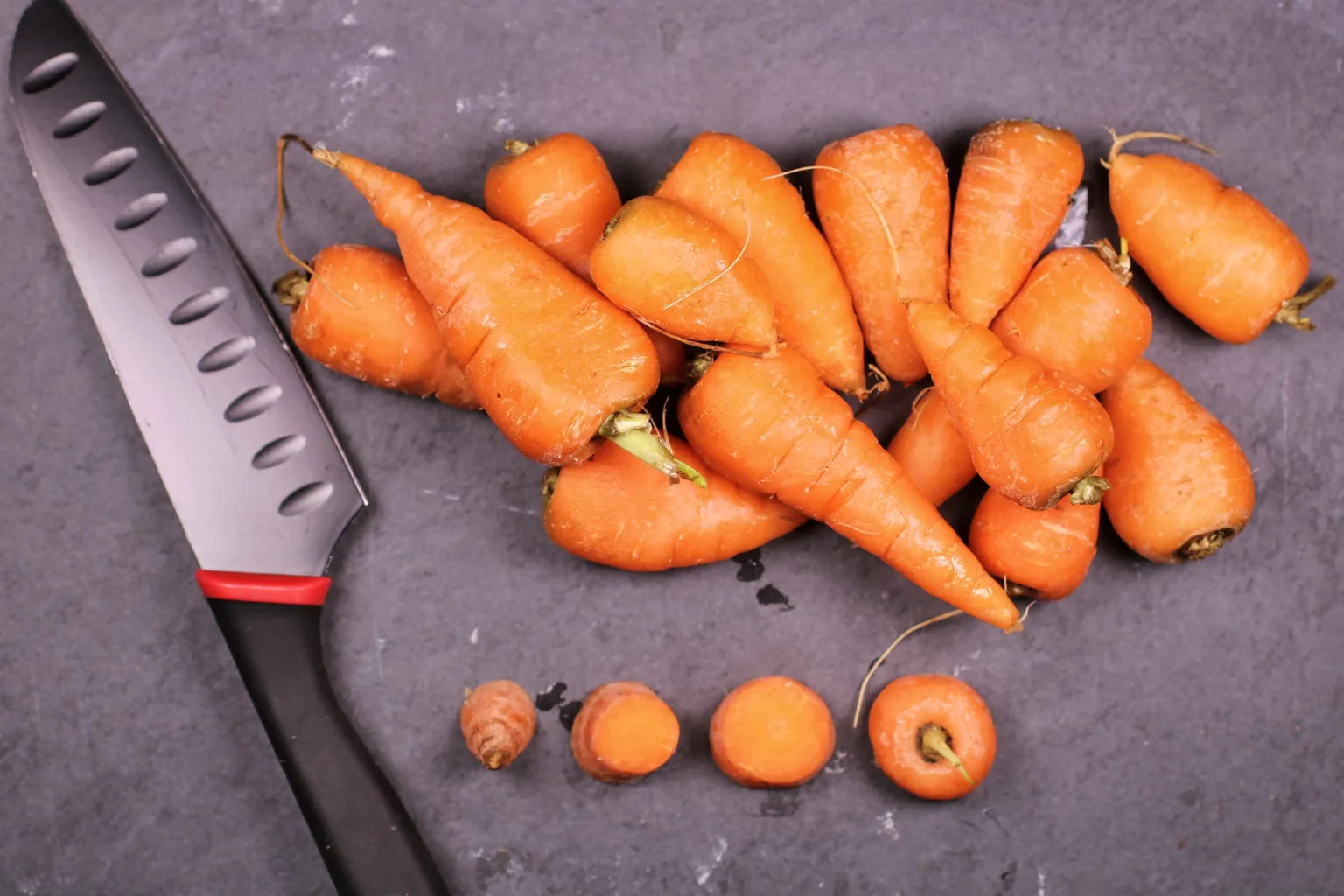
A large carrot is a fresh carrot in the large-size category, classified as a root vegetable. Its size alone does not dictate one particular recipe: this category is described for both raw eating and stewing. It is useful to distinguish it from carrot categories described by shape or presentation, such as long, thin carrots, generally associated with canning, and bunch carrots, described as tender and sweet for fresh eating. Those qualities should not automatically be applied to every large carrot.
When to use it
Choose a large carrot when you want a root vegetable to eat raw or add to a stew. For raw preparations, use it in dishes that call for washed carrot, cut or grated as needed. For cooking, add it to a stewed dish with a cut that suits the recipe. If you specifically want a carrot described as tender and sweet for fresh eating, note that this description applies to bunch carrots, not necessarily to every large carrot.
How to use it
Before eating or cooking the carrot, wash it thoroughly under running water and remove surface dirt. Then cut or grate it to suit the preparation: it can be served raw or added to a stew. For a raw dish, make sure the pieces are an appropriate size for the recipe and the people eating it. For stewing, use a cut that works practically in the dish. If preserving carrots at home, do not improvise the method: low-acid root vegetables require a safe canning process, while acidified pickled carrots use different instructions.
Flavour and texture
The available description identifies large carrots by their raw and stewed uses, but does not establish one distinctive flavor or texture for every large carrot. Tenderness and sweetness are attributes given for bunch carrots, so do not assume that all large carrots share them. The result can also vary with the individual carrot and its preparation.
How to choose it
Choose a carrot that suits the use you have in mind: large carrots are described for raw preparations or stewing. Select a fresh carrot without obvious damage. Do not confuse large size with the bunch-carrot category, described as tender and sweet, or with long, thin carrots, generally associated with canning.
Storage
Follow the package or retailer’s storage instructions for this fresh carrot; no single storage duration can be recommended for every piece here. Before eating or preparing it, wash it thoroughly under running water. Keep the preparation surface and utensils clean, and avoid leaving the vegetable exposed to dirt while you work.
Substitutions
If a recipe calls for carrot without specifying a size, another carrot type may suit it depending on the intended use. Bunch carrots are described as tender and sweet for fresh eating; large carrots are also identified for stewing. Shapes and characteristics can differ, so adapt the cut to the preparation.
Common mistakes
Do not assume that every large carrot is tender and sweet: that description is given for bunch carrots. Also, do not confuse large carrots, described for raw eating or stewing, with long, thin carrots, generally associated with canning. Wash the carrot before eating or cooking it.
Safety and allergens
Wash fresh carrots thoroughly under running water before eating or preparing them, and use clean utensils and surfaces. For home preservation, follow a tested process for carrots: low-acid root vegetables require pressure canning, while acidified pickled carrots use specific instructions. Do not substitute one method for the other.
Culinary uses
- Raw vegetable ingredient
- Ingredient for stewed dishes
Recommended techniques
- Eat raw after washing; cut or grate as needed for the dish
- Stew as part of a cooked vegetable dish
Pairs well with
- Raw vegetable dishes and salads
- Stews and other cooked vegetable dishes
Frequently asked questions
Can a large carrot be eaten raw?
Yes. Large carrots are described for both raw eating and stewed dishes. Wash one thoroughly before eating, then cut or grate it to suit the preparation.
Are large carrots always sweet and tender?
That cannot be assumed. Tenderness and sweetness are described for bunch carrots, not necessarily for every large carrot.
How should I can carrots at home?
Use tested instructions for carrots. Low-acid root vegetables require pressure canning; acidified pickled carrots follow a different method.
Ingredient allergens
Allergen listThere are no verified associations for these ingredients yet.
Sources and review
Automatically researched, cross-checked and validated content. Sources consulted:
- Client Challenge doi.org/10.2307/jj.27939689.16
- The Essential Glossary of Cooking Terms for the Culinary Arts - Escoffier www.escoffier.edu/blog/culinary-arts/the-essential-glossary-of-cooking-terms-for-the-culinar…
- Gastronomía del Perú - Wikipedia, la enciclopedia libre es.wikipedia.org/wiki/Gastronom%C3%ADa_del_Per%C3%BA
- Agencia Española de Seguridad Alimentaria y Nutrición www.aesan.gob.es/
- Vamos a Conservar Alimentos: Raíces comestibles: remolachas, zanahorias, nabos y colinabos extension.psu.edu/vamos-a-conservar-alimentos-raices-comestibles-remolachas-zanahorias-nabos…
- EFNEP Hispanic Heritage Recipes | Community Nutrition | Extension/College of Agriculture, Health & Natural Resources | University of Connecticut communitynutrition.cahnr.uconn.edu/efnep-hispanic-heritage-recipes/
- Choice Salsa - National Center for Home Food Preservation nchfp.uga.edu/how/can/canning-salsa/choice-salsa/
- - YouTube www.youtube.com/watch?v=lZfixipnWcA
- Para la ciudadanía www.aesan.gob.es/para-la-ciudadania
- Evolución del léxico culinario desde 1932 a 1972 | OpenAlex openalex.org/W2291578502
- Growing Culturally Relevant Food at the Urban Farm scholarship.claremont.edu/cgi/viewcontent.cgi?article=1171&context=pitzer_theses
- Hortalizas (II) www.mapa.gob.es/ministerio/pags/biblioteca/revistas/pdf_DYC/DYC_2004_76_89_119.pdf