- Category
- Grains, flour and pasta
- State
- Dry
- Usual unit
- cup
What it is
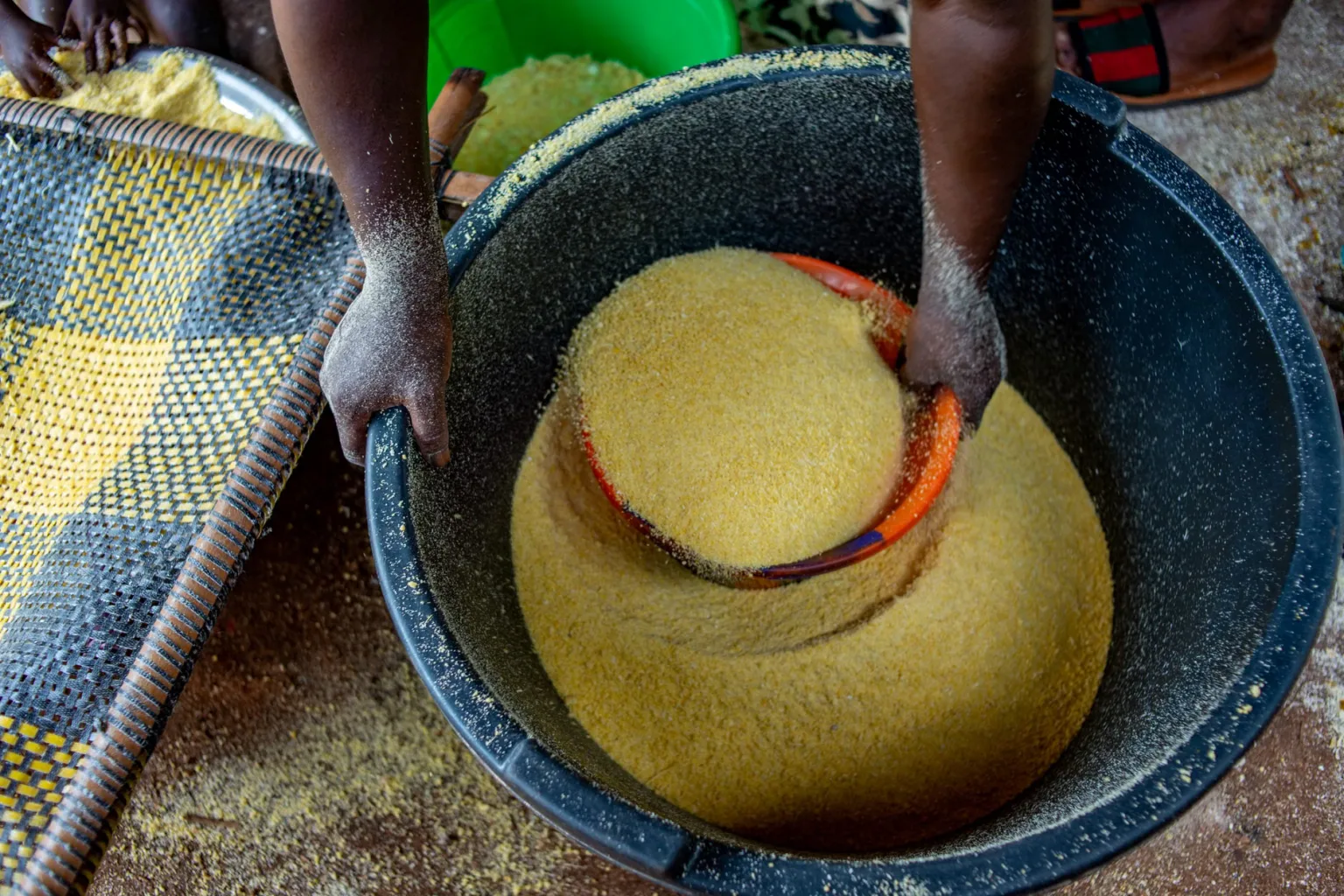
Medium-grind cornmeal is a dry product made by milling corn kernels to particles larger than fine corn flour but smaller than coarse grits. “Medium grind” describes particle size, not a particular treatment of the corn. Cornmeal can vary with the type of corn and the milling process, so color and texture may differ between products. It is not the same as cornstarch, which is a separate corn product, and should not automatically be confused with precooked corn flour or masa harina, which are made using different processes.
When to use it
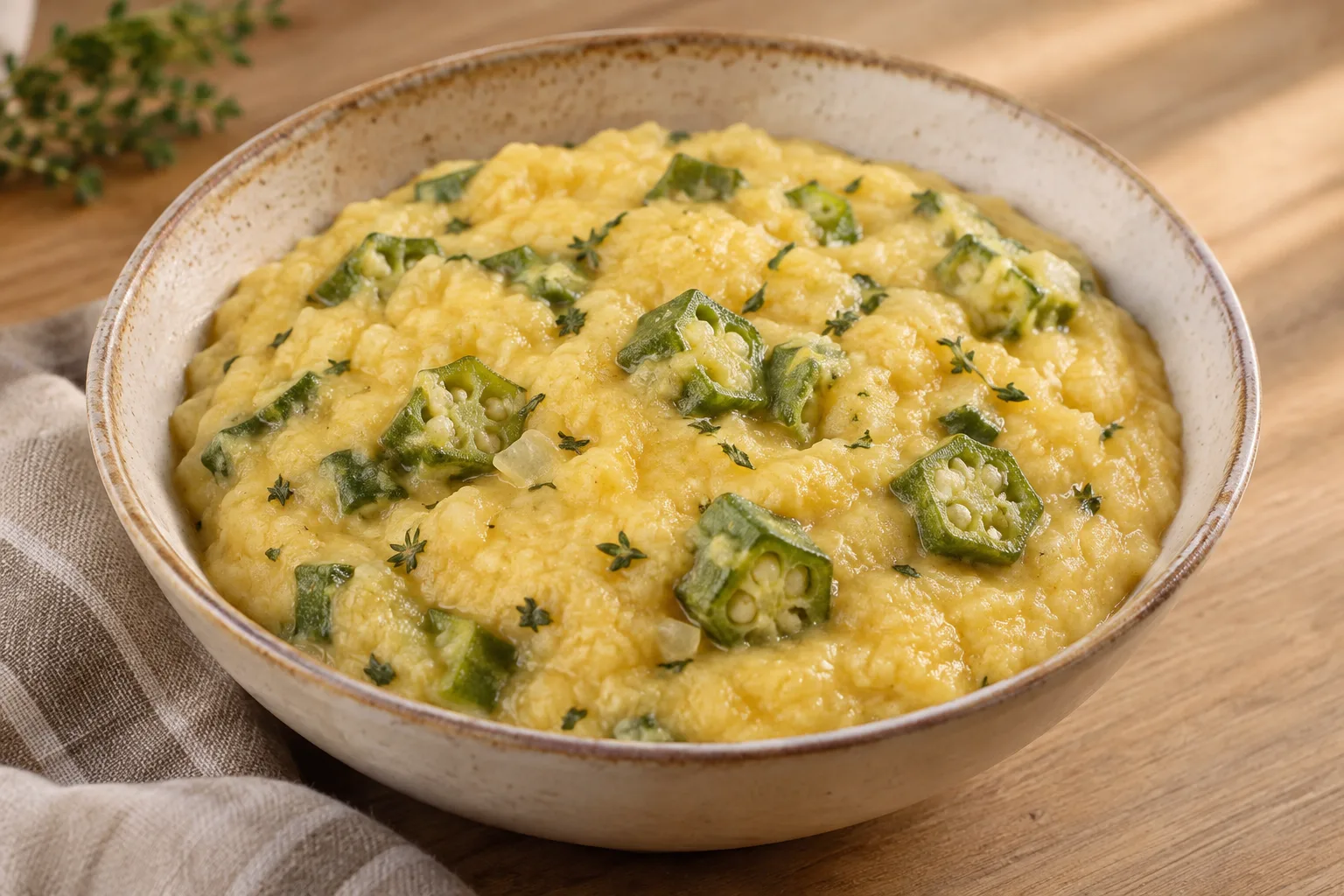
Choose this grind when you want corn to remain noticeable in the texture without the large particles of coarse grits. It suits cooked dishes such as polenta and can be used in baked recipes such as cornbread. It can also serve as a coating when you want more texture than fine flour would provide. If a recipe depends on dough for tortillas or tamales, check whether it calls for nixtamalized corn flour or masa harina: ordinary medium-grind cornmeal is not automatically interchangeable.
How to use it
For a cooked dish, add the cornmeal to liquid and cook until it reaches the consistency you want. The liquid ratio and cooking time depend on the recipe and product, so follow package directions when available. For baking, combine it with the other ingredients in a cornbread recipe or another suitable bake. Mixing it with wheat flour produces a different texture and set of baking properties from using corn alone. It can also be used dry as a coating. Do not swap in cornstarch when a recipe needs grain particles: cornstarch is a different product used mainly as a thickener.
Flavour and texture
It has a recognizable corn flavor, which may be more or less pronounced depending on the corn and how it was processed. Medium grinding leaves a noticeable texture, though the particles are smaller than those in coarse grits. When cooked with liquid, it can form a thick dish; in baked mixtures, it contributes a distinct corn character. Color is not fixed and depends on the corn variety and product.
How to choose it
Look for “medium grind” on the package and check that the product is cornmeal or corn grits, rather than cornstarch, precooked corn flour, or masa harina. These products are made differently and may behave differently in a recipe. Color alone does not identify the grind or processing method. If you need a particular result, also check the product description and package directions.
Storage
Keep it tightly sealed in a dry place, protected from light. Keeping moisture out helps maintain its condition. If you store several kinds of flour, label the containers to avoid mix-ups. Whole-grain cornmeal may keep less well than refined cornmeal; if you do not use it often, refrigeration can help delay deterioration. Follow any storage directions on the package.
Substitutions
Fine-ground cornmeal can work if you are comfortable with a smoother result; the liquid amount or final texture may differ. A coarser grind gives more noticeable particles and may not cook in the same way as medium grind. Cornstarch is not an equivalent substitute because it is a different product used mainly for thickening. For tortillas or tamales, use the type named in the recipe, such as masa harina, rather than assuming this cornmeal will work the same way.
Common mistakes
Do not assume all corn products are interchangeable: grind, refining, and processing affect the result. Do not confuse cornmeal with cornstarch, or automatically use medium grind in recipes that call for masa harina or precooked corn flour. In baking, replacing all the flour in a recipe with cornmeal can change its structure; adapt the recipe instead of making a direct swap.
Safety and allergens
Keep the product dry and follow the package storage directions. Prevent moisture from entering the container, and use clean, dry utensils.
Culinary uses
- Base for polenta and other cooked cornmeal dishes
- Grain ingredient in cornbread and baked goods
- Coating for foods before cooking
Recommended techniques
- Simmer or boil in liquid until cooked to the desired consistency
- Bake into cornbread or other batters
- Use as a dry coating
Pairs well with
- Cheese
- Butter
- Milk
- Nuts
- Wheat flour or other flours in baking
Frequently asked questions
Is medium-grind cornmeal the same as polenta?
Polenta usually refers to a cooked cornmeal dish and is also used for a coarse grind. Check the particle size and package directions; products sold as polenta do not all have the same grind.
Is it the same as cornstarch?
No. Cornstarch is a separate, finer product used mainly for thickening. Medium-grind cornmeal contains noticeable corn particles and gives a different texture.
Can I use it for tortillas?
Not necessarily. Tortillas and tamales often call for masa harina or nixtamalized corn flour. Check the recipe’s specified product, since ordinary medium-grind cornmeal is not automatically equivalent.
Ingredient allergens
Allergen listThere are no verified associations for these ingredients yet.
Estimated nutrition
- Fat
- 2.33 g
- Saturates
- 0 g
- Carbohydrate
- 53.5 g
- Sugars
- 0 g
- Fibre
- 11.6 g
- Protein
- 4.65 g
- Salt
- 0.06 g
Sources and review
Automatically researched, cross-checked and validated content. Sources consulted:
- Evaluación de harina de amaranto como ingrediente antioxidante para la preparación de matrices alimentarias funcionales doi.org/10.35537/10915/162211
- Harinas de maíz ¿Cuántos tipos hay y para qué sirven? - Formacion en Gastronomia www.formacionengastronomia.com/cocina-latina/harinas-de-maiz-cuantos-tipos-hay-y-para-que-si…
- La harina de maíz y sus diferentes usos en la cocina | masymas supermercados www.supermasymas.com/blog/la-harina-de-maiz-y-sus-diferentes-usos-en-la-cocina/
- Para qué sirve la harina de maíz y cuántos tipos de ella existen www.eldiario.es/consumoclaro/sirve-harina-maiz-tipos-existen-pm_1_12914046.html
- Desarrollo de un pan de masa madre rico en GABA y péptidos ... diposit.ub.edu/bitstreams/c65d2e73-d41c-4715-b8e0-cc85adfa9c24/download
- El maiz en la nutrición humana - Tecnología postcosecha: la elaboración www.fao.org/4/t0395s/T0395S06.htm
- Revista del comité científico de la Aecosan número 27 www.aesan.gob.es/dam/jcr:e9146cf9-fb19-49d5-a7d1-39de06f59ec0/CONSUMO_INSECTOS.pdf
- Harina de Maíz - Olivapan olivapan.es/harinas/harina-de-maiz/
- Efecto de la harina de fibra de trigo (Triticum aestivum) o ... bdigital.zamorano.edu/bitstreams/af2898b0-bace-4e92-b8c2-99e8cd259acf/download
- - YouTube www.youtube.com/watch?v=OIHeGCiaUJM
- Harina de maíz – Innograin innograin.uva.es/2021/03/09/harina-de-maiz/
- Your Guide to Using Corn Flour in Latino Cooking – Familia Kitchen familiakitchen.com/es/your-guide-to-using-corn-flour-in-latino-cooking/
- Propiedades de la harina de maíz – Botanical-online www.botanical-online.com/alimentos/harina-maiz-propiedades-caracteristicas
- Harina de maíz | Consumer www.consumer.es/alimentacion/harina-de-maiz-2.html