- Category
- Herbs and spices
- State
- Dry
- Usual unit
- teaspoon
What it is
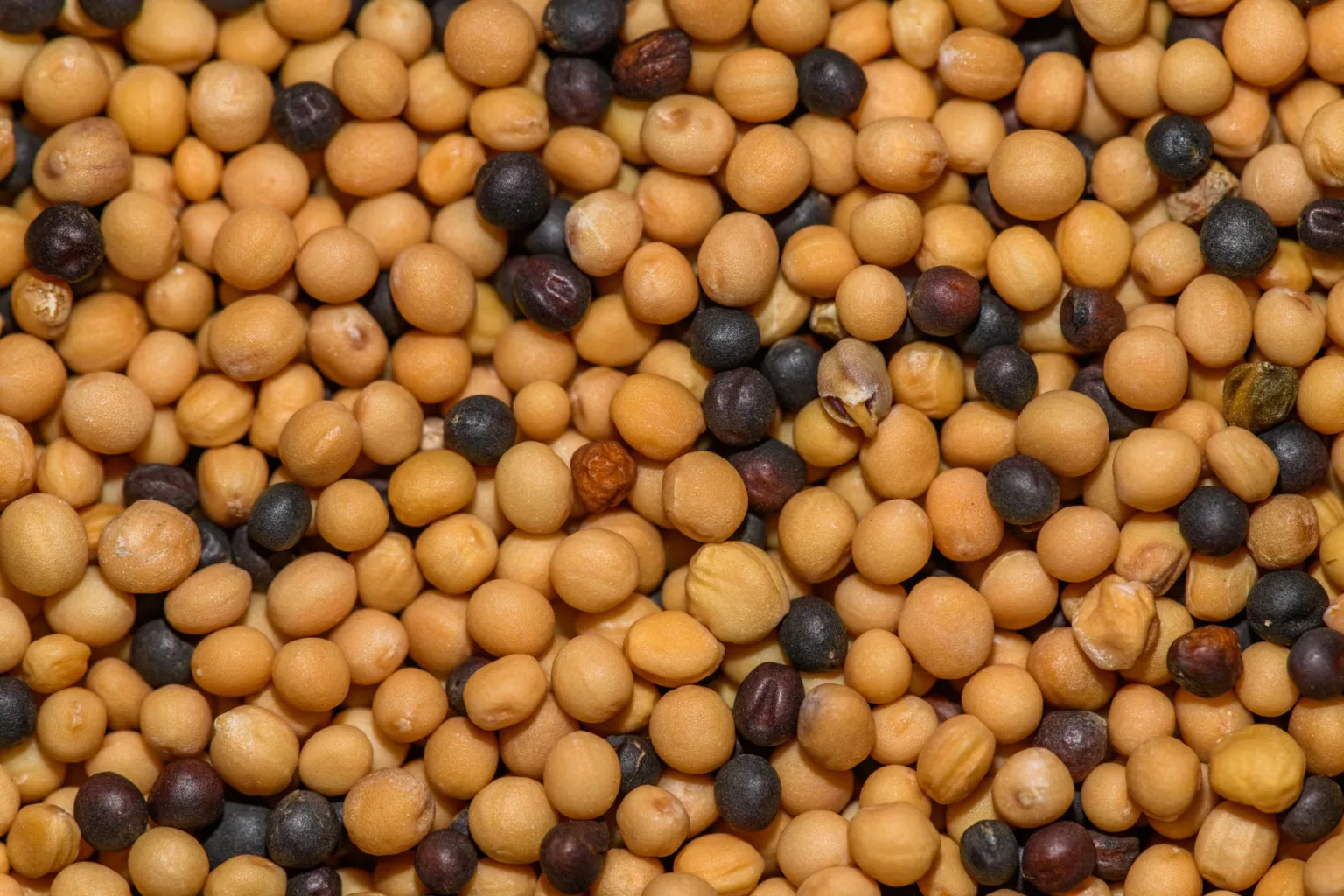
Mustard seeds are small seeds from plants in the cabbage family. Sold whole as a spice, they can also be crushed or ground to make mustard and other condiments. Culinary varieties include yellow or white, brown, and black seeds; they differ in intensity, with pale varieties generally milder and darker ones stronger. Whole seeds can taste relatively restrained, while crushing and mixing them with liquid can bring out a more pungent character. The seeds should not be confused with prepared mustard, which is a seasoned condiment made from them and other ingredients.
When to use it
Choose mustard seeds when you want a spicy accent in pickles, sauces, or meat and fish dishes, or when you want to make a condiment yourself. Whole seeds retain their texture and give a more restrained effect; crushed or ground seeds blend more readily into a mixture. Use yellow or white seeds for a milder profile and brown or black ones for a stronger one. Whole seeds may not taste as pungent as prepared mustard: soaking or mixing them with liquid changes how their flavor comes through.
How to use it
Use the seeds whole in preparations where you want to keep their texture, such as a pickling liquid. For a more integrated flavor, crush or grind them before adding them. You can also grind the seeds and mix them with water to make a seasoning paste, or stir crushed seeds into vinegar for a coarse mustard. Adjust the amount to suit the variety and desired intensity; brown and black seeds tend to be stronger than yellow or white ones. Add them to meat, sausages, or some fish, or use them to add character to sauces and pickles. Follow a recipe for liquid proportions: the available evidence does not establish one universal measure.
Flavour and texture
Whole mustard seeds are small and firm, with a flavor that can be fairly restrained. Crushing them and mixing them with liquid can create a more pungent result. Yellow or white seeds are generally milder, while brown and black seeds tend to be stronger. Prepared mustard is not the same as whole seed: its flavor and texture also depend on how the seeds are ground and which liquids are added.
How to choose it
Choose clean, dry seeds in a well-sealed package with no visible moisture. Check the label for the variety—yellow or white, brown, or black—because it affects intensity and can guide your choice for a recipe. Buy whole seeds if you want a distinct texture; for a uniform mixture, you can grind them at home. The available information does not establish a particular harvest or shopping season.
Storage
Keep the seeds in a clean, dry, tightly closed container, away from moisture. Storing them whole lets you crush only the amount needed when cooking. For more specific storage guidance, follow the package directions and inspect the product before use. A universal storage period cannot be set here for all varieties and formats.
Substitutions
Yellow or white seeds can replace brown or black ones, and vice versa, but pale seeds are generally milder while darker ones tend to be stronger. Adjust the amount gradually so the flavor does not overwhelm the dish. Mustard powder is also made from ground seeds, but it is not an exact stand-in for whole seeds: the texture changes, and the recipe’s liquid may need adjustment.
Common mistakes
A common mistake is treating every variety as equally strong: yellow or white seeds are generally milder than brown or black ones. It can also be disappointing to expect whole seeds to taste just like prepared mustard. Crush or grind the seeds when you want them to blend into a dish, and avoid adding a large amount without considering the variety.
Safety and allergens
Keep the seeds dry in a clean, closed container and follow the package directions. Do not use them if they show moisture or dirt, or if the package is damaged. The available sources do not identify a specific safety precaution for this ingredient.
Culinary uses
- Especia para aportar un sabor punzante y aromático
- Ingrediente para encurtidos y condimentos de mostaza
Recommended techniques
- Machacar o triturar las semillas antes de usarlas
- Molerlas y mezclarlas con líquido, como agua o vinagre, para preparar un condimento
Pairs well with
- Vinagre y otros líquidos ácidos para encurtidos o mostaza preparada
- Carnes, embutidos y algunos pescados
Frequently asked questions
Are mustard seeds pungent on their own?
Whole seeds can taste fairly restrained. Crushing them and mixing them with liquid can bring out a more pungent character, and the variety matters too.
What is the difference between yellow and brown mustard seeds?
Yellow or white seeds are generally milder; brown and black seeds tend to have a stronger flavor.
Can I use whole seeds instead of prepared mustard?
Yes, but the result will not be identical. Prepared mustard uses crushed or ground seeds and liquid, so its texture and flavor expression differ.
Ingredient allergens
Allergen listDocumented presence
-
Mustard
Mustard seeds
Estimated nutrition
- Fat
- 50 g
- Saturates
- 0 g
- Carbohydrate
- 0 g
- Sugars
- 0 g
- Fibre
- 0 g
- Protein
- 0 g
- Salt
- 0 g
Sources and review
Automatically researched, cross-checked and validated content. Sources consulted:
- The Essential Glossary of Cooking Terms for the Culinary Arts - Escoffier www.escoffier.edu/blog/culinary-arts/the-essential-glossary-of-cooking-terms-for-the-culinar…
- Los japonesismos culinarios | OpenAlex openalex.org/W2906636610
- Washington State Food Access English-Spanish Glossary wpcdn.web.wsu.edu/wp-snaped/uploads/sites/2/2025/10/Food-Access-Spanish-Glossary.pdf
- the elements of the latina bildungsroman through self- ... hammer.purdue.edu/articles/thesis/FEMALE_KITCHEN_NARRATIVES_THE_ELEMENTS_OF_THE_LATINA_BILDU…
- NUTRITION IN ACTION Beans & Peas • Frijoles & ... www.stonybrookmedicine.edu/sites/default/files/Grocery_List_FAM.pdf
- Project MUSE -- Verification required! doi.org/10.1353/hsf.2012.0041
- Brussels Sprouts | UNL Food | Nebraska food.unl.edu/article/brussels-sprouts/
- UTIA Real. Life. Solutions. solutions.tennessee.edu/publication/SP813D-ES/
- CrowdSec Challenge spanport.ucla.edu/wp-content/uploads/2025/08/Spain_-On-a-Plate-Blog-Post-Matthew-Starr.pdf
- Going Off-Road with Mugaritz to Explore Creativity - Arts at MIT arts.mit.edu/going-off-road-mugaritz-explore-creativity/
- Food & Nutrition | Colorado State University Extension foodsmartcolorado.colostate.edu/category/recipes-and-how-tos/recipe-index/pantry-staples-and…
- Qué es la mostaza www.directoalpaladar.com/cultura-gastronomica/que-es-la-mostaza
- Mostaza - Wikipedia, la enciclopedia libre es.wikipedia.org/wiki/Mostaza
- Curiosidades que no sabías acerca de la mostaza foodandtravel.mx/sabores/productos-en-temporada/curiosidades-que-no-sabias-acerca-de-la-most…
- Managing allergens | Food Standards Scotland www.foodstandards.gov.scot/business-guidance/running-a-food-business/managing-allergens