- Category
- Dairy and eggs
- State
- Other
- Usual unit
- g
What it is
Pecorino is the general name for Italian cheeses made from sheep’s milk; it does not refer to one single recipe or aging level. Varieties include Pecorino Romano, Pecorino Toscano and Pecorino Sardo, some of which have protected designations of origin. Sheep’s milk distinguishes pecorino from hard cheeses such as Parmigiano-Reggiano and Grana Padano, which are made from cow’s milk. Texture and flavor depend on the variety and maturation: some cheeses are more tender, while others are firm, dry or granular and suited to grating. Check the full name on the label before choosing pecorino for a particular dish, since the name alone does not tell you exactly how aged or assertive the cheese will be.
When to use it
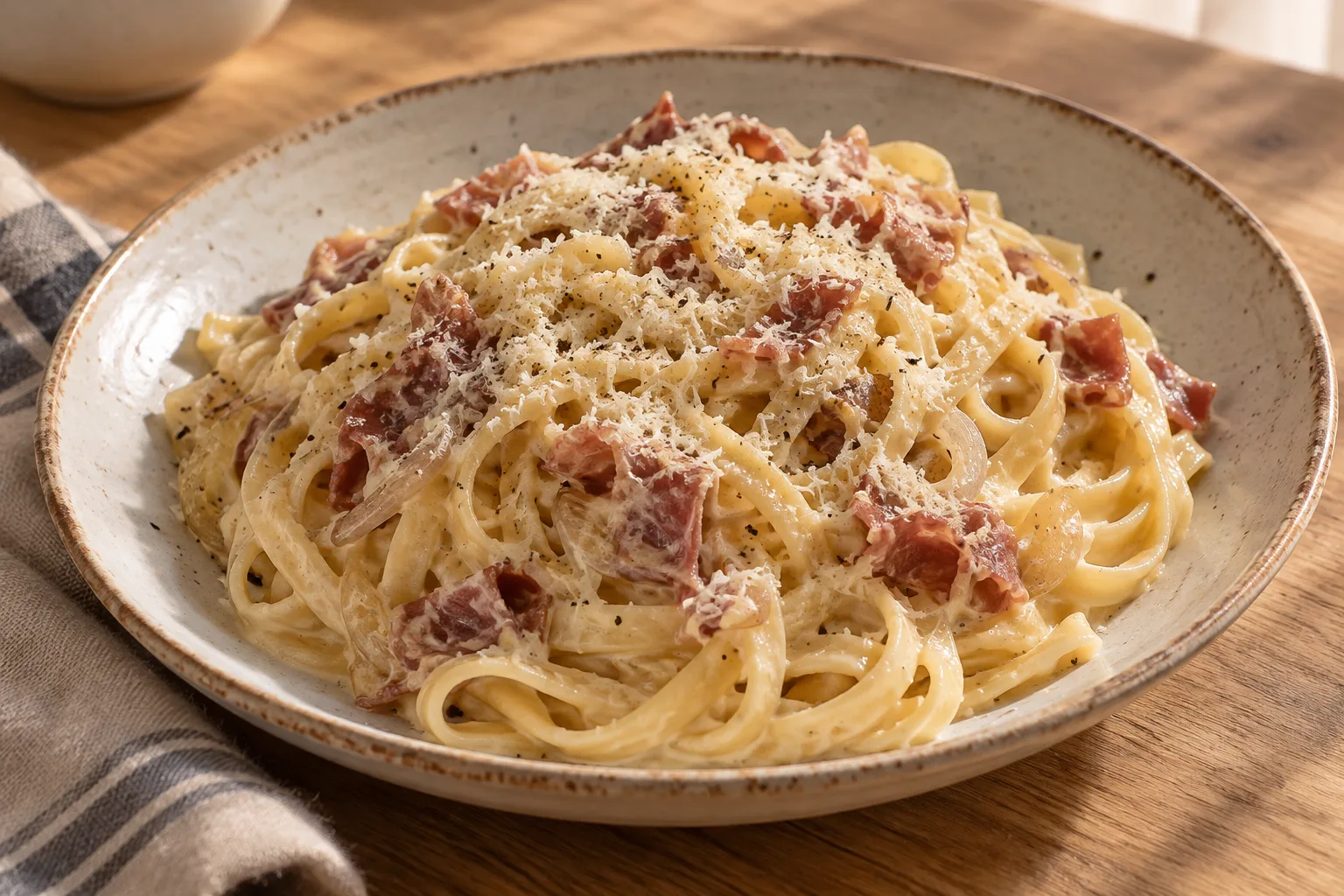
Choose pecorino when you want a sheep’s-milk cheese with a noticeable presence in pasta, soups or salads. A firm, aged variety is convenient for grating or shaving; a more tender one can be served on a cheese board or used in bites and fillings. Pecorino Romano is a familiar choice for Roman-style dishes such as cacio e pepe, carbonara and amatriciana, but varieties have their own character. If the dish already contains salty ingredients, use the cheese sparingly and taste before adding more salt. Its strong flavor can make a small amount go a long way.
How to use it
Finely grate pecorino over pasta, vegetables, soups or baked dishes just before serving, or stir it into a sauce for flavor and body. For pasta with black pepper, combine the cheese with a little cooking water to help make a sauce; avoid adding it all at once to rapidly boiling liquid, as it may clump. You can also shave it over salads, crumble it onto vegetables or serve it on a cheese board. Firmer pieces are usually easier to grate, while less-aged varieties may be better suited to slices or cubes. Taste the dish before adjusting the salt, because pecorino can contribute a distinctly salty flavor.
Flavour and texture
Flavor depends on the variety and aging. Pecorino can be bold and salty; more-aged pieces tend to be firm, dry or granular and easy to grate. Less-aged varieties may have a more tender texture.
How to choose it
Look for the specific variety on the label, along with the sheep’s-milk description and any indication of aging or suggested use. Choose a firm piece for grating and consider a more tender texture for slices or cubes. Pecorino varieties do not all have the same intensity.
Storage
Follow the package directions, since pecorino includes varieties with different textures and aging. Once opened, wrap it or place it in a clean, closed container and refrigerate it when the label instructs you to do so. Keep the whole piece separate from grated or cut cheese, and discard the product if its packaging says to do so or it shows signs of spoilage.
Substitutions
Parmigiano-Reggiano or Grana Padano can stand in for pecorino in dishes that call for a hard grating cheese. Both are made from cow’s milk rather than sheep’s milk, and their flavor may be less bold or salty. Adjust the amount and taste before adding salt.
Common mistakes
Do not assume that every pecorino is Pecorino Romano or that all varieties have the same intensity and texture. Avoid making a substitution without tasting the dish, and do not add salt before checking the cheese’s effect. For a sauce, add the cheese gradually and avoid a vigorous boil, which can make it clump.
Safety and allergens
Pecorino is a dairy product made from sheep’s milk. Check the label if you have a milk allergy, and follow the package instructions for storage and use.
Culinary uses
- Grated seasoning cheese
- Table cheese
- Flavoring for pasta, soups, salads and baked dishes
Recommended techniques
- Finely grate over hot food
- Shave or crumble for serving
- Melt into sauces or fillings
Pairs well with
- Pasta and black pepper
- Tomatoes and olive oil
- Honey, pears and walnuts
Frequently asked questions
Is all pecorino Pecorino Romano?
No. Pecorino is a general name for Italian sheep’s-milk cheeses; Romano, Toscano and Sardo are distinct varieties.
Can pecorino replace Parmesan?
Yes, a hard grating cheese can replace another in many dishes, but pecorino often tastes bolder and saltier. Adjust the amount and taste before adding salt.
How is pecorino usually served?
It can be grated over pasta and soups, shaved onto salads or served on a cheese board. The best format depends on the variety’s texture.
Ingredient allergens
Allergen listThere are no verified associations for these ingredients yet.
Estimated nutrition
- Fat
- 32.1 g
- Saturates
- 17.9 g
- Carbohydrate
- 0 g
- Sugars
- 0 g
- Fibre
- 0 g
- Protein
- 28.6 g
- Salt
- 3.12 g
Sources and review
Automatically researched, cross-checked and validated content. Sources consulted:
- Client Challenge doi.org/10.2307/jj.27939689.16
- Cheese • The Nutrition Source nutritionsource.hsph.harvard.edu/cheese/
- A Guide to Cheese: 30 Cheeses You Should Know - Escoffier www.escoffier.edu/blog/culinary-arts/a-complete-guide-to-cheese/
- The Difference Between Parmigiano-Reggiano, Grana Padano & Pecorino www.ice.edu/blog/italian-cheeses-parmigiano-reggiano-grana-padano-pecorino
- Comité Científico aesan.gob.es/dam/jcr:a7c4e553-46f5-4def-9ede-b6d1e19b3948/comite_cientifico_42.pdf
- Pecorino Romano Cheese Recalled Due to Potential Listeria Contamination ag.purdue.edu/news/department/foodsci/feng-news/2025/12/pecorino-romano-cheese-recall.html
- How long until cheese spoils? | OSU Extension Service extension.oregonstate.edu/ask-extension/featured/how-long-until-cheese-spoils
- Selecting Cheese for Health extension.psu.edu/selecting-cheese-for-health/
- CIM Arts, Beats & Eats Recipes Fall 2024 - Baker College www.baker.edu/academics/affiliated-institutions/culinary-institute-of-michigan/cim-abe-recip…
- Blue Zones Food List maui.hawaii.edu/wp-content/uploads/sites/4/2018/02/Blue-Zones-Food-List.pdf
- Queso Pecorino Romano DOP: Historia, elaboración y usos culinarios, con Álvarez Selección - Charcutería Online Madrid | Álvarez Selección www.alvarezseleccion.com/queso-pecorino-romano-dop-historia-elaboracion-y-usos-culinarios/?s…
- Queso Pecorino: Tipos, sabor y usos en cocina lafamigliarestaurantes.com/blog/queso-pecorino/
- Queso pecorino romano: Características y usos www.ditaly.es/queso-pecorino-romano/
- El Queso Pecorino | La Boulette www.laboulette.com/blog/queso-pecorino
- ▷ El queso Pecorino es un excelente alimento nutritivo【 Kitchen Academy 】 kitchenacademy.es/pinones-3-2-2/
- Food allergen labelling and information requirements technical guidance - GOV.UK www.gov.uk/government/publications/food-allergen-labelling-and-information-requirements-tech…