- Category
- Fruit
- State
- Fresh
- Usual unit
- unit
What it is
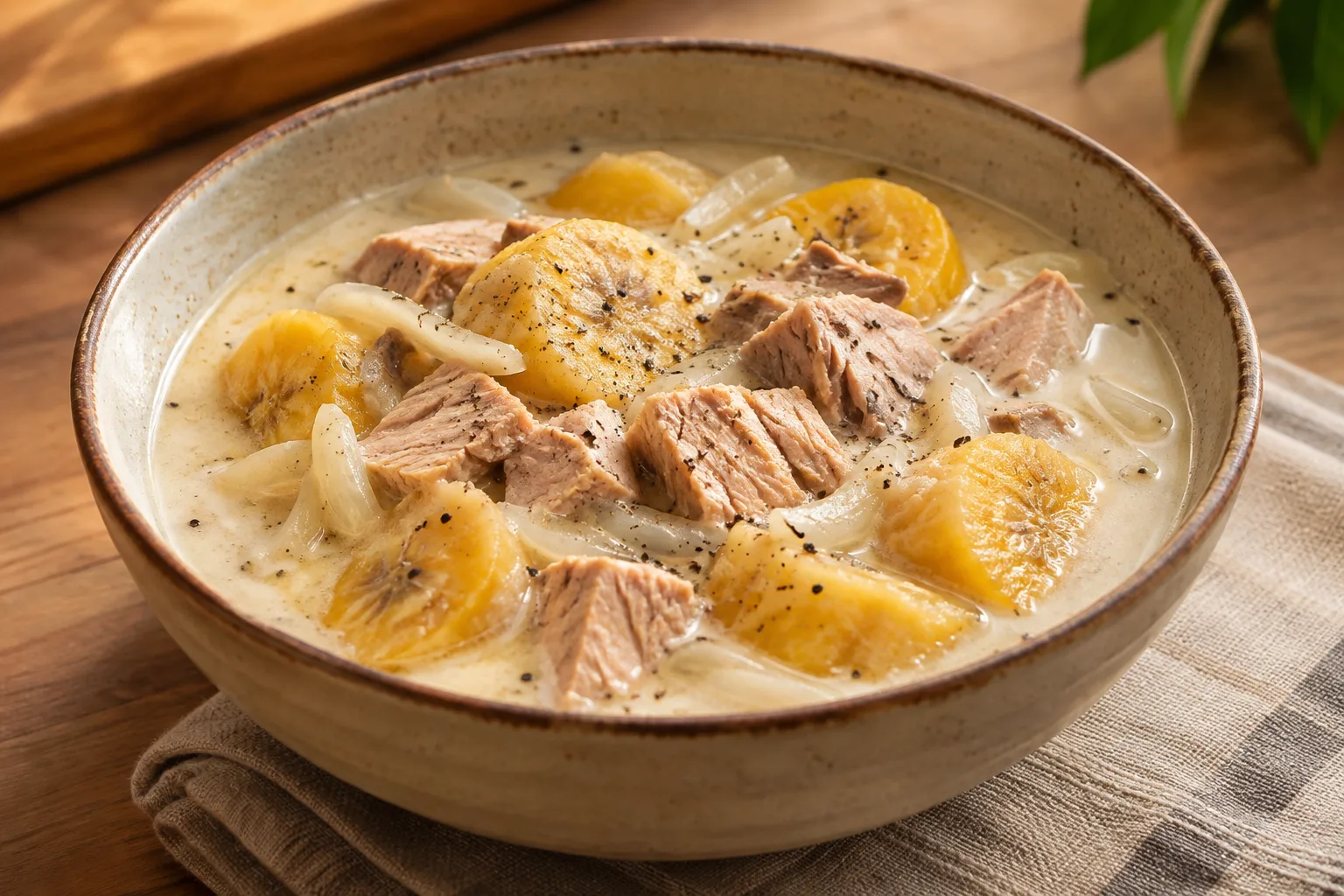
Plantain is a fruit in the Musa genus, used mainly as a cooking ingredient. It is often larger, with thicker skin and firmer, starchier flesh than a sweet dessert banana. When green, its flavor is mild and its flesh is firm and floury; as it ripens, the skin may turn yellow and the flesh becomes softer and sweeter. Ripeness therefore affects both flavor and the way the fruit behaves in a recipe. Plantain is sold fresh and can be boiled, fried, baked, roasted or steamed. It should not be treated as identical to a dessert banana: the fruits look related, but their texture and typical culinary uses differ.
When to use it
Choose green plantain when you want a firm, mildly flavored ingredient for stews, soups, chips or dishes that are mashed and fried, such as tostones. A riper plantain is a better fit when a softer texture and more sweetness are welcome, for example as a cooked or roasted side. Varieties can also produce different results: some hold their shape better when fried, while others are creamier when boiled or roasted. Check ripeness before you begin and choose according to the texture you want rather than assuming every plantain will cook the same way.
How to use it
Peel the plantain and cut it to suit the dish; the skin can be thick and green flesh firm. For a stew or soup, cut it into pieces and cook until it reaches the texture you prefer. It can also be boiled, roasted, baked or steamed and served as a side. To make tostones or patacones, fry thick slices, flatten them, then fry them again until golden and crisp. Thin slices can be fried as chips. Cooked plantain can also be mashed with garlic and salt for a savory preparation, or made into dough for some recipes. Ripeness changes sweetness, firmness and the final result, so select the fruit with the cooking method in mind.
Flavour and texture
Green plantain tastes mild and not very sweet, with compact, starchy, floury flesh. When cooked, it can remain firm in pieces or become tender enough to mash. As it ripens, it becomes sweeter and softer, though variety and cooking method also affect the result. Thin fried slices can turn crisp; boiled or roasted pieces are generally softer and substantial. Do not expect the juiciness or dessert-like sweetness of a ripe banana.
How to choose it
Choose firm fruit without significant bruising or soft, damaged areas. Skin color can help indicate ripeness: green usually means firmer, less sweet flesh, while yellow tones can signal a riper fruit. Do not rely on color alone, since appearance can vary by variety and handling. For frying or tostones, look for firm fruit; for a softer, sweeter result, choose a riper one. Size and shape can vary.
Storage
The supplied evidence does not establish a precise shelf life or storage conditions for whole plantains, so avoid relying on a fixed number of days. If the fruit is still green and you want it to ripen, leave it at room temperature and check it as it changes. Once peeled or cut, refrigerate it and do not leave it at room temperature for more than two hours in total. To limit browning of cut flesh, prepare it close to cooking time and keep it covered and refrigerated while you wait.
Substitutions
There is no exact substitute that reproduces plantain’s combination of firmness, starch and mild flavor. A different ripeness stage may work if the recipe can accommodate a change: riper fruit is sweeter and softens more, while green fruit is firmer and more neutral. Plantain flour is used in some baking preparations, but it does not automatically replace whole fruit; use a recipe adapted for the flour. Dessert banana is not a neutral swap because it is sweeter and juicier.
Common mistakes
Do not confuse plantain with a dessert banana: they differ in sweetness, firmness and usual cooking use. Avoid choosing a very ripe fruit when you need pieces to hold their shape in a stew or during frying. For tostones, flattening the slices is part of the method; a single fry will not give the characteristic twice-fried texture. Cooking times are not universal: variety, cut size and ripeness all affect the finished texture.
Safety and allergens
Wash the outside before peeling and use clean utensils. Refrigerate peeled or cut fruit; do not leave it at room temperature for more than two hours in total. Green flesh is highly starchy and is commonly cooked for a more appealing texture. Culinary descriptions also include uses for ripe fruit without cooking, so it is not accurate to claim that every plantain is inedible raw.
Culinary uses
- Starchy cooked side dish
- Ingredient for snacks, soups, stews, purées and doughs
Recommended techniques
- Boiling
- Frying, including twice-fried slices
- Baking or roasting
- Steaming and mashing
Pairs well with
- Garlic and salt in savory mashed preparations
- Soups and stews
- Sauces or dips alongside crisp fried slices
- Seasonings that complement a mild, starchy base
Frequently asked questions
Is plantain the same as a banana?
No. Both belong to the Musa genus, but plantain usually has firmer, starchier flesh and is more often cooked. Dessert bananas are generally sweeter and juicier.
Can plantain be eaten raw?
Green plantain is firm and very starchy, so it is usually cooked. Some culinary descriptions include ripe plantain eaten without cooking, but its flavor and texture are not the same as a dessert banana.
What can I make with green plantain?
Fry it in slices, flatten and fry it again to make tostones, or add pieces to soups and stews. It can also be boiled, roasted or mashed.
Ingredient allergens
Allergen listThere are no verified associations for these ingredients yet.
Estimated nutrition
- Fat
- 11.8 g
- Saturates
- 3.69 g
- Carbohydrate
- 49.2 g
- Sugars
- 3.63 g
- Fibre
- 3.5 g
- Protein
- 1.5 g
- Salt
- 0 g
Sources and review
Automatically researched, cross-checked and validated content. Sources consulted:
- The Essential Glossary of Cooking Terms for the Culinary Arts - Escoffier www.escoffier.edu/blog/culinary-arts/the-essential-glossary-of-cooking-terms-for-the-culinar…
- Usos culinarios apropiados de las variedades de plátano verde barraganete, dominico y maqueño, en la gastronomía ecuatoriana. | Revista de Gastronomía y Cocina doi.org/10.70221/rgc.v4i2.97
- Curiosidades sobre el plátano macho - Formacion en Gastronomia www.formacionengastronomia.com/cocina-latina/curiosidades-sobre-el-platano-macho/
- Food Storage in the Home - Digital Commons@USU digitalcommons.usu.edu/cgi/viewcontent.cgi?article=1640&context=extension_histall
- A Recipe for Memory: Hispanic Heritage as Told Through Cultural Dishes news.sunyempire.edu/a-recipe-for-memory-hispanic-heritage-as-told-through-cultural-dishes/
- digital dining discourse: authenticity online ninercommons.charlotte.edu/record/2745/files/Andre_uncc_0694N_13857.pdf
- Plátano macho: qué es, propiedades y cómo utilizarlo en la cocina www.directoalpaladar.com/ingredientes-y-alimentos/platano-macho-que-propiedades-como-utiliza…
- Plátano macho: 8 beneficios y cómo consumirlo - Tua Saúde www.tuasaude.com/es/platano-macho/
- Tanzania Food Composition Tables | The Nutrition Source nutritionsource.hsph.harvard.edu/wp-content/uploads/2023/09/Tanzania-Food-Composition-Tables…
- How to Prevent Cut Fruit from Turning Brown | UNL Food | Nebraska food.unl.edu/article/how-prevent-cut-fruit-turning-brown/
- The Toughest Cook in the Kitchen - OAKTrust oaktrust.library.tamu.edu/bitstreams/a5ad2993-6728-4fe4-8d1d-a6a3ca2fa02e/download
- Salt Sugar Fat: How the Food Giants Hooked Us scalar.usc.edu/works/uiuc-food-networks/media/MichaelMoss_SaltSugarFat2013_2.1.pdf
- Plátano macho | www.cocinista.es www.cocinista.es/web/es/enciclopedia-cocinista/ingredientes-del-mundo/platano-macho.html
- Plátano Macho Origen Colombia - Grupo Plátanos López platanoslopez.com/platano-macho-origen-colombia/