- Category
- Sugar and sweeteners
- State
- Powdered
- Usual unit
- g
What it is
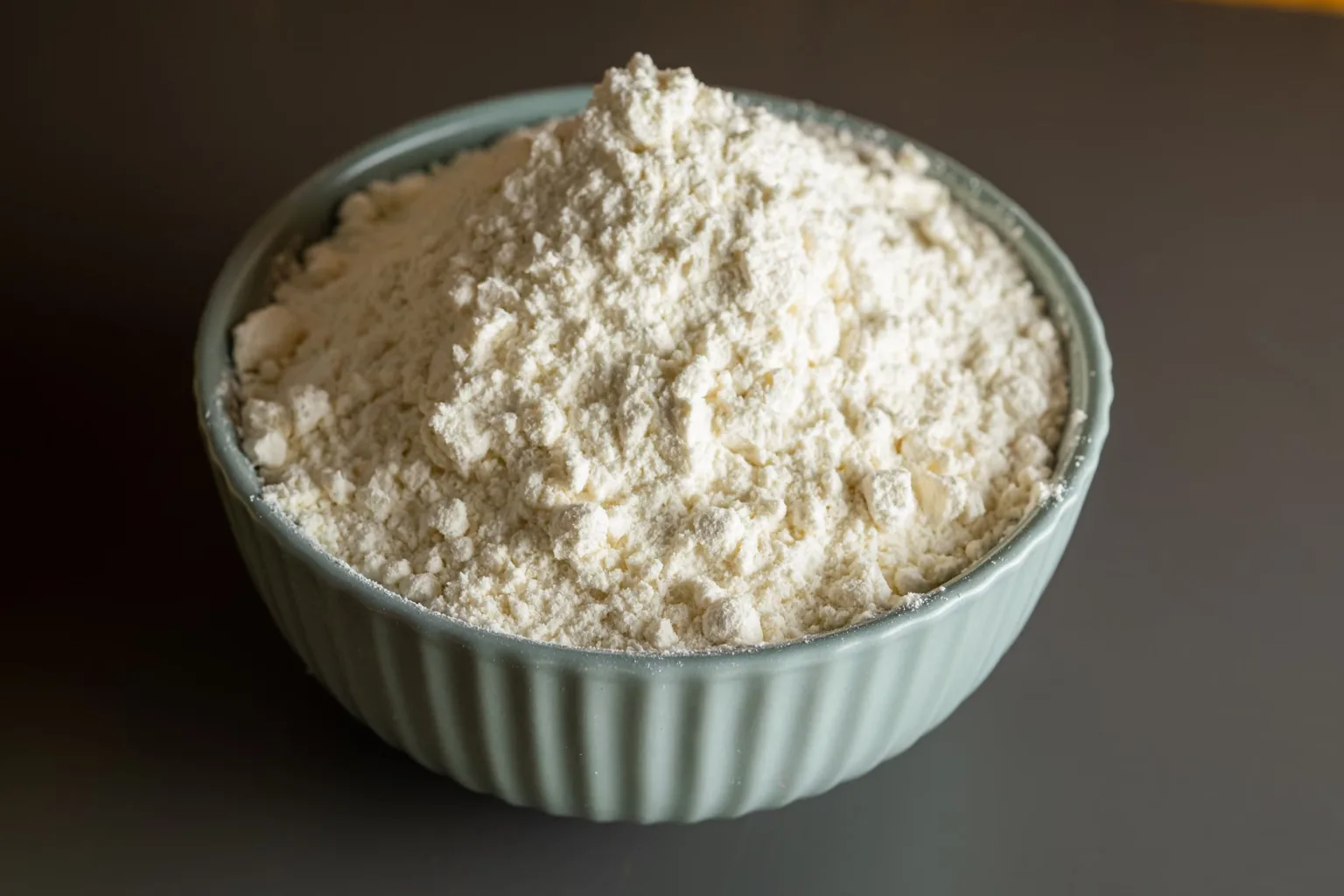
Powdered sugar, also called icing sugar or confectioners’ sugar, is granulated sugar milled into a fine powder. Its fine texture makes it easy to blend into icings and creams and helps create a smoother feel than undissolved granulated sugar. Products do not all have the same composition: some contain only milled sugar, while others include a small amount of starch to help the powder resist clumping in humidity. Check the ingredient label when a recipe calls for a particular kind or when you need to avoid a specific ingredient. Powdered sugar is a baking ingredient, not an automatic one-for-one replacement for granulated sugar in every recipe. Its fine particle size, and any starch it contains, can affect the texture and balance of a mixture.
When to use it
Choose powdered sugar when you want sweetness to blend readily and a fine texture, especially in icing, glazes, frosting and creams. It is also useful for dusting cakes, cookies and pastries after they have cooled, as a finishing touch. In delicate doughs, it can contribute to a finer texture than granulated sugar. Do not swap it into every recipe by default: when sugar contributes to structure or browning, the change in particle size and the possible presence of starch may affect the result. If a chilled preparation needs to be smooth, without noticeable sugar crystals, first check which type of sugar the recipe specifies.
How to use it
Sift powdered sugar if it has lumps, particularly before adding it to a cream or dusting it over a dessert. To make a simple glaze, gradually mix it with a liquid such as water or citrus juice until it reaches a consistency that can be spread or drizzled; add the liquid in small amounts. For buttercream, add the sugar in several batches and beat each addition in before adding more, which helps limit lumps and gives you control over the consistency. For decoration, wait until cakes or pastries are cool and dry, then dust with a fine sieve. Follow the recipe if it specifies powdered sugar with or without starch: the two varieties are not identical, and starch can affect texture. For accurate measurement, use the weight specified in the recipe rather than assuming that the same volume is interchangeable with another type of sugar.
Flavour and texture
Powdered sugar has a clean sweetness and a very fine texture, without the obvious crystals of granulated sugar when properly incorporated. It can help make icing and frosting smooth, while a dusting gives baked goods a light white finish. Its behavior can vary by product, especially when starch is included or the grind differs.
How to choose it
Check the ingredient list before buying: powdered sugar may be milled sugar alone or may contain starch to help prevent clumping. Choose a product that suits the recipe, since composition can affect the texture of icing and frosting. Check that the package is intact and that the powder shows no visible dampness or hard, compact lumps.
Storage
Protect powdered sugar from moisture to help keep it loose and reduce clumping. Close the package securely after each use and do not put wet utensils into it. Sift loose lumps before use; if the product shows signs of dampness or contamination, do not add it to food.
Substitutions
Granulated sugar is not a direct substitute in every recipe: its crystals are larger and dissolve less readily, so the finished texture may differ. Grinding granulated sugar at home can be useful when powdered sugar is unavailable, although the result may not be as fine as a commercial product. Do not substitute by volume without checking the recipe, and weigh ingredients when the recipe gives weights.
Common mistakes
Replacing granulated sugar with powdered sugar without considering structure, texture or browning can change a recipe. Other common mistakes include using clumped powder without sifting, adding too much liquid to a glaze at once, or dusting a warm or damp surface, which can spoil the neat finish.
Safety and allergens
Handle the powder gently to avoid raising and dispersing it into the air. Keep the package closed and clean, and check the ingredient label if you need to know its composition, as some varieties contain starch.
Culinary uses
- Sweetener in icing, frosting and creams
- Fine finishing dust for baked goods and desserts
- Ingredient for delicate pastry doughs
Recommended techniques
- Sift before mixing or dusting to break up lumps
- Whisk with a small amount of liquid to make a glaze
- Beat gradually into butter or cream for a smooth frosting
Pairs well with
- Butter and cream cheese in frostings
- Water or citrus juice in simple glazes
- Cakes, pastries, cookies and other baked desserts
Frequently asked questions
Is powdered sugar the same as icing sugar?
These are regional names for finely milled sugar. The ingredients can vary: some products contain starch and others do not, so check the label.
Can I replace it with granulated sugar?
Not in every recipe. Granulated sugar has larger crystals and dissolves less readily, which can change the texture. Follow the recipe’s instructions.
Why does powdered sugar get lumpy?
Moisture can make the powder clump. Keep the package closed and sift the sugar before use if it has loose lumps.
Ingredient allergens
Allergen listThere are no verified associations for these ingredients yet.
Estimated nutrition
- Fat
- 0 g
- Saturates
- 0 g
- Carbohydrate
- 100 g
- Sugars
- 100 g
- Fibre
- 0 g
- Protein
- 0 g
- Salt
- 0 g
Sources and review
Automatically researched, cross-checked and validated content. Sources consulted:
- Client Challenge doi.org/10.2307/jj.27939689.16
- Azúcar glas. Qué es, cómo usarlo y sacarle partido en tus recetas dulces www.abc.es/recetasderechupete/azucar-glas-que-es-como-usarlo-y-sacarle-partido-en-tus-receta…
- Azúcar glas - Wikipedia, la enciclopedia libre es.wikipedia.org/wiki/Az%C3%BAcar_glas
- Azúcar impalpable: análisis, usos y comparativa de las mejores opciones para repostería aliciascake.es/azucar-impalpable/
- FASHIONING AFROCUBA: FERNANDO ORTIZ AND THE ... uknowledge.uky.edu/cgi/viewcontent.cgi?article=1378&context=gradschool_diss
- La cocina técnico conceptual: origen, significado, características y propuesta gastronómica a partir de 25 productos cultivados, en la provincia del Azuay-Ecuador | OpenAlex openalex.org/W66629700
- Wuthering Heights people.duke.edu/~garci/cybertexts/BRONTE-EMILY/WUTHERING-HEIGHTS/TRANSLATE/WUTHERING-HEGHTS.…
- Azúcar impalpable: qué es y cómo usarla | Especias 51 especias51.com.ar/especia/azucar
- - YouTube www.youtube.com/watch?v=YBgWZTvhUGs
- Los tipos de azúcar, diferencias y usos en cocina - Pepekitchen pepekitchen.com/articulo/los-tipos-de-azucar-diferencias-y-usos-en-cocina/
- Azúcar glasé: análisis y comparativa de las mejores opciones para repostería doncaramelo.es/azucar-glase/