- Category
- Dairy and eggs
- State
- Fresh
- Usual unit
- unit
What it is
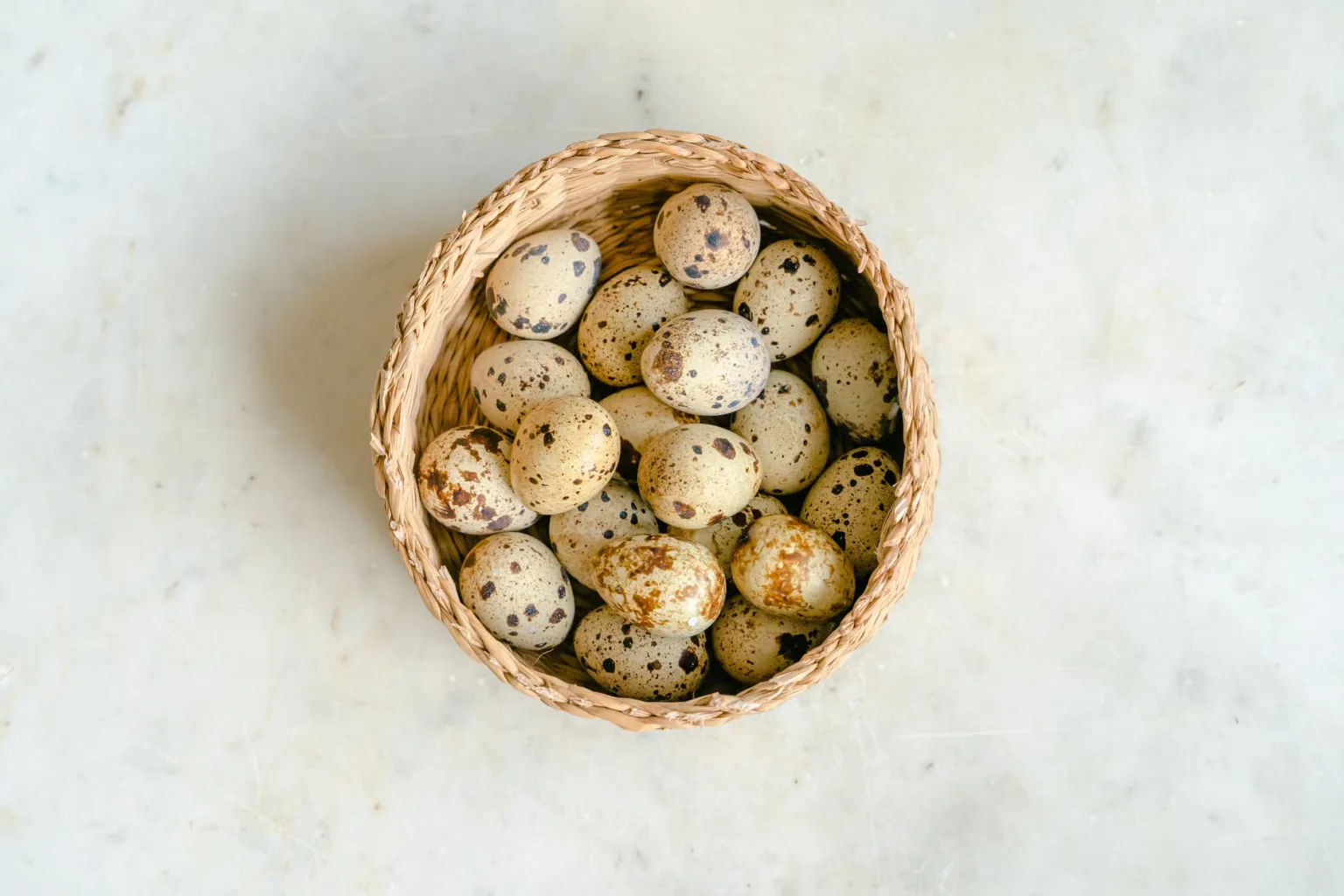
Quail eggs are eggs laid by quail and are commonly sold fresh in their shells. They are much smaller than hen eggs and are often recognized by their pale shells with dark speckles. Their size makes them convenient to serve whole as small bites or as individual additions to a dish, though they can also be used in preparations that call for eggs. Their flavor is generally described as mild and delicate, although it may seem a little stronger to some palates. Like other eggs, they are versatile, but their smaller size affects presentation and means they are not a direct one-for-one replacement in every recipe.
When to use it
Use quail eggs when you want a small egg portion, an eye-catching presentation or a garnish that can be served whole. Boiled and peeled, they work in salads, as appetizers or on toast; fried or poached, they can top potatoes and other dishes. They are especially useful when a recipe benefits from individual bites and a speckled appearance, but may be less convenient than hen eggs in larger dishes that need substantial amounts of egg. When adapting a recipe written for hen eggs, adjust the quantity and check the texture rather than assuming a direct equivalent.
How to use it
Handle fresh eggs gently and crack each one into a small bowl before adding it to a pan or mixture. This lets you check it and helps keep shell fragments out of the dish. To boil them, lower them carefully into water that is already boiling and make sure they are covered. One culinary source gives a short boiling time of about four minutes, but the result depends on the desired doneness and egg size, so check the center and adjust as needed. Cool them in cold water afterward to make peeling easier. You can also fry or poach them and serve them on toast, salads or potatoes. If a recipe calls for hen eggs, do not substitute one for one: adjust the amount to the role the egg needs to play.
Flavour and texture
Their flavor is usually described as mild and delicate, though some people find it a little more pronounced than that of hen eggs. Cooked white and yolk have the familiar textures of egg in a smaller package that can be served whole or cut. The shell has dark speckles on a pale background, a distinctive visual feature; it is not eaten and should be removed before serving. The final texture and appearance depend on the cooking method: boiled, fried and poached eggs each give a different result.
How to choose it
Choose eggs with intact shells and no visible dirt, and check that the package is closed and in good condition. Look for the date and storage directions on the package, since conditions can vary by product and place of sale. Quail eggs are small and commonly have speckled shells; differences in size or pattern between eggs are not, by themselves, a reason to reject them. Avoid eggs with cracked shells, and do not use an egg that smells unpleasant when opened.
Storage
Keep the eggs in their package and follow the storage directions printed on it. Leave the shells intact until you are ready to use the eggs, and separate any that break. Once cooked and peeled, handle them with clean utensils and store them according to the product or recipe directions. Do not rely on the speckled appearance to decide whether an egg is still suitable: check the package and inspect each egg when you open it.
Substitutions
Hen eggs can replace quail eggs when a recipe allows for egg, but they are a different size. Adjust the amount to the function and volume needed instead of making a one-for-one swap. Another edible bird egg may serve a similar purpose if available and suitable for the dish, though its size and flavor may differ. In a garnish or small-bite presentation, a substitute will also change the appearance.
Common mistakes
Do not treat quail eggs as though they were the same size as hen eggs or assume a direct one-for-one equivalent in recipes. Avoid dropping them roughly into boiling water, since they may crack and hot water can splash. Peel gently to avoid crushing the white. Do not use eggs with cracked shells or an unpleasant smell, and do not assume that a normal appearance makes hygienic handling unnecessary.
Safety and allergens
As with other eggs, avoid using eggs with cracked shells or an unpleasant smell. Handle them with clean utensils and cook them thoroughly; a study of eggs sampled at markets found E. coli contamination in some samples. Also follow the package's storage and preparation directions.
Culinary uses
- Small-format main ingredient
- Garnish or topping
- Appetizer or snack
Recommended techniques
- Boiling
- Frying
- Poaching
Pairs well with
- Toast and ham
- Leafy salads and vegetables
- Potatoes
Frequently asked questions
How are quail eggs different from hen eggs?
They are much smaller and commonly have pale shells with dark speckles. Their flavor is usually described as mild and delicate.
How can I serve quail eggs?
Boil, fry or poach them. They work as appetizers or on salads, toast and potatoes.
Can I substitute them one for one for hen eggs?
Do not assume a one-for-one equivalent because the eggs differ in size. Adjust the quantity to the role the egg plays in the recipe.
Ingredient allergens
Allergen listThere are no verified associations for these ingredients yet.
Estimated nutrition
- Fat
- 5.17 g
- Saturates
- 0 g
- Carbohydrate
- 3.45 g
- Sugars
- 0 g
- Fibre
- 0 g
- Protein
- 6.9 g
- Salt
- 2.07 g
Sources and review
Automatically researched, cross-checked and validated content. Sources consulted:
- ¿Por qué la muerte es origen de miedos y tabúes? doi.org/10.64628/aao.fccyk3qj3
- The Essential Glossary of Cooking Terms for the Culinary Arts - Escoffier www.escoffier.edu/blog/culinary-arts/the-essential-glossary-of-cooking-terms-for-the-culinar…
- Gastronomía de México - Wikipedia, la enciclopedia libre es.wikipedia.org/wiki/Gastronom%C3%ADa_de_M%C3%A9xico
- Gastronomía de la provincia de Zaragoza - Wikipedia, la enciclopedia libre es.wikipedia.org/wiki/Gastronom%C3%ADa_de_la_provincia_de_Zaragoza
- "Brood parasitism of Greater Sage-Grouse by California Quail in Idaho" by Jordan C. Rabon, Sarah E. McIntire et al. scholarsarchive.byu.edu/wnan/vol80/iss4/18/
- Cómo cocinar y pelar huevos de codorniz | Recetas Nestlé www.recetasnestle.com.ar/escuela-sabor/ingredientes/huevos-de-codorniz
- Huevos de codorniz: beneficios y usos culinarios huevosqovo.com/huevos-de-codorniz-beneficios-y-usos-culinarios/
- De la cultura gastronómica del barroco a la cultura gastronómica del neoclásico (1680-1795) | OpenAlex openalex.org/W4402680290
- Determinación de Escherichia coli, Salmonella spp. y características sensoriales en huevos de codorniz (Coturnix coturnix) expendidos en mercados mayoristas de Lima, 2024 doi.org/10.21142/tl.2025.4465
- - YouTube www.google.com/goto?url=CAESZgHrOzAV9h_jPYZ9vv8IximgLL4lXDOY4gcnwxFVYCMUblbOPXLCh7dBA25Fxy6a…
- Food allergen labelling and information requirements technical guidance - GOV.UK www.gov.uk/government/publications/food-allergen-labelling-and-information-requirements-tech…