- Category
- Bread and dough
- State
- Dry
- Usual unit
- unit
What it is
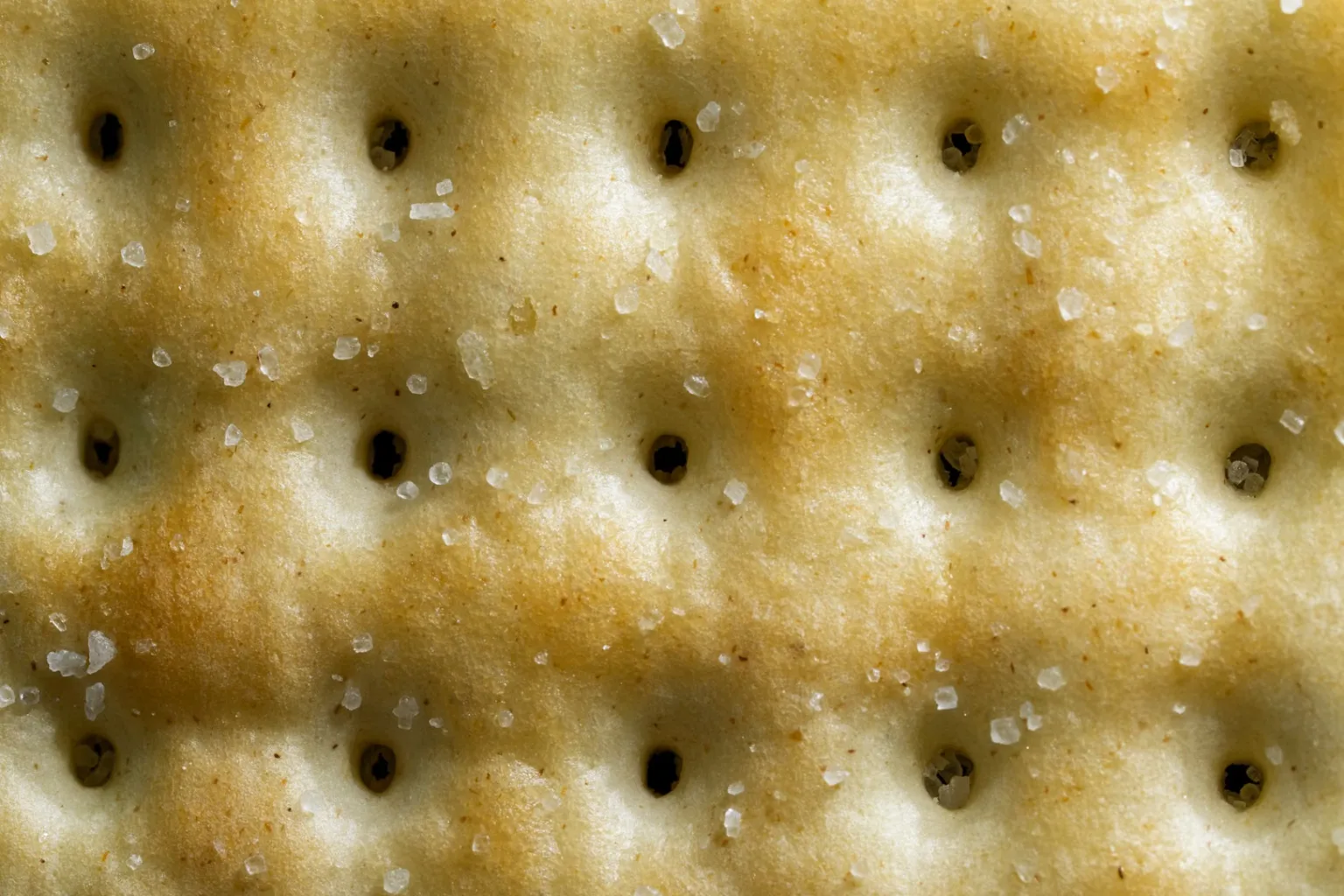
Salted crackers are dry, crisp baked pieces, often flat and available in different shapes, sizes, and flavors. Some are seasoned with salt; others may include ingredients such as herbs, seeds, or cheese. Common recipes can use flour, salt, and fat, but the exact ingredients differ among brands and varieties. The name alone therefore does not guarantee a particular ingredient list or suitability for a dietary need. Crackers can be eaten as they are or used as a base or accompaniment for savory foods. Check the package for the composition of the specific product you plan to serve.
When to use it
Use salted crackers when you want a crisp element for a simple snack or a small base for cheese, pâté, or savory mousse. They can also accompany a meal in place of another bakery item. Choose a variety to suit the flavor and texture you want: a plain cracker lets the topping stand out, while a version with seeds, herbs, or cheese contributes its own flavor. If you want the base to stay crisp, add moist toppings shortly before serving rather than preparing the crackers well in advance.
How to use it
Serve crackers straight from the package as a snack, or arrange them on a platter with cheese, pâté, or savory mousse. To make small bites, spread a modest amount of topping on each cracker and add any other ingredients shortly before serving to maintain a crisp contrast. You can also break crackers into pieces or crumble them over a dish when you want to add crunch. Taste one first if the topping is also salty, since the salt level varies by product. Thin toast or crisp flatbread can serve a similar role when crackers are unavailable.
Flavour and texture
Their defining quality is a dry, crisp texture, and their flavor is commonly salty. The flavor is not uniform across products: some are plain, while others may contain herbs, seeds, or cheese. Thickness and shape also vary. These differences affect how prominent the cracker tastes beside a topping and how easily it can be spread without breaking.
How to choose it
Choose the shape, thickness, and flavor according to how you plan to serve the crackers. Flat pieces may be convenient for toppings, while smaller ones are easy to arrange on a platter. Read the ingredient and allergen information on the package rather than assuming every salted cracker has the same composition. If you want a plain flavor, check whether the variety includes seeds, herbs, cheese, or other ingredients that will change its taste.
Storage
Store crackers according to the package directions and close the pack again after serving. Because they are dry and crisp, avoid leaving them exposed for a long time while preparing the table. Follow any specific storage instructions printed on the package. If the pack is damaged or the crackers have not been stored as directed, check their appearance and smell before use.
Substitutions
Thin toast or crisp flatbread can replace crackers when you need a similar base or accompaniment. The result will not be identical: thickness, texture, and possibly saltiness will differ. If the substitute is less salty, adjust the rest of the appetizer to taste. Check its ingredients and allergen information just as you would for crackers.
Common mistakes
Do not assume that every variety has the same ingredients, flavor, or salt level. Avoid adding moist toppings far ahead of serving if you want a crisp contrast, since they can change the texture. Check the package when allergies or dietary restrictions are a concern.
Safety and allergens
Check the ingredient and allergen label, especially when wheat allergy or gluten sensitivity is a concern; recipes vary, and not all crackers are alike. Follow the package storage directions, and do not eat a product if its package is damaged or its appearance or smell is abnormal.
Culinary uses
- Base crujiente para aperitivos
- Acompañamiento de quesos, patés y untables
Recommended techniques
- Servir enteros como base o acompañamiento
- Desmenuzar para añadir una textura crujiente
Pairs well with
- Queso
- Paté o mousse salada
Frequently asked questions
Are salted crackers always made with wheat?
Not necessarily. Recipes vary, so check the ingredient list for the specific product.
What are salted crackers commonly served with?
They can be served with cheese, pâté, or savory mousse, or used as a base for small appetizers.
What can I use instead of crackers?
Thin toast or crisp flatbread can play a similar role, though the texture and flavor will differ.
Ingredient allergens
Allergen listDepends on the product
-
Tree nuts
Salted crackers
Sources and review
Automatically researched, cross-checked and validated content. Sources consulted:
- Client Challenge doi.org/10.2307/jj.27939689.16
- The Essential Glossary of Cooking Terms for the Culinary Arts - Escoffier www.escoffier.edu/blog/culinary-arts/the-essential-glossary-of-cooking-terms-for-the-culinar…
- Agencia Española de Seguridad Alimentaria y Nutrición www.aesan.gob.es/
- Nutrition After Your Transplant - Health Online healthonline.washington.edu/sites/default/files/record_pdfs/Nutrition-After-Your-Transplant-…
- A Grounded Theory Study Using PhotoVoice Methodology aquila.usm.edu/cgi/viewcontent.cgi?article=1024&context=masters_theses
- Winter Squash | UNL Food | Nebraska food.unl.edu/article/winter-squash/
- Using direct observations on multiple ... oaktrust.library.tamu.edu/bitstream/1969.1/182261/1/document-1.pdf
- wordlist.txt zoo.cs.yale.edu/classes/cs470/materials/hws/hw6/aima-data/EN-text/wordlist.txt
- - YouTube www.youtube.com/watch?v=gaaSiR1UVIQ
- Orígenes de las Galletas de Soja ¿Lo Sabías? - Aprende con Secofrut www.secofrut.com/galletas-de-soja-saladas/?srsltid=AYCX9vKNxxmYilz5VzxhvZY2JnjHNwryL9akRJPc-…
- Cracker (alimento) - Wikipedia, la enciclopedia libre es.wikipedia.org/wiki/Cracker_(alimento)
- Galletas saladas extrafinas o crackers, un aperitivo con 5 ingredientes basicos | DECORECETAS www.decorecetas.com/2019/04/galletas-saladas-extrafinas-o-crackers-aperitivo-con-5-ingredien…
- Managing allergens | Food Standards Scotland www.foodstandards.gov.scot/business-guidance/running-a-food-business/managing-allergens