- Category
- Nuts and seeds
- State
- Dry
- Usual unit
- g
What it is
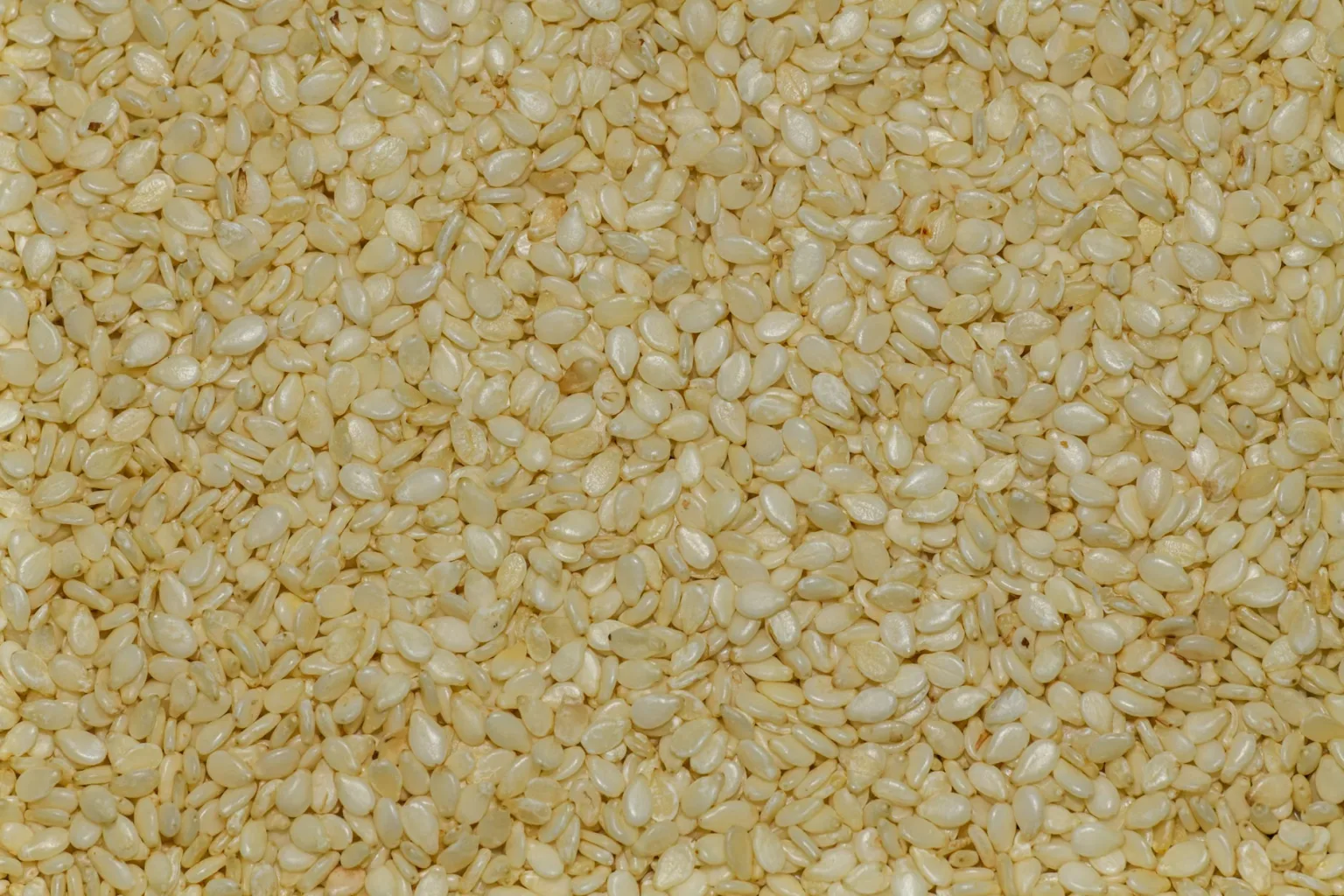
Sesame, also called benne in some contexts, is an edible seed used whole, ground, or made into paste and oil. As a finishing ingredient, whole seeds are scattered over a dish to add visual contrast and a small, crisp texture. Sesame seeds are available in pale, golden, and black colors, and they may be sold raw or already toasted. Pale seeds are generally milder, while black seeds can have a more pronounced, earthy flavor. Heat also changes their character: toasted seeds tend to smell and taste more nutty than raw ones. Check the package to find out whether the seeds have already been toasted before heating them.
When to use it
Use sesame when you want a little textural contrast and a nutty note without making the seed the main ingredient. It works as a finish for bread, rolls, and biscuits, and can also be scattered over salads, soups, rice, noodles, and cooked vegetables. Pale seeds are unobtrusive and versatile; black seeds can provide stronger visual contrast and a more pronounced flavor. If you want a toasted aroma, first check whether the product is raw or already toasted. This helps prevent reheating seeds that are ready to use.
How to use it
For a simple finish, scatter whole seeds over a dish just before serving, or add them to dough or the surface of bread and baked goods. They also work on salads, rice, noodles, soups, and vegetables. If the seeds are raw and you want a toastier aroma, heat them briefly in a pan and watch them closely: they toast quickly, and too much heat can make them taste bitter. Do not assume that the seeds are raw; check the package and, if their status is unclear, inspect and taste a small amount before toasting the rest. To make a paste, grind sesame seeds; tahini is a sesame paste.
Flavour and texture
Whole seeds give a small, distinct crunch, especially when added at the end. Raw sesame tends to be milder and less aromatic; toasting brings out a nuttier aroma and a stronger flavor. Color can help guide your choice, although the varieties are not identical: black sesame is often more intense and earthy, while white sesame tends to be more delicate.
How to choose it
Choose the color and toast level for the effect you want: white sesame is subtle, black sesame adds contrast, and toasted seeds have a more pronounced aroma. Read the package to check whether the seeds are raw or toasted, since product descriptions do not always make this clear. Also check the ingredient list and allergen information on the product.
Storage
The available information does not establish a specific storage temperature or shelf life for sesame seeds. Follow the package directions and reseal the container after use. If the package gives particular storage instructions, follow them. Do not rely on color alone to tell whether the seeds are raw or toasted; check the label when possible.
Substitutions
For a seed-like finish, poppy seeds can work in a small amount, but their appearance and flavor are different. If you mainly need crunch, chopped nuts may be another option when suitable for the dish and the people eating it. No substitute exactly reproduces sesame's flavor; check for allergies and dietary restrictions before switching ingredients.
Common mistakes
A common mistake is to toast seeds that were already toasted: extra heat can make their flavor too strong or bitter. Check the package and watch the seeds while heating, because toasting can progress quickly. Another mistake is adding them too early when you want a crisp finish; sprinkle them on close to serving time.
Safety and allergens
Sesame is a food allergen. If you have a sesame allergy, avoid the product and check labels on prepared foods, where sesame may appear as seeds, paste, or oil. Read the package for ingredient and allergen information.
Culinary uses
- Finishing garnish
- Crunchy seasoning
Recommended techniques
- Sprinkle whole seeds over a dish just before serving
- Toast raw seeds briefly and watch closely to avoid over-browning
Pairs well with
- Bread and baked goods
- Salads, rice, noodles, and cooked vegetables
Frequently asked questions
How do I use sesame seeds as a finishing touch?
Scatter whole seeds over bread, salads, rice, noodles, or vegetables just before serving for a little crunch and flavor.
Do I always need to toast sesame seeds before using them?
No. You can use them as they are. If you want to toast them, check the package first to see whether they are already toasted, and watch them closely as they heat.
What is the difference between white and black sesame?
White sesame is usually milder and more subtle; black sesame often has a stronger, earthier flavor and gives greater visual contrast.
Ingredient allergens
Allergen listThere are no verified associations for these ingredients yet.
Sources and review
Automatically researched, cross-checked and validated content. Sources consulted:
- Empleo de semillas como ingrediente saciante: chía y sésamo | Anales de Veterinaria de Murcia doi.org/10.6018/analesvet.411681
- Washington State Food Access English-Spanish Glossary wpcdn.web.wsu.edu/wp-snaped/uploads/sites/2/2025/10/Food-Access-Spanish-Glossary.pdf
- revista del - Comité Científico www.aesan.gob.es/dam/jcr:c6a76f54-0d6e-43b4-ad26-ac603ba37960/comite_cientifico_38.pdf
- Guía de Alimentos Caseros 2026 - Illinois Extension extension.illinois.edu/media/9377/download?inline=
- Sesame – Gardening Solutions gardeningsolutions.ifas.ufl.edu/plants/edibles/vegetables/sesame/
- Food & Nutrition | Colorado State University Extension foodsmartcolorado.colostate.edu/tag/grains/
- Conocé las propiedades culinarias del sésamo | Recetas Nestlé www.recetasnestle.com.ar/escuela-de-sabor/ingredientes/sesamo
- Semillas de Sésamo - Javi Recetas www.javirecetas.com/semillas-de-sesamo/
- Smashing Seeds! Hummus (3rd Grade) coloradosph.cuanschutz.edu/docs/librariesprovider151/default-document-library/smashing-seeds…
- Home food preservation | Servicio de Extensión de OSU extension.oregonstate.edu/es/food/preservation
- El sésamo en la cocina japonesa - Muy Japones www.muyjapones.com/el-sesamo-en-la-cocina-japonesa/
- Living Whole Recetas myllu.llu.edu/livingwhole/recetas/
- Banquete para el día del partido: 3 recetas ganadoras para llevar los sabores del estadio de Notre Dame a tu hogar | Noticias e historias | Hospitalidad de Notre Dame | Universidad de Notre Dame hospitality.nd.edu/es/news/gameday-feast-3-winning-recipes-to-bring-notre-dame-stadium-flavo…
- Gobierno de España - Sede Electrónica del Ministerio de Agricultura, Pesca y Alimentación sede.mapa.gob.es/portal/site/seMAPA/ficha-procedimiento?procedure_id=242&procedure_suborg_re…
- Graines de sésame : bienfaits, variétés et utilisations en cuisine – nutandme www.nutandme.com/blogs/blog/semillas-de-sesamo-beneficios-tipos-y-usos-en-la-cocina?srsltid=…
- Food allergen labelling and information requirements technical guidance - GOV.UK www.gov.uk/government/publications/food-allergen-labelling-and-information-requirements-tech…