- Category
- Vegetables
- State
- Fresh
- Usual unit
- unit
What it is
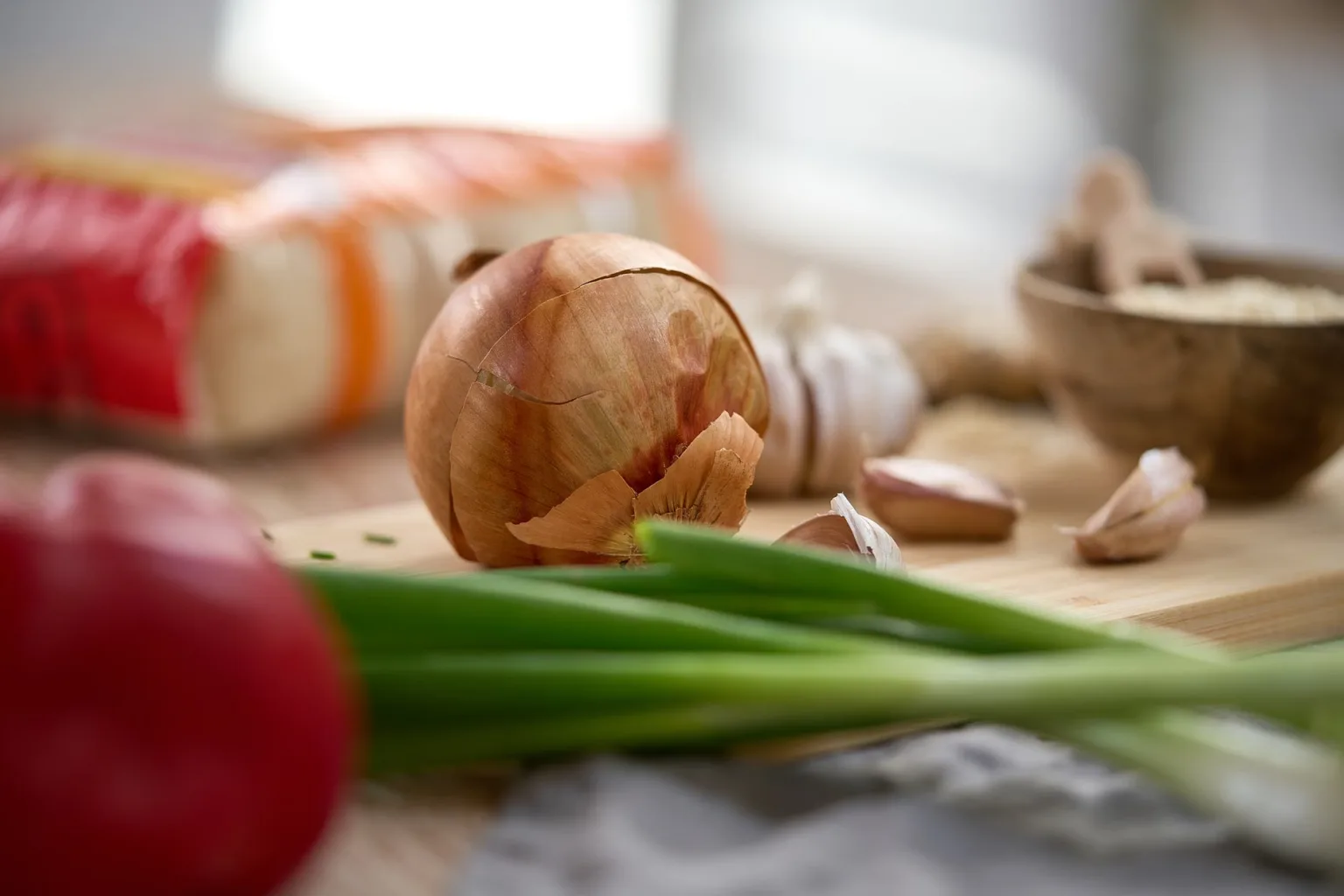
Spring onion commonly means an ordinary onion harvested young, before its bulb reaches the size and maturity of a dry storage onion. It may have a small bulb and edible green leaves. The name is not used consistently: it is sometimes treated as interchangeable with scallion or bunching onion, which can refer to Allium fistulosum, a similar plant that does not form the same kind of bulb. Names and appearance therefore vary between markets. Spring onions are generally valued for their juicy texture and a flavor that is milder and less pungent than that of a mature dry onion. The white bulb and green leaves can both be used, although their firmness and intensity vary with the variety and stage of growth.
When to use it
Use spring onions raw when you want freshness and gentle onion flavor in salads, sandwiches, or vegetable dishes. The green leaves can also add an aromatic finish. Cooked, they work in omelets and scrambled eggs, rice, quick sautés, soups, and broths; they can flavor a sauce or accompany meat and fish without being as persistent as a more mature onion. Adjust the amount to suit the dish: their flavor is more noticeable when raw and blends into the other ingredients when cooked.
How to use it
Trim away the roots and any wilted parts, then use the bulb and any tender green leaves. For raw dishes, slice thinly and add to salads, sandwiches, or vegetable plates. For an omelet, scrambled eggs, rice, or sauce, chop the onion and sauté it briefly before adding the other ingredients. It can also be added to soups and broths for aroma; use tender green leaves in these dishes too. Choose the cut and quantity to suit the recipe: thin slices distribute easily in raw dishes, while larger pieces keep more presence. Avoid browning it heavily if you want a light, delicate result.
Flavour and texture
Spring onions have a fresh, juicy, vegetal character and are generally milder and less pungent than mature dry onions. The young bulb is tender, while the green leaves bring a more herbaceous note. Flavor can vary with variety, size, and maturity, so one spring onion may not taste exactly like another.
How to choose it
Choose fresh-looking onions with green leaves that are not visibly wilted or damaged. The bulb may be small, and its color can vary by variety; uniform size is not essential. Because the names spring onion and scallion can refer to different plants, look at the shape: some have a small bulb, while others do not form a rounded bulb.
Storage
Keep spring onions refrigerated to maintain freshness. Remove damaged parts before storage and avoid leaving them at room temperature for extended periods. No exact storage duration is specified here, so check their condition before use and discard any that are clearly spoiled.
Substitutions
A different mild green onion can stand in for spring onions, but the result will not be identical. A young Allium cepa onion has a small bulb; Allium fistulosum is similar in flavor but does not form that same type of bulb. A mild young onion can also work, with the amount adjusted to its intensity and to how much green leaf is available.
Common mistakes
Do not assume that spring onion and scallion always mean the same plant: usage varies. Nor should you automatically discard tender green leaves, which can be used in soups, broths, and other dishes. If serving the onion raw, start with a modest amount and taste before adding more, since its intensity can vary.
Safety and allergens
Keep spring onions refrigerated and do not use pieces that are clearly spoiled. No specific official storage-time guidance for this ingredient is available here.
Culinary uses
- Fresh salad and garnish ingredient
- Mild aromatic base for soups, broths, sauces, and quick-cooked dishes
Recommended techniques
- Slice and serve raw
- Sauté briefly for sauces, rice, or egg dishes
- Add to soups and broths
Pairs well with
- Eggs and omelets
- Rice and mild white fish
- Salads, tomato, and avocado
- Meat and fish dishes
Frequently asked questions
Can you eat the green leaves?
Yes. Tender leaves can be chopped into soups, broths, and other dishes, as well as using the bulb.
Are spring onions and scallions the same?
Not always. Spring onion often means a young common onion, while scallion can also refer to Allium fistulosum, a similar but distinct plant.
Can spring onions be eaten raw?
Yes. Thinly sliced, they add a mild, fresh flavor to salads, sandwiches, and vegetable dishes.
Ingredient allergens
Allergen listThere are no verified associations for these ingredients yet.
Estimated nutrition
- Fat
- 0.19 g
- Saturates
- 0.03 g
- Carbohydrate
- 7.34 g
- Sugars
- 2.33 g
- Fibre
- 2.6 g
- Protein
- 1.83 g
- Salt
- 0.04 g
Sources and review
Automatically researched, cross-checked and validated content. Sources consulted:
- ¿Por qué la muerte es origen de miedos y tabúes? doi.org/10.64628/aao.fccyk3qj3
- Client Challenge doi.org/10.2307/jj.27939689.16
- The Essential Glossary of Cooking Terms for the Culinary Arts - Escoffier www.escoffier.edu/blog/culinary-arts/the-essential-glossary-of-cooking-terms-for-the-culinar…
- ¿Cómo elegir la mejor cebolla para cocinar? Guía de sabores www.patataslazaro.com/consejos/cual-es-la-mejor-cebolla-para-cocinar/
- Allium ampeloprasum var. porrum - Wikipedia, la enciclopedia libre es.wikipedia.org/wiki/Allium_ampeloprasum_var._porrum
- Panorama actual de la producción y comercialización de cebolla blanca (Allium cepa L.) en México: Una revisión de literatura | OpenAlex openalex.org/W7115589963
- Migas - Wikipedia, la enciclopedia libre es.wikipedia.org/wiki/Migas
- Cebolleta o cebolla tierna | Gastronomía & Cía www.gastronomiaycia.com/cebolleta-o-cebolla-tierna/
- «Pro lenguaje culinario»: reflexiones en torno al léxico en prensa especializada del primer cuarto del siglo XX | OpenAlex openalex.org/W7223703522
- ¿Qué tipos y variedades de cebolla existen? - Cebolla frita Hida www.google.com/goto?url=CAESaQHrOzAVTiZAbenQoLiElhDANfLLknNZ5f6nRDkwTVkKcwbs_QrdBMXZHz9In68n…