- Category
- Sugar and sweeteners
- State
- Dry
- Usual unit
- tablespoon
What it is
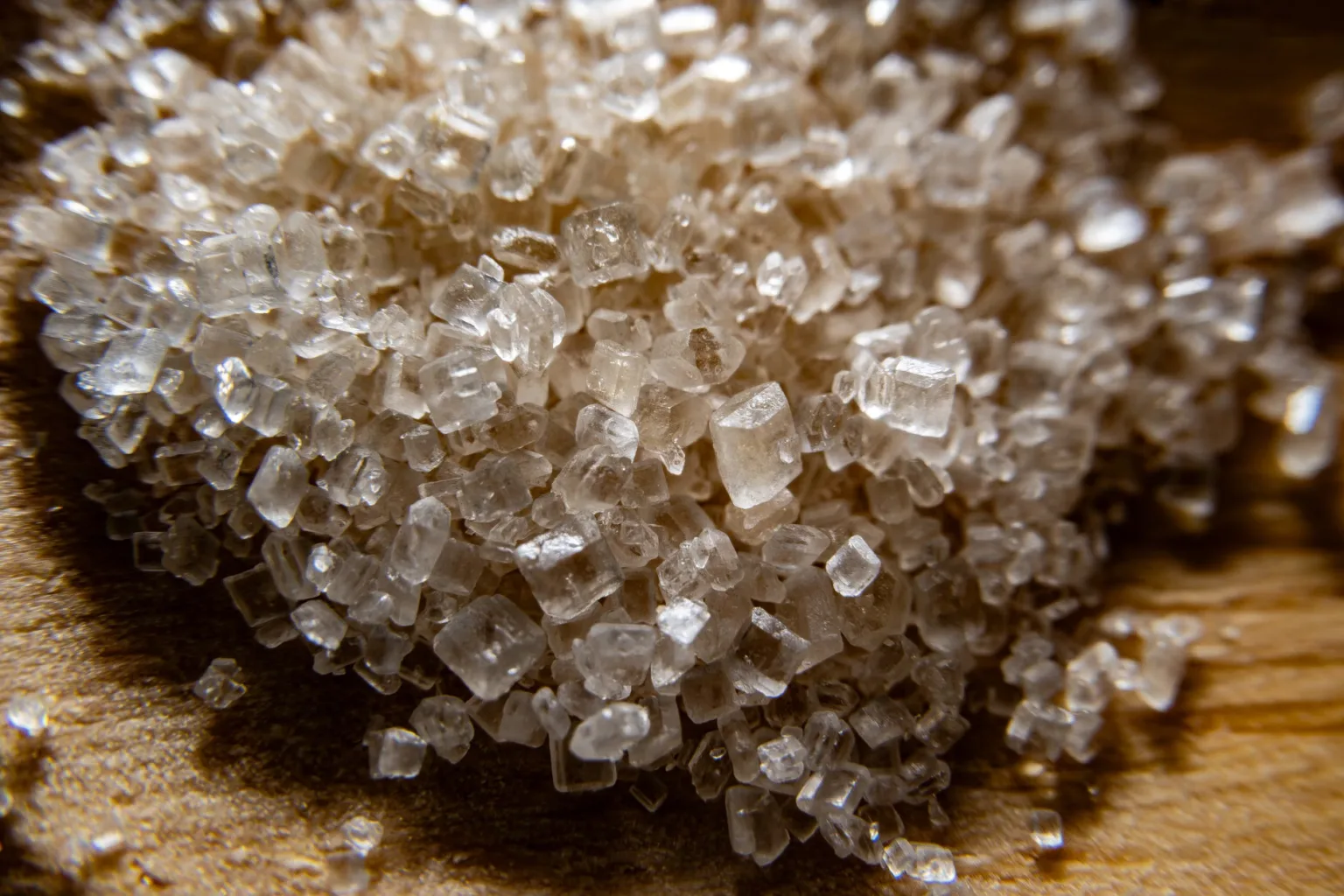
Sugar for jelly is the sugar added to fruit juice when making a sweet, semi-solid fruit spread. It does not make a set on its own: traditional jelly depends on the right proportions of fruit or juice, sugar, pectin, and acidity. The natural pectin level varies with the fruit and its ripeness, so adding sugar by guesswork is not a reliable way to correct a weak set. Measure the ingredient accurately and follow the amounts and method in the recipe. Low-sugar versions need pectin designed for that purpose and a recipe formulated around it; they are not direct, interchangeable adaptations of traditional recipes.
When to use it
Use sugar when making fruit jelly from a recipe that calls for it, especially a traditional formula with specified proportions of juice, sugar, and pectin. The correct amount contributes to the balance needed for a gel as well as adding sweetness. Do not increase or reduce it by instinct: an incorrect proportion can prevent the jelly from setting or encourage sugar crystals. If you want a lower-sugar result, choose a recipe designed for low-sugar pectin rather than simply modifying a conventional formula.
How to use it
Prepare the fruit juice and gather the ingredients listed in the recipe. Measure the sugar accurately because the proportions matter for setting. Add it at the stated stage and stir as the mixture cooks so it dissolves. Follow the cooking directions for the recipe and the specific pectin: liquid and powdered pectin can require different methods and should not be swapped without an adapted formula. Make a small batch, and do not double the recipe unless its instructions allow it. For a lower-sugar version, use pectin intended for that purpose along with its matching recipe.
Flavour and texture
Sugar adds sweetness and softens the tartness of fruit juice. In jelly, it is also part of the ingredient balance needed to form a gel, so its proportion can affect the result. Too much sugar can encourage crystals, while reducing it without adapting the recipe can lead to a poor set. The finished flavor also depends on the fruit and its acidity, so follow the proportions in the chosen formula.
How to choose it
Choose sugar that suits the recipe and check whether it specifies a particular type or form. Do not assume that different sugars or pectins are interchangeable: the required sugar and acid proportions depend on the formula and pectin type. If you want to reduce sugar, choose a recipe developed for low-sugar pectin and follow its directions. Measure rather than estimate, since accuracy affects setting and the chance of sugar crystals forming.
Storage
For storing finished jelly, use the processing and storage directions of a tested recipe; safe storage cannot be determined from the sugar amount alone. Properly processed, sealed jars are stored in a cool, dry, dark place and refrigerated after opening. Do not eat jelly with mold or fermentation, or with bubbles that are moving. For unused sugar, follow the package directions and protect it from moisture.
Substitutions
Do not reduce the sugar in a traditional recipe or switch pectin forms without a formula designed for the change; altered proportions can prevent setting. For a lower-sugar jelly, use a recipe developed for low-sugar pectin. Another type of sugar is an option only when the recipe specifies it; a direct swap may not produce the same result.
Common mistakes
Common mistakes include estimating instead of measuring, reducing sugar without changing the formula, swapping liquid and powdered pectin, and making an oversized batch or cooking too slowly. Excess sugar can form crystals, while incorrect proportions or cooking can weaken the set. Stir to dissolve the sugar during cooking and follow the recipe for the fruit and pectin you are using.
Safety and allergens
The amount of sugar alone does not guarantee that homemade jelly is safe for storage. For shelf storage, use a tested recipe and follow its processing, sealing, and storage instructions. Refrigerate after opening. Do not eat jelly with mold or fermentation, or with moving bubbles.
Culinary uses
- Sweetens fruit jelly
- Works with fruit pectin and acidity to help form a gel
Recommended techniques
- Measure precisely
- Stir until dissolved during cooking
Pairs well with
- Fruit juice
- Pectin and acidic fruit or lemon juice
Frequently asked questions
Can I reduce the sugar in a jelly recipe?
Do not reduce it without changing the formula. For a lower-sugar version, use a recipe developed for low-sugar pectin.
Can I replace powdered pectin with liquid pectin?
Not as a direct swap. The two forms can require different methods, so use a recipe formulated for the pectin you have.
Why does my jelly have sugar crystals?
Too much sugar or sugar that has not dissolved can lead to crystals. Measure accurately and stir during cooking to dissolve it.
Ingredient allergens
Allergen listThere are no verified associations for these ingredients yet.
Sources and review
Automatically researched, cross-checked and validated content. Sources consulted:
- REGLAMENTO (UE) No 1169/2011 DEL PARLAMENTO ... eletiquetadocuentamucho.aesan.gob.es/media/reglamento-11692011.pdf
- The Essential Glossary of Cooking Terms for the Culinary Arts - Escoffier www.escoffier.edu/blog/culinary-arts/the-essential-glossary-of-cooking-terms-for-the-culinar…
- Jams and jellies: Problems and solutions | Servicio de Extensión de OSU extension.oregonstate.edu/es/food/preservation/jams-jellies-problems-solutions
- Vamos a Conservar Alimentos: Mermeladas, jaleas y compotas extension.psu.edu/vamos-a-conservar-alimentos-mermeladas-jaleas-y-compotas/
- Por qué el azúcar de la fruta es bueno para la salud y el de los procesados no doi.org/10.64628/aao.6yfuugrhx
- Para la ciudadanía www.aesan.gob.es/para-la-ciudadania
- Conservación de Alimentos - Mermeladas y Jaleas extension.illinois.edu/media/6893/download?inline=
- Gelatina Elastica – MRSEC Education Group – UW–Madison education.mrsec.wisc.edu/gelatina-elastica/
- Conservación de alimentos en casa: Untables de frutas | Extensión UMN es.extension.umn.edu/Comida/preparing/cocinar-en-casa/Conservaci%C3%B3n-de-los-alimentos/unt…
- Flan De Cafe/Flan de Café (LCH) | CSU Northridge w2.csun.edu/wic/lets-cook-healthy/recipes/desserts/flan-de-cafeflan-de-cafe
- LILIKO` I healthcare.utah.edu/sites/g/files/zrelqx136/files/migration/media/liliko-recipe-card.pdf
- Los múltiples usos de la gelatina: de la fabricación a la cocina de vanguardia | Rousselot | Darling Ingredients www.darlingii.com/es-es/rousselot/resources/blogs/2019/09/rousselot-the-many-uses-of-gelatin…
- - YouTube www.youtube.com/watch?v=wgff8jmW8MM
- Mousse de Guanábana 1999 (Soursop Mousse) - lacocina.utsa.edu/4535/
- ¿Con Qué Se Hace la Gelatina? Ingredientes, Tipos y Mejores Opciones para Prepararla en Casa doncaramelo.es/con-q-se-hace-la-gelatina/
- ¿De qué está hecha la gelatina? ¿Está hecha de animales? sentientmedia.org/es/de-donde-diablos-viene-la-gelatina/