- Category
- Dairy and eggs
- State
- Preserved
- Usual unit
- g
What it is
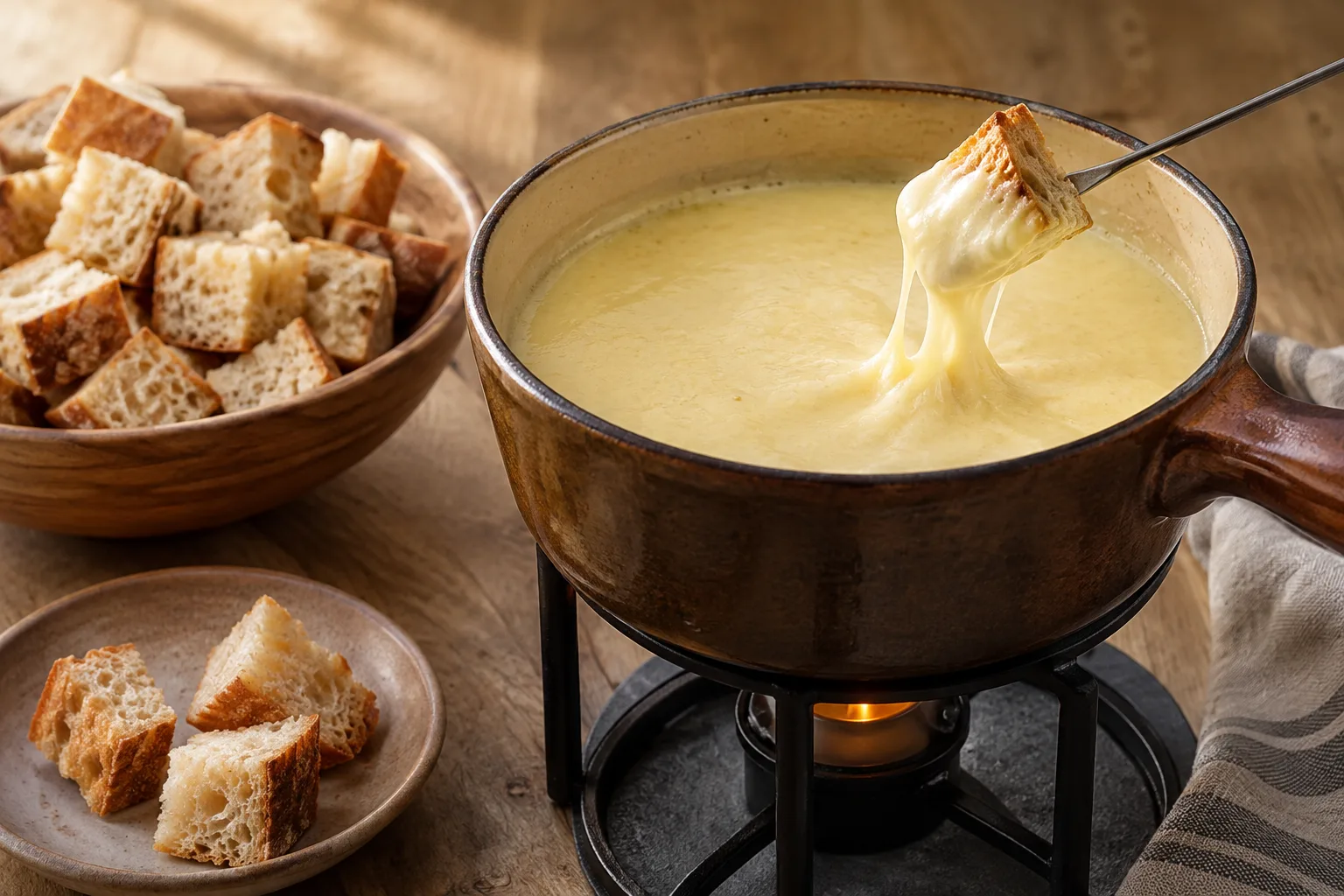
Vacherin Fribourgeois is a semi-hard Swiss cheese associated with the canton of Fribourg and made from cow’s milk. It may be made with raw or thermised milk, so do not assume that every cheese bearing this name has the same milk treatment; check the label. Its variety and maturation affect its texture and intensity. The available description of the Classic type notes a creamy consistency and a slight tang. It is distinct from Vacherin Mont-d’Or, a different cheese that is typically much softer and presented in a wooden box. Vacherin Fribourgeois can be served as it is or melted, and is well known as part of moitié-moitié fondue with Gruyère.
When to use it
Choose Vacherin Fribourgeois when you want a cheese that adds creaminess and melts readily, particularly for fondue. It also suits a cheese board when you want a semi-hard cheese with a milky, slightly tangy character, although intensity varies with the variety and maturation. For moitié-moitié fondue, combine it with Gruyère in equal parts. If serving it unmelted, check which variety you have and let its own texture and flavor complement a simple selection rather than assuming it will be as soft as Mont-d’Or.
How to use it
For moitié-moitié fondue, combine equal parts Vacherin Fribourgeois and Gruyère and warm the mixture gently, stirring until melted and even. Do not confuse it with Vacherin Mont-d’Or: they are different cheeses and do not necessarily have the same texture or presentation. You can also serve Vacherin Fribourgeois on a cheese board with potatoes or pickles, or use it in dishes where melted cheese is wanted. Since varieties and maturation can change its character, taste a small amount before adjusting other ingredients. Follow the package directions for handling and storage.
Flavour and texture
It is described as aromatic and milky, with a slightly tangy note. The paste can be creamy and melting, though firmness and intensity depend on the variety and maturation. Its ability to melt makes it particularly suitable for fondue.
How to choose it
Look for the full name Vacherin Fribourgeois to distinguish it from Vacherin Mont-d’Or and other cheeses called Vacherin. Read the label to identify the variety and check whether the milk is raw or thermised; the cheese name alone does not specify the treatment. If you are buying it for fondue, ask whether the particular cheese is suitable for melting and check that the packaging is intact.
Storage
Store it according to the temperature and storage directions on the package, which can differ by product and packaging. Keep the cheese refrigerated and well protected so it does not dry out or absorb other food odors. One description mentions refrigerated storage and waxed paper, but there is no universal storage duration for every cheese; follow the producer’s date and instructions.
Substitutions
For fondue, Gruyère is the stated partner in moitié-moitié and can make up a larger share if Vacherin Fribourgeois is unavailable. Fontina is described as a similarly tangy cheese, but it is not guaranteed to melt or behave exactly the same way. Adjust the blend to suit the result you want.
Common mistakes
Do not mistake Vacherin Fribourgeois for Vacherin Mont-d’Or: they are different cheeses with different textures and presentations. Do not assume the milk is always pasteurised or raw; treatment can vary, so check the label. When making fondue, avoid abrupt heating that can make it harder to achieve an even mixture.
Safety and allergens
Contains milk. Milk treatment can vary: check the label, particularly if you need to avoid cheeses made with raw milk, and follow the package storage directions. Anyone who needs special precautions regarding raw milk should consult current official food-safety guidance.
Culinary uses
- cheese for fondue
- table cheese
- melting cheese
Recommended techniques
- melt gently for fondue
- slice or shave for a cheese board
- grate or cut into pieces for a blended fondue
Pairs well with
- Gruyère
- dry white wine
- potatoes
- pickles
Frequently asked questions
Is it the same as Vacherin Mont-d’Or?
No. Vacherin Fribourgeois is a semi-hard cheese from Fribourg; Mont-d’Or is a different Vacherin cheese and is typically much softer.
Can I use it for fondue?
Yes. It is used in fondue and can be combined in equal parts with Gruyère for moitié-moitié fondue.
Is this cheese always made with raw milk?
Not necessarily. The available information indicates that it may be made with raw or thermised milk. Check the label of the specific cheese.
Ingredient allergens
Allergen listThere are no verified associations for these ingredients yet.
Sources and review
Automatically researched, cross-checked and validated content. Sources consulted:
- ¿Por qué la muerte es origen de miedos y tabúes? doi.org/10.64628/aao.fccyk3qj3
- Client Challenge doi.org/10.2307/jj.27939689.16
- Tipos de queso: Guía completa 2026 - Fotos y maridajes www.dehesadelosllanos.com/tipos-de-queso-guia-completa/
- Dictionary www.eecis.udel.edu/~lliao/cis320f05/dictionary.txt
- NSync A Mei A Tribe Called Quest A*Teens aima.cs.berkeley.edu/npdict.txt
- Queso Vacherin | La Boulette www.laboulette.com/blog/el-queso-vacherin
- Atención queseros: Vacherin Mont-d'Or. ¿Por qué es uno de los quesos franco-suizos más deseados? www.directoalpaladar.com/cultura-gastronomica/queso-vacherin-mont-dor-de-donde-viene-como-se…
- Vacherin Fribourgeois: ficha, cata y dónde comprar | Quesos del Mundo quesosdelmundo.com/quesos/vacherin-fribourgeois/
- Vacherin Fribourgeois AOP | Quesos de Suiza www.quesosdesuiza.es/schweizer-kaese/cheesefinder/detail/vacherin-fribourgeois-aop
- Vacherin - Wikipedia, la enciclopedia libre es.wikipedia.org/wiki/Vacherin
- Vacherin d’Or: Análisis y Comparativa de sus Mejores Versiones laovejaquebala.es/vacherin-dor/
- El queso Vacherin en todas sus formas | Grupo Gourmets www.gourmets.net/salon-gourmets/2017/catalogo-expositores/swiss-cheese-marketing-quesos-de-s…
- Food allergen labelling and information requirements technical guidance - GOV.UK www.gov.uk/government/publications/food-allergen-labelling-and-information-requirements-tech…