- Category
- Grains, flour and pasta
- State
- Dry
- Usual unit
- tablespoon
What it is
Whole-grain sorghum flour is made by milling sorghum while retaining the parts of the grain associated with a whole-grain product. Sorghum is a cereal, and its flour is used in preparations ranging from porridge to breads, pancakes, and other doughs. It is not wheat flour and will not necessarily behave the same way in a recipe: the result depends on the formula and its other ingredients. “Whole-grain” distinguishes this product from refined flour, though products can vary with processing. For a stew, use it only as directed by the specific recipe rather than assuming that a spoonful will work just like another flour.
When to use it
Choose whole-grain sorghum flour when a recipe calls for it or when you want to try a cereal flour in a savory or sweet preparation. It can be used in porridge and some doughs, and some cereal recipes call for sorghum flour. For a particular stew, follow that recipe: there is no universally supported ratio for replacing wheat flour or changing the texture of every broth. If you need to avoid gluten for medical reasons, check the label and potential cross-contact before buying.
How to use it
Read the ingredient list and recipe directions first, since pure whole-grain flour and a commercial blend are not necessarily interchangeable. Measure the amount specified by the formula. If the recipe calls for adding it to liquid, first mix it with some of the liquid to distribute it evenly; sorghum-flour porridge recipes use this kind of mixture. For bread, pancakes, or other doughs, follow a formula designed for this flour or for gluten-free flours: replacing all the wheat flour with sorghum without adapting the recipe can produce a different result. In a stew, do not add an arbitrary amount; follow the recipe and its cooking directions.
Flavour and texture
Sorghum flour is generally described as mild in flavor, making it suitable for savory and sweet recipes. The whole-grain version retains parts of the grain and may differ from refined flour in texture and performance. The final result also depends on milling, the recipe, and accompanying ingredients; do not expect it always to create the same consistency as wheat flour.
How to choose it
Look for a package clearly identified as sorghum flour, and check that it says whole-grain if that is the form you want. Read the ingredients: some products may be blends with other flours or components. Check that the package is intact and that the flour shows no dampness, signs of mold, or unusual odor. If you need a gluten-free diet for medical reasons, choose an appropriately labeled product and consider the risk of cross-contact.
Storage
Keep the flour dry in a closed container and follow any package instructions. Protect it from moisture and check its appearance and smell before use. Do not use flour with visible mold, unusual dampness, or signs of spoilage. Available evidence notes that grain stored in moist conditions can support mold growth, so keeping the product dry is important.
Substitutions
Millet, rice, or corn flour may work in some recipes, but substitution is not automatic: each flour can produce a different texture. For doughs, use a formula that accounts for the substitute and follow its directions. For a stew, there is no universal spoon-for-spoon equivalence that guarantees the same result.
Common mistakes
Do not assume whole-grain sorghum flour replaces wheat flour in the same amount and with identical texture. Do not confuse pure flour with a blend or add an arbitrary quantity to a stew. If cooking for someone avoiding gluten, do not overlook labeling or possible cross-contact.
Safety and allergens
Keep the flour dry and do not use a product with mold or unusual dampness. Sorghum is naturally gluten-free, but cross-contact can occur during processing or packaging; for a medically required gluten-free diet, check for appropriate labeling.
Culinary uses
- Harina de cereal para preparaciones saladas y dulces
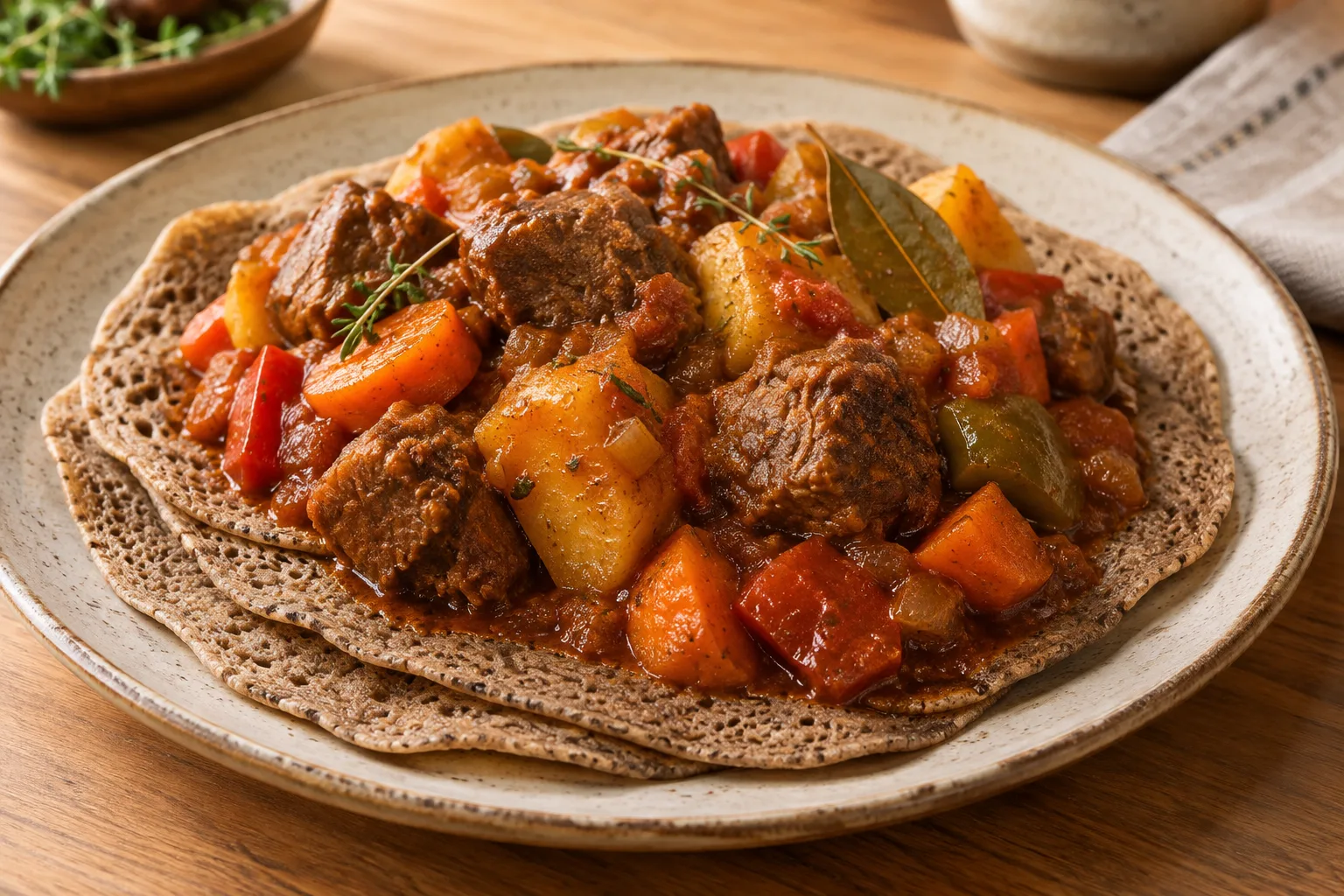
- Ingrediente para gachas y masas; puede incorporarse a recetas de cereales y guisos según la receta
Recommended techniques
- Mezclar con líquido antes de añadirla a una preparación para ayudar a distribuirla
- Combinar con otras harinas o ingredientes aglutinantes en algunas masas sin gluten
Pairs well with
- Verduras y otros ingredientes habituales de platos salados
- Leche o alternativas líquidas y endulzantes en gachas
Frequently asked questions
Is sorghum flour whole-grain?
Only if the package identifies it as whole-grain. Sorghum flour can also be processed differently, so check the label.
Can I use it in a stew?
Use it if the recipe calls for it, and follow its quantities and directions. There is no universal substitution for every stew.
Is it suitable for a gluten-free diet?
Sorghum is naturally gluten-free, but cross-contact may occur. If you need to avoid gluten for medical reasons, check for appropriate labeling.
Ingredient allergens
Allergen listThere are no verified associations for these ingredients yet.
Sources and review
Automatically researched, cross-checked and validated content. Sources consulted:
- Pan - Wikipedia, la enciclopedia libre es.wikipedia.org/wiki/Pan
- Client Challenge doi.org/10.2307/j.ctvndv9t9.22
- Evaluación de harina de amaranto como ingrediente antioxidante para la preparación de matrices alimentarias funcionales doi.org/10.35537/10915/162211
- Cultura del pan en España - Wikipedia, la enciclopedia libre es.wikipedia.org/wiki/Cultura_del_pan_en_Espa%C3%B1a
- El sorgo y el mijo en la nutrición humana - Inhibidores nutricionales y factores tóxicos, Recetas a base de sorgo y mijos www.fao.org/4/t0818s/T0818S0l.htm
- Sorgo, el cereal sin gluten que revoluciona la cocina 'healthy': qué es, propiedades, beneficios y cómo cocinarlo www.directoalpaladar.com/ingredientes-y-alimentos/sorgo-cereal-naturalmente-gluten-que-revol…
- La harina de sorgo refinada puede ofrecer beneficios a la salud www.dicyt.com/noticias/la-harina-de-sorgo-refinada-puede-ofrecer-beneficios-a-la-salud
- Sorgo: propiedades y usos en la dieta sin gluten | Dr. Schär Institute www.drschaer-institute.com/es-ES/learn/estudios-e-investigacion/sorgo-propiedades-y-usos-en-…
- El amaranto, propiedades, usos y aplicación en la gastronomía | OpenAlex openalex.org/W20082531
- Qué es el sorgo y qué beneficios aporta al organismo – Leon the baker leonthebaker.com/blogs/blog/sorgo-beneficios?srsltid=AYCX9vKxy9zW-EoBBlkxWie3N2I27cJO7m-fEkB…
- Sorgo: cómo usar su harina sin gluten - Vive sanamente natural vivesanamentenatural.com/sorgo-harina-sin-gluten/
- Sorgo sin gluten, un buen sustituto del trigo - Celicidad celicidad.net/sorgo-sin-gluten-sustituto-del-trigo/
- Alimentación y nutrición: Sorgo: qué es, propiedades y cómo cocinar el cereal | Cocinatis www.cocinatis.com/como-cocinar/consejos-trucos/sorgo_1_1002187.html
- Efectos de la aplicación del hongo micorrízicos vesículo arbuscular (Glomus Intraradices), en el cultivo de quinua (Chenopodium quinoa W.) Puno | OpenAlex openalex.org/W3217683880