Documentary synthesis prepared with AI assistance. It does not replace specialist review or certify kitchen testing. · Updated 31 October 2026
A country read through particular foodways
France stretches across western Europe, from the Atlantic and the English Channel to the Mediterranean and the Pyrenees; the French state also includes overseas territories. That geography offers many possible culinary routes, but the dishes documented here belong to specific places rather than representing every French table. Brittany appears through its Roscoff onions; Marseille, in Provence, through the fish preparation called bouillabaisse; and Castelnaudary, in Occitania, through its version of cassoulet.
These are useful points of comparison because their central ingredients behave differently. Onions soften and deepen in a soup; several fish contribute to a broth and may be presented separately; white beans absorb the cooking liquid and juices in a substantial casserole. Each preparation also brings a different relationship between cooking and serving. The examples are not a complete national inventory, nor do they establish exclusive origins for dishes shared across neighbouring communities. Instead, they make visible how local products, remembered names, vessels and methods can give a preparation a recognisable regional character.
History, movement and stories with uncertain edges
Food histories rarely reduce to a single invention. The record of cassoulet illustrates why: accounts place its development in the Languedoc and connect it with several towns, including Castelnaudary, Carcassonne and Toulouse. A dramatic tale links the dish to a medieval siege, but the sources identify that account as legend rather than established history. Another local account describes changes in its beans and cooking vessel over time; the details and chronology differ between narratives. The safer historical point is that the dish evolved, and that the named town’s version has its own stated particulars.
Marseille’s fish soup also has a history of changing context. One account describes an everyday meal made by fishers from less marketable catch, while another traces the dish’s movement into Parisian restaurants in the late eighteenth century. The soup’s ingredients and status changed as cooks and settings changed; later versions include ingredients not present in the earliest described form. Such movement is evidence of exchange, not proof that a single modern recipe has remained unchanged. These histories help distinguish a documented local association from a definitive claim about who first created a dish.
Ingredients that define these three routes
A small set of documented ingredients opens onto very different cooking. In Brittany, Roscoff onions are identified as a regional product and as an option for the caramelised base of French onion soup. Their role is not merely decorative: slowly cooked onion contributes the soup’s concentrated, rounded flavour. That soup is commonly completed with broth, bread and grated cheese, though the precise cheese and broth can vary between recipes.
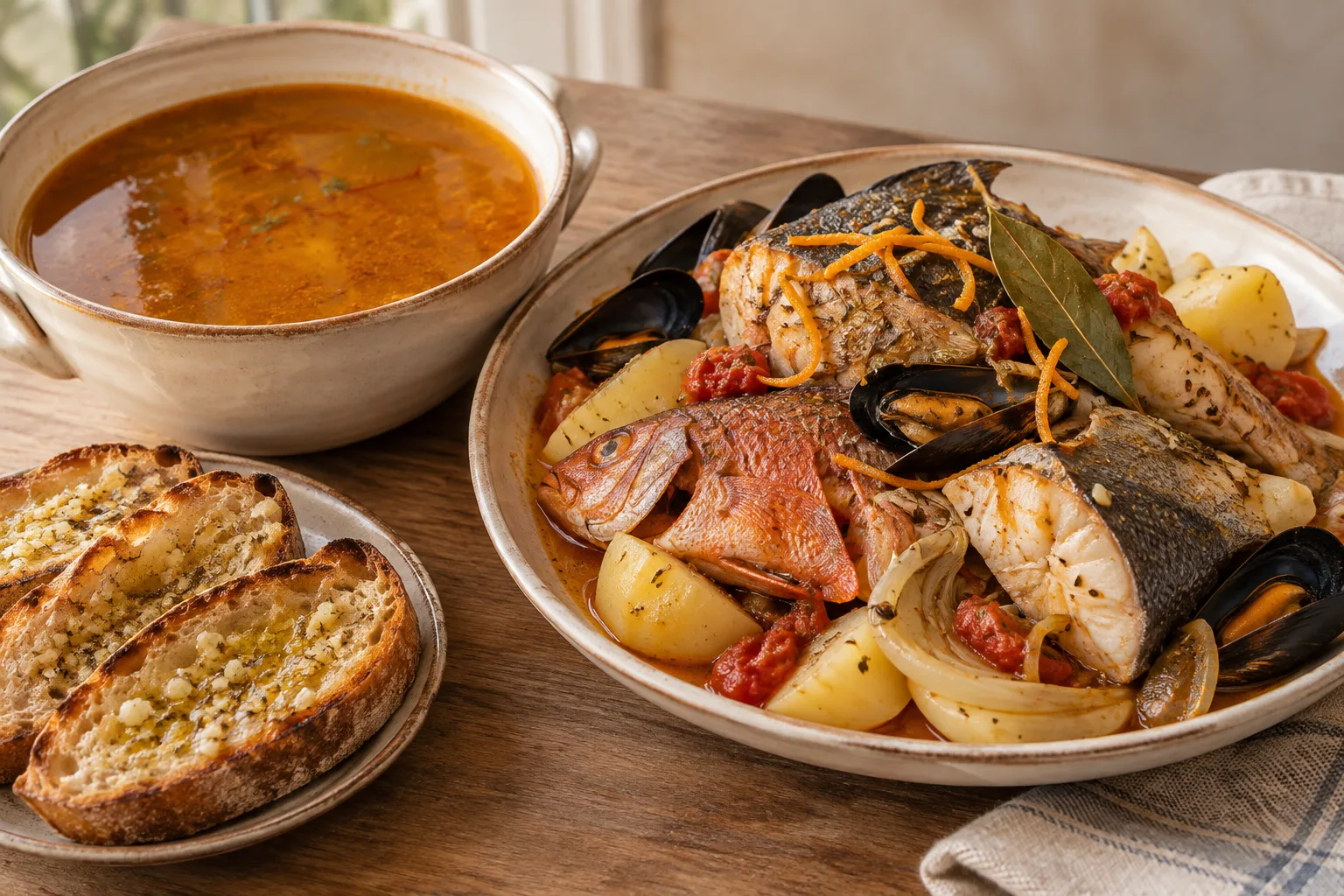
Marseille’s bouillabaisse draws on several fish, especially rock fish in accounts of the traditional preparation. Olive oil, tomato, garlic, onion, fennel and saffron appear in descriptions of its aromatic base; some versions also use orange peel or potatoes. The choice and number of fish are part of continuing discussion, so one list should not be treated as universal. In Castelnaudary’s cassoulet, white beans are joined by meats such as pork, sausage and duck confit. The local recipe also names lingot beans, pork skin and a poultry carcass or pork bones for stock. Ingredients may differ across versions; what matters here is the documented combination of beans, meat and long cooking.
From sweet onion to saffron broth and mellow beans
The flavours in these dishes are built through time and combination, not a single seasoning. In onion soup, sliced onions cook until softened and browned; how far they are caramelised affects the finished soup’s colour and sweetness. Broth gives the base another dimension, while toasted bread and melted cheese add a savoury, browned top. The result can be served as a gratin, but the underlying soup and its topping remain distinguishable parts of the preparation.
In bouillabaisse, fish, olive oil and the aromatics create a marine broth with the fragrance of fennel and saffron. Garlic and tomato bring further depth; orange peel is present in some documented versions, not all. The broth and fish may be presented in separate dishes, making the texture and flavour of each easier to notice. A garlicky, saffron-coloured rouille and bread accompany this service in Marseille-focused accounts. In cassoulet, slow cooking allows the white beans to take on the juices of the meats. A browned surface is a feature of some versions, while tenderness in the beans and the balance of beans, stock and meat remain central. These are related through their generosity, not through a single shared taste.
Local memory, changing recipes and occasions to gather
Tradition is visible both in what cooks prepare and in how a dish is kept associated with a place. Castelnaudary’s tourism account sets out a local cassoulet with specific beans, meats and a cassole, while acknowledging that the dish’s beginnings are unclear. Other accounts preserve neighbouring versions rather than a single standard. Castelnaudary also has a documented annual festival devoted to the dish. Such an event gives a local preparation a public occasion, but it does not make every family’s recipe identical or settle its contested history.
Marseille’s bouillabaisse carries a different memory: a fishers’ meal that became a recognised regional dish and appears in restaurant service as well as accounts of home cooking. Serving broth and fish separately is a notable way of presenting it, with bread and rouille alongside. The dish’s transformation from modest ingredients to a celebrated preparation is part of its story, not a reason to erase the earlier context. French onion soup, meanwhile, is described as a winter meal found in homes and bistros. These examples show several forms of transmission—daily cooking, restaurant practice, local storytelling and a town festival—without claiming one ritual or occasion for the whole country.
The work of simmering, layering and serving
Each preparation teaches a different sequence. For cassoulet, dried beans are soaked and cooked; meats are prepared separately, often browned; then beans, meat and stock are assembled in an oven-safe earthenware vessel and cooked slowly. Castelnaudary’s account describes a browned crust forming on top and calls for the casserole to be served bubbling in its dish. The cassole is more than a serving prop: the vessel gives the dish its name and belongs to the way this version is prepared. Other recipes may use different timings and ingredient arrangements.
For bouillabaisse, the aromatic base and broth are built before fish are added. The fish should not be treated as interchangeable pieces: traditional descriptions emphasise several kinds, and a Marseille service may separate the liquid from the cooked fish. Some accounts use a vigorous boil at the start followed by gentler cooking; exact methods and species vary. Onion soup relies on patience at another stage: onions are cooked until softened and coloured before broth is added, then bread and cheese can be gratinated over the soup. In each case, sequence matters—whether the aim is to keep beans intact, cook fish appropriately, or bring out the sweetness of onions.
How the dish arrives shapes the meal
The act of serving can be as distinctive as what happens in the pot. In a Marseille-style bouillabaisse, accounts describe the broth in one vessel and the fish on a separate platter. Bread and rouille complete the presentation; diners can bring them together according to taste. This service makes the broth, the fish and the accompaniment visible as related but separate elements. Since recipes differ, the exact contents of a restaurant or household version should not be assumed from the name alone.
A Castelnaudary cassoulet arrives in a different manner: cooked and served in its earthenware casserole, hot and with its browned top intact. It is a substantial dish built for sharing portions from a common vessel. Onion soup offers a smaller-scale but similarly clear presentation: individual ovenproof bowls may carry bread and cheese gratinated on the surface, or the toasted topping may be served separately. These examples suggest three ways of organising a meal—platter and broth, shared casserole, and individual gratin—without prescribing a national table ritual. A winter supper, a restaurant meal, or a local festival can each give these preparations a setting, while the details remain particular to the dish and community.
A short vocabulary of dishes and vessels
The names below refer to concrete preparations and equipment documented in the regional routes above. They help distinguish a dish from a loose category such as “fish soup” or “bean stew.”
- Bouillabaisse: A Provençal, particularly Marseille-associated, preparation of varied fish in an aromatic broth. Some traditional services present the broth and fish separately, with bread and rouille.
- Cassoulet: A family of slow-cooked white-bean and meat preparations associated with Languedoc towns, including Castelnaudary. Versions and origin stories differ.
- Cassole: The deep earthenware cooking vessel associated with cassoulet; the vessel’s name is linked to the dish’s name.
- Rouille: A garlic-based, often saffron-coloured sauce served with bread alongside Marseille-style fish soup. Ingredients vary between recipes.
- Soupe à l’oignon gratinée: French onion soup topped with bread and cheese and finished under heat until browned. It is distinct from the onion soup base before the topping is added.
- Tarte Tatin: An inverted apple tart associated with Lamotte-Beuvron in the Loire region: caramelised apples are covered with pastry, baked, then turned out for serving. Its popular origin story is disputed.
One country, many cuisines
Brittany
Brittany is documented here through Roscoff onions, identified as a regional product and as an ingredient that can form the browned, sweet base of French onion soup. This provides a specific connection between place and pantry; it does not imply that onion soup alone defines Breton cooking or that one onion variety is used in every version.
Occitania
Castelnaudary is associated with a particular cassoulet: white beans are combined with meats and stock, arranged in an earthenware cassole and cooked slowly. Accounts differ about the dish’s beginnings and preserve variations associated with nearby towns, so Castelnaudary’s version is best understood as a documented local expression rather than an exclusive claim to the entire dish.
Provence
Marseille anchors this documented Provençal route through bouillabaisse, a fish preparation associated with coastal fishing and the use of several kinds of fish in an aromatic broth. Accounts describe broth and fish served separately, often with bread and rouille. Species and recipes vary, and the dish’s changing history should not be reduced to one fixed ingredient list.
Cook